Timeline of horological history
This timeline brings together selected milestones in horological history. It is intended to entertain, encourage an interest in the subject and provide a starting point for further research. Not every invention can be attributed to a single year or a single person. “Around”, date ranges and references to historical accounts therefore indicate cautious dating.
Many foundations of timekeeping originate in antiquity and in different cultures. European mechanical horology later develops a particularly wide variety of mechanical clocks, escapements and portable timepieces. China, the Islamic world and, in modern times, the USA and Japan also contribute important developments of their own.
Industrial watch production develops gradually. Mechanical aids and early factories already exist before 1850. In the USA, a system of specialised machines and largely interchangeable parts subsequently gains importance. The company that later becomes the Waltham Watch Company is founded in Roxbury in 1850 and moves production to Waltham near Boston in 1854.
In 1876, Jacques David and Théo Gribi study American production at the World's Fair in Philadelphia and during factory visits. David's report of around 108 pages gives Swiss rationalisation an important impetus. Swiss mechanisation had already begun, however, with Leschot's machines and the Longines factory in Saint-Imier, for example.
Go straight to an era: Early timekeeping · Portable timepieces and pendulums · Escapements and precision · Industrialisation · Electronics, quartz and radio-controlled timekeeping
Early timekeeping and medieval mechanical clocks
| Date | Development |
|---|---|
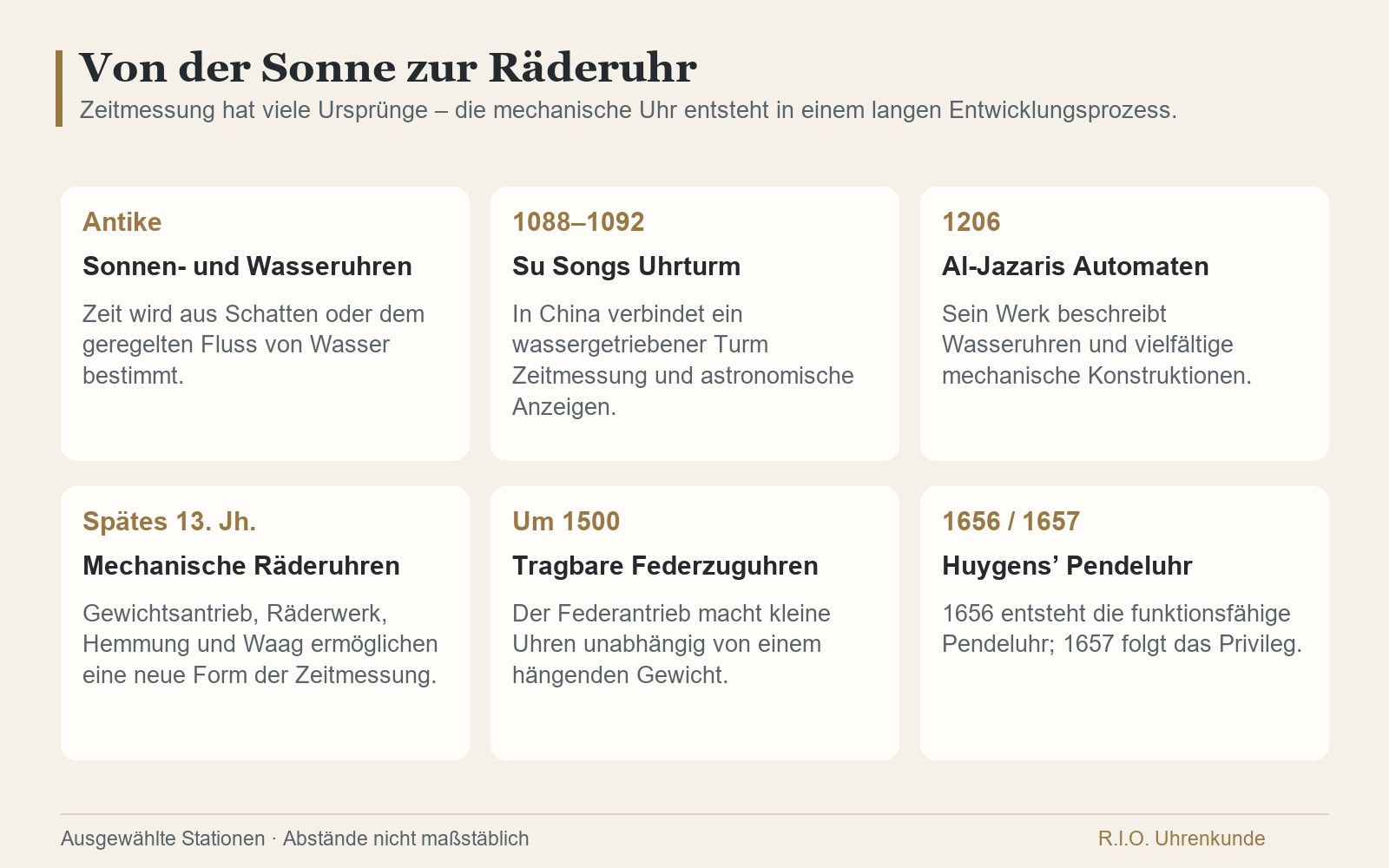
| around 1400 BC | Outflow water clocks are used in Egypt: the falling water level in a vessel with an opening in its base and marked scales allows hours to be measured even at night. |
| around 1000 | Older accounts attribute an early mechanical clock to the learned monk Gerbert of Aurillac, later Pope Sylvester II. His possession of a mechanical clock with an escapement has not been established. |
| 1088–1092 | Su Song builds a water-wheel-driven astronomical clock tower with an armillary sphere in Kaifeng. |
| 1206 | Al-Jazari describes water clocks and mechanical automata in his Book of Knowledge of Ingenious Mechanical Devices. |
| late 13th century | Weight-driven mechanical clocks with a foliot appear in European monasteries and cathedrals. Individual early records cannot always be distinguished clearly from older timekeepers. |
| 1321–1325 | Roger of Stoke builds the astronomical clock for Norwich Cathedral. |
| 1336 | A public clock striking the hours is recorded in Milan. |
| 1344 | A clock with a twenty-four-hour striking mechanism is built for the palace of the city's ruler in Padua. |
| 1348 | A tower clock with a striking mechanism (“Big Tom”) is recorded in London. |
| 14th century | Minutes and seconds are used in astronomy and in increasingly elaborate timekeepers. The sexagesimal division has ancient roots and was not invented in 1345. |
| 1354 | The first elaborate astronomical clock in Strasbourg Cathedral is built. |
| 1368 | A tower clock with a twelve-hour striking mechanism is installed in Breslau. Public striking clocks spread through European cities. |
| 1386 | The Salisbury clock is one of the oldest surviving European mechanical tower clocks. It has no conventional dial; the time is conveyed by its striking mechanism. |
| 1392 (recorded in historical accounts) | Older timelines mention a German tower clock with an alarm mechanism. This alone cannot establish a general claim to being the first. |
| 1410 (recorded in historical accounts) | A tower watchman in Montpellier, dismissed for repeated drunkenness, is said to have been replaced by a clock with a striking mechanism. The anecdote does not establish the first replacement of human labour by a machine. |
| early 15th century | Spring drive comes into use in clocks. The older attribution of the “invention of the clock spring” to Heinrich Arnold in 1427 is insufficiently substantiated. |
| 1430 | A spring-driven clock belonging to Philip the Good of Burgundy is recorded. |
| 15th century | The astronomical clock in Exeter Cathedral is one of England's well-known medieval clocks. It is not the first mechanical tower clock. |
| 1480 | The surviving sketchbook of the Augustinian friar and clockmaker Paulus Almanus from this period, only recently rediscovered, shows that spring-driven movements and the verge escapement were already known. The fusee, initially driven by a gut cord, is also already used in clocks with a mainspring to compensate for the spring's uneven delivery of power. This invention was long attributed to Jakob Zech of Prague (1525). |
| around 1494 | Leonardo da Vinci draws mechanisms for clocks and pendulums. The drawings document designs, not a working pendulum clock built at that time. |
| around 1500 | Small portable spring-driven timepieces appear. Early examples are box- or drum-shaped and have movements with many iron parts. Oval cases become widespread later. The spring-force brake, often called the “stackfreed”, compensates for the varying drive and is used in some timepieces until towards the end of the 16th century. |
Portable timepieces, pendulums and the balance spring
| Date | Development |
|---|---|
| 1506–1509 | The present Männleinlaufen automaton at the Frauenkirche in Nuremberg is created: the prince-electors parade before Emperor Charles IV. Jörg Heuss makes the mechanism, and Sebastian Lindenast the Elder makes the copper figures. |
| 1511 | The master locksmith Peter Henlein of Nuremberg (probably around 1485–1542) becomes known for his small portable timepieces with a running time of up to 40 hours. The mainspring and spring-force brake allow a compact construction. Box, drum and pomander forms are associated with his circle; not every attribution is substantiated. Henlein is an important early maker, but has not been established as the sole inventor of the portable timepiece. |
| 1525 | Jakob Zech's clock from Prague is a well-known example of a clock with a fusee. The fusee is already described in the drawings of Paulus Almanus around 1480; 1525 is therefore not the year of its invention. |
| 1530 | Nuremberg clockmakers begin occasionally making movement plates from brass. |
| 1540 | Weight-driven wall clocks become everyday timekeepers for townspeople and farmers. |
| 1544 | Foundation of the Paris clockmakers' guild. |
| around 1550–1600 | Oval portable timepieces, later known as “Nuremberg eggs”, are made. The name describes the case shape, not Henlein's earliest box-shaped timepieces. |
| 1550 | Automatically striking timepieces, which Peter Henlein had already made, are now produced more frequently. |
| 16th century | Mechanical aids supplement hand work in making small screws. Development is gradual; 1569 does not mark a general beginning of machine screw production. |
| 16th–17th centuries | Steel fusee chains supplement and gradually replace the gut cord between the barrel and fusee. The transition does not take place everywhere at the same time. |
| 1555 | Pocket watches with moving figures are made in Geneva. |
| around 1570 | Six- and eight-sided portable timepieces are made. |
| 1570 | Box-shaped timepieces are made to be worn around the neck, particularly in Augsburg. |
| 1573 | Astronomical Renaissance table clocks also display minutes. These early records must be distinguished from the later general introduction of the minute hand. |
| 1575 | Portable timepieces are fitted with alarm mechanisms. |
| 1580s | Galileo Galilei investigates pendulum oscillations. The well-known story about the chandelier in Pisa Cathedral is an account written down later; the often-cited year 1583 is not established. |
| 1582 | The Gregorian calendar is introduced. Individual countries adopt it at different times. |
| 1587 (recorded in historical accounts) | An early clock with a coaxial arrangement of hands is described: the long hand indicates the hours, and the short hand the minutes. This is not yet the later conventional assignment of hand lengths. |
| 1595 | Christoph Margraf is granted a patent for a rolling-ball clock. (Balls run down channels like those in modern marble runs, released by the clock mechanism.) |
| around 1600 | Portable timepieces are also made with alarm mechanisms. |
| 1600 | Cases in the shapes of crosses, skulls and animals are made for timepieces worn around the neck. |
| 1615 | Watch glass comes into use, after rock crystal had already occasionally been used to protect the dial and hand since 1550. |
| 1620 | Pocket-watch cases with tortoiseshell coverings are made. The preference for these cases and outer cases continues until around 1800. |
| 1631 | The Worshipful Company of Clockmakers in London receives its royal charter on 22 August. |
| around 1632 | Coloured enamel painting gains importance in the decoration of watch cases. |
| 1634 | France places its prime meridian through the Canary Island of Ferro (El Hierro). The international selection of the Greenwich meridian follows in 1884. |
| around 1635 | Enamel dials come into use. |
| 1639 | Thomas Tompion is born in Northill, England. He is later often described as the “father of English clockmaking”. His grandfather, and probably also his father, were blacksmiths; his own training in clockmaking is not known with certainty. A bell at St Lawrence's Church in Willington bears the inscription “Thomas Tompion fecit 1671”. He becomes Master of the Clockmakers' Company in 1704 and dies in 1713. George Graham becomes his important collaborator, partner and successor. |
| 1640 | Pair cases come into use, particularly to protect enamel watches. |
| 1641 | Galileo Galilei describes a pendulum clock and has designs prepared. His son Vincenzo later works on its construction. A reliably running Galilean pendulum clock from this period is not documented. |
| 17th century | Clockmaking develops in the Black Forest; some early attributions are known only from historical accounts. |
| 1650 | Watch cases are made with repoussé decoration. |
| 1650 | Watches with three cases are made: the inner case in precious metal, the middle case often with repoussé decoration, and the outer case in base metal covered with leather or tortoiseshell. Fabric linings of velvet, unbleached cloth and similar materials are soon placed in the outer cases, sometimes decorated with fine embroidery. Later, paper watch-case inserts begin to come into use, showing the equation of time or portraits of crowned heads and giving the name of the maker or seller of the watch. |
| 1656 / 1657 | Christiaan Huygens develops the working pendulum clock with a verge escapement in 1656. He receives the Dutch privilege in 1657; Salomon Coster makes the early clocks. |
| 1658 | Huygens publishes the construction of his pendulum clock in Horologium. This must be distinguished from his later work on the balance spring. Christiaan Huygens |
| 1667 | The first beginnings of clockmaking in the Black Forest. |
| 1670 | Pierced pocket-watch cases with foliage and animal motifs date from the half-century beginning in this year and continuing until 1720. |
| around 1670–1671 | The recoil anchor escapement allows smaller pendulum arcs and long pendulums. Its early development is usually attributed to William Clement and sometimes to Robert Hooke. |
| 1673 | Huygens publishes Horologium Oscillatorium with his theory of the pendulum. Christiaan Huygens |
| 1675 | Huygens publishes his balance with a hairspring and receives a French privilege. Isaac Thuret makes early examples in Paris; preparatory work is sometimes dated to 1674/75. Robert Hooke and Jean de Hautefeuille also claim priority. The history therefore involves several contributors and no uncontested sole attribution. Christiaan Huygens / Isaac Thuret |
| 1675 | The Greenwich Observatory is founded. Its meridian is selected as the international reference meridian in 1884. Cycloidal tooth forms are studied theoretically in the later 17th century; their use is a separate development. |
| around 1676 | Edward Barlow develops rack striking, an important basis for repetition in domestic clocks and pocket watches. Daniel Quare also works on repeating watches. Such watches become widespread in the early 18th century. |
| around 1680 | William Clement is credited with using a thin steel spring to suspend a pendulum. Johann Joachim Becher describes a clock that can be wound by changes in air pressure. The recoil anchor escapement originates around 1670/71. |
| around 1681 (recorded in historical accounts) | Daniel Jeanrichard is associated with the beginnings of watchmaking in the Neuchâtel Jura. Watchmaking has already existed in Geneva since the 16th century; Jeanrichard therefore does not found the entire Swiss watch industry. |
| 1685 | The projection clock is invented. The time is displayed by a rotating dial projected onto a wall, with a sword hanging there serving as the hand (described in Johann Zahn's textbook on optics, 1685). |
| 1687 | Daniel Quare prevails in the patent dispute over the repeating watch. |
| late 17th century | The minute hand becomes widespread in portable timepieces. Minute indications are documented earlier in elaborate clocks and table clocks. |
| 1690s / 1695 | Thomas Tompion develops a precursor of the later cylinder escapement. The joint patent of Tompion, Houghton and Barlow is granted in 1695. |
| 1700 | From now on, and throughout the 18th century, watches are made in agate and jasper cases, as well as in cases set with precious stones. |
| 1700 | The minute hand comes into more general use, sharing a dial with the hour hand. |
| 1700 | Keyless winding already appears in a very small number of watches. |
New escapements and the path towards precision
| Date | Development |
|---|---|
| 1704 | Nicolas Fatio de Duillier and the brothers Peter and Jacob Debaufre receive the English patent for making watch bearings from drilled gemstones. Debaufre also works on his own escapements with jewelled pallets; these must be distinguished from Graham's later cylinder escapement. |
| early 18th century | Early cylinder escapements are initially used only occasionally. The verge escapement remains widespread for a long time; Graham's improved cylinder escapement follows around 1725/26. |
| 1710 | Watches in cases with repoussé decoration are now frequently made until around 1750. |
| around 1711 | Dust rings are used to protect pocket-watch movements. |
| 1712 | Stogden replaces the chain in the repeating mechanism with a rack. |
| 1714 | Jeremy Thacker uses the term “chronometer” and describes a clock with maintaining power during winding. Other forms of maintaining power are already known earlier. |
| around 1715 | George Graham develops the deadbeat anchor escapement for pendulum clocks, known as the Graham escapement. |
| around 1720 | Horizontal arrangements of tower-clock movements are used. |
| 1721 | George Graham develops the mercury compensation pendulum to compensate for changes in length caused by temperature. |
| 1721 | Pinchbeck invents his gold-like alloy, which is widely used for cases. |
| 1722 | Invention of the rack-and-pinion lever escapement. |
| around 1724 | Jean-Baptiste Dutertre develops an early duplex escapement. Pierre Le Roy later improves the duplex escapement, around 1750. |
| around 1725–1726 | George Graham improves Tompion's precursor into a cylinder escapement suitable for lasting use. |
| 1725–1727 | John and James Harrison build longcase clocks with the grasshopper escapement. The gridiron pendulum compensates for changes in length caused by temperature. |
| around 1730 (recorded in historical accounts) | Franz Anton Ketterer of Schönwald is described as the inventor of the cuckoo clock in an account not written down until 1810. This attribution is disputed: clocks with a cuckoo call are documented earlier. |
| 1730 | The so-called Telleruhr, modelled on the French cartel clock, spreads from Augsburg: it is a wall clock suspended from a ring, often without a striking mechanism. |
| 1730 | (1730–1735) The brothers John and James Harrison build their first accurate sea clock. The Harrison brothers |
| around 1740 | Four-colour gold appliqués (“à quatre couleurs”) are used to decorate watch cases. |
| 1741 | Louis Amant presents the pinwheel or scissor escapement for clocks and tower clocks. This is not the later pin-pallet escapement of Roskopf watches. The frequent direct attribution to Galileo is insufficiently substantiated. |
| around 1750 | Pierre Le Roy improves the duplex escapement. |
| 1750 | Further development of the maintaining-power mechanism (Harrison). |
| 1753 | Jean-André Lepaute improves the pinwheel escapement and introduces it widely in wall and mantel clocks. A clock by the Paris clockmaker Le Plat, wound by changes in air pressure, is already mentioned for 1751. |
| 1753 | Invention of the double-virgule escapement (Beaumarchais). |
| around 1753 / later 18th century | The single-virgule escapement is associated with Lepaute. Lépine later uses it in thin pocket watches; 1776 is not an established year of its invention. |
| mid-18th century / around 1770 | Thomas Mudge develops the detached lever escapement for watches. Literature gives different dates in the 1750s and 1760s for its development; the surviving watch for Queen Charlotte is dated to 1770 by the Royal Collection. Development must be distinguished from the completion of a particular watch. |
| 1759 / 1761–1762 | John Harrison completes the sea timekeeper H4 in 1759; the first decisive Atlantic trial takes place in 1761/62. An accurate clock, together with local time, makes it possible to determine longitude. H5 is completed in 1770 and tested in 1772. Harrison receives several payments; Parliament approves a further £8,750 in 1773. The sum of £20,000 is therefore not a single prize simply paid for H5. |
| 1760 | The seconds hand only now begins to appear more often, although it becomes more common only towards 1800. |
| 1764 | John Arnold makes the first watch with a ruby cylinder, a repeating watch built into a ring for the King of England. |
| 1765 | The first pendulum clocks are built in the Black Forest, replacing the foliot clocks previously in use. |
| 1766 | Pierre Le Roy completes his marine chronometer with a detached detent escapement and temperature compensation. |
| 1770 | Watches are no longer made as thick as immediately after the introduction of the hairspring. |
| 1770s | Early self-winding pocket watches appear. Abraham-Louis Perrelet is associated with such experiments; a rotor design by Hubert Sarton is documented in 1778. The authorship of individual winding principles is disputed and cannot be attributed wholesale to Perrelet. |
| 1770s | John Arnold uses the cylindrical hairspring in marine chronometers and further develops the detached detent escapement. Pierre Le Roy's marine chronometer with a detached escapement had already been completed in 1766. |
| 1772 | John Arnold patents temperature compensation for the balance. Pierre Le Roy had already described and implemented principles of temperature compensation in the 1760s. The later conventional cut bimetallic balance develops from several earlier contributions. |
| 1774 | Dust covers come into use to protect movements. |
| 1776 | The Lépine calibre begins to replace the thick form of the verge watch. |
| 1776 | Jean-Moïse Pouzait presents a watch with an independent seconds hand that can be stopped. Without a reset to zero, it is an important precursor of the chronograph. In 1786 he also develops a distinctive lever escapement with a large seconds-beating balance. |
| around 1780 | In Geneva, local apparent solar time is determined partly from observations at Jacques-André Mallet's observatory. A bell is installed in the south tower of St Pierre in 1780. The calculation of apparent solar time itself is not an invention of this period. |
| around 1780 | Engine-turned watch cases become widespread; the engine turning is initially often rather coarse. |
| 1780 | The barrel-shaped hairspring is used. |
| 1780 | Recordon invents the pocket watch wound by shaking (perpetual). |
| 1781 | Earnshaw constructs the detent escapement (spring-detent form) in its present configuration. |
| 1782 | John Arnold is granted a patent for the spring-detent escapement. He had already used the pivoted-detent escapement earlier. |
| 1783 | Breguet uses gongs for repeating watches. The curved gong replaces the bulky bell and allows thinner constructions. Abraham-Louis Breguet |
| 1790 | Abraham Louis Breguet invents the “parachute” shock-protection system. |
| 1790 | Pocket watches with moving figures on the dial that strike imitation bells, with mill wheels and similar features now appear; their production can be traced until 1820. |
| 1791 | Litherland patents the rack-and-pinion lever escapement (with the pinion on the balance staff). |
| 1795 | Abraham Louis Breguet invents the “Breguet overcoil”, named after him, which produces even “breathing”. |
| late 18th century / 1810–1812 | Jewellery watches are occasionally worn on a bracelet. A particularly well-documented example is Breguet's watch No. 2639 for Caroline Murat, Queen of Naples: ordered in 1810 and delivered in 1812. This does not establish a general invention of the wristwatch in 1795. |
| around 1795 | After lengthy experiments, Breguet brings the jewelled cylinder to a mature form. John Arnold had already made a ruby cylinder in 1764; Breguet is therefore not the sole inventor. Abraham-Louis Breguet |
| 1798 | In England, 18-carat gold is permitted for the relevant gold articles alongside 22-carat gold; this also affects watch cases. |
| 1800 | Pocket watches with musical movements now appear more frequently. |
| around 1800 | Pearl-set watch cases are part of the fashion for jewellery watches. |
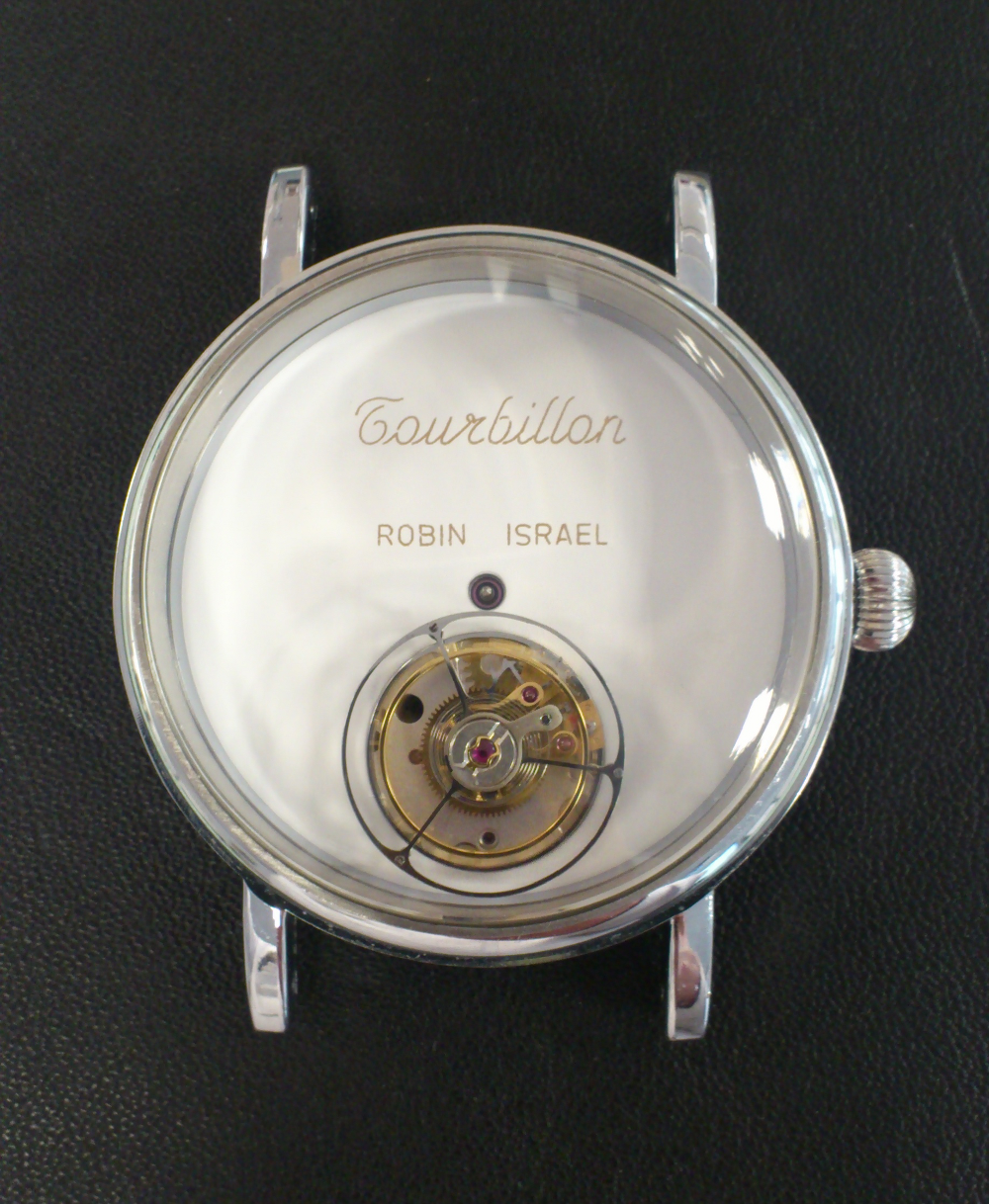
| 1800 | The carriage of Breguet's watch No. 282 is dated to Messidor in Year VIII. It is one of the early dated tourbillon constructions before the patent was granted. Abraham-Louis Breguet |
| 1800 | Pocket watches in the shapes of flasks, mandolins, harps, tulips and similar objects are now favoured until around 1820, as are watches in finger rings. Watches for ordinary use are made thinner than before. |
| 1800 | Seconds hands for pocket watches. |
| 26 June 1801 | Abraham-Louis Breguet receives the patent for the tourbillon in Paris. The balance and escapement sit in a rotating carriage; in classic examples, a revolution often takes one minute. Rotation averages out certain rate deviations in vertical positions. It neither eliminates all centre-of-gravity errors nor automatically removes the difference between horizontal and vertical positions. Additional mass, friction and susceptibility to shocks are design challenges, but are not general proof that every improvement is cancelled out. |
| 1805 (recorded in historical accounts) | An early watchman's clock is mentioned for Triberg. A general claim to being the first is not established. |
| 1807 | Urban Jürgensen's first pocket chronometer. |
| 1815 (recorded in historical accounts) | An early electrically operated clock is attributed to Karl Heinrich Klingert in Breslau. Giuseppe Zamboni's experiments with electrostatically driven pendulums are already described around 1814; attributing the electric clock unambiguously to a single inventor is therefore inappropriate. |
| 1820 | In Black Forest clocks, some wooden wheels are replaced by cast-brass wheels. The verge escapement with a short front pendulum is replaced by the anchor escapement with a long pendulum. |
| early 19th century | Hole jewels made from natural rubies are increasingly used in Swiss watches to reduce friction and wear. Bearing jewels are not a new invention of 1820, however; the English patent dates from 1704. |
| 1821 / 1822 | Nicolas-Mathieu Rieussec uses an ink chronograph to time horse races in 1821. The patent follows on 9 March 1822. Earlier short-time measuring instruments and precursors of the chronograph must be distinguished from this. |
| 1822 (recorded in historical accounts) | Early dedicated stopwatches are described in England. A substantiated general claim to being the first cannot be derived from the existing information. |
| around 1825 | Georges-Auguste Leschot introduces or improves draw in the lever escapement. Attribution and precise dating differ in the literature. |
| 1826 | Johann Mannhardt in Munich develops a gravity escapement for clocks. Comparable principles have earlier precedents; it is not the first gravity escapement of any kind. |
| 1827 | Watch No. 160, “Marie-Antoinette”, ordered in 1783, is completed after Abraham-Louis Breguet's death (1823) under the direction of his son Antoine-Louis. It combines minute repetition, a perpetual calendar, an independently stoppable centre-seconds hand, the equation of time, automatic winding, a power-reserve indicator and a thermometer. |
| around 1830 | Brass wheels, chains, metal bells and gongs become widespread in Black Forest clocks. The change takes place at different times depending on the workshop and design. |
| 1830s / around 1838 | Joseph Thaddäus Winnerl further develops the split-seconds mechanism (rattrapante) in Paris. Earlier catch-up mechanisms, including Perrelet's patent of 1827, form part of its earlier history. 1870 is not a correct year of invention. |
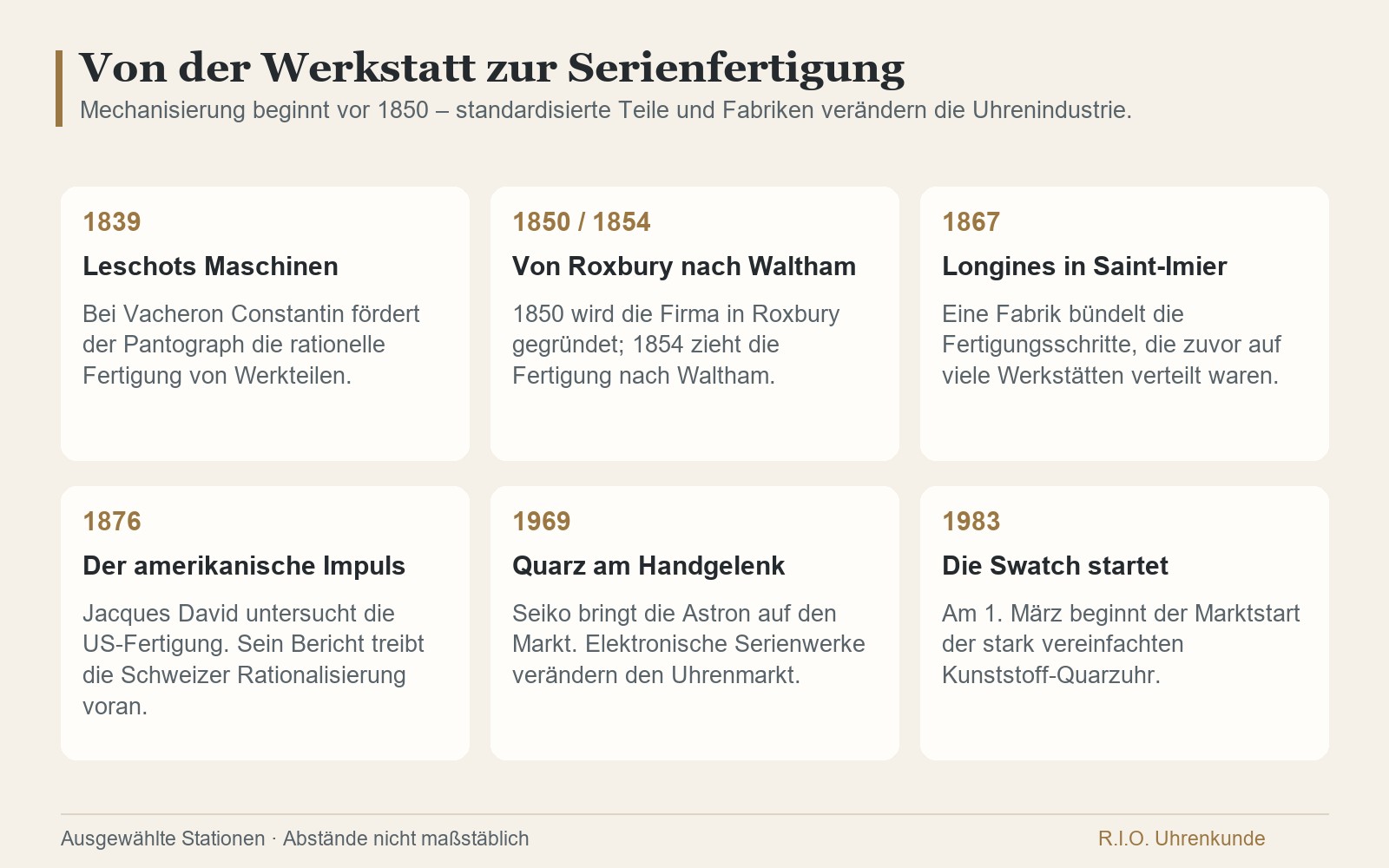
| 1839 | Georges-Auguste Leschot develops machines and a pantograph at Vacheron Constantin for the efficient manufacture of matching movement parts. Mechanisation thus begins well before American factory production around 1850. |
| 1839 | Carl August von Steinheil (1801–1870) in Munich describes a clock system: a master clock advances secondary clocks by electrical impulses from electrochemical batteries. |
| 1840 | Very thin cylinder watches with pin winding are made in Switzerland. |
| 1840s / 1847 | Matthäus Hipp develops electrical short-time measuring instruments. His chronoscope of 1847 is used to measure very short time intervals; it must be distinguished from a recording chronograph. |
| 1841 / 1843 | Alexander Bain and John Barwise receive British patent No. 8783 for an electromagnetically driven clock on 11 January 1841. Bain's subsequent patent No. 9745 of 27 May 1843 describes further electrical clock designs. |
| 1842–1845 | Adrien Philippe develops practical crown or pendant winding and combines it with hand setting. Earlier keyless winding designs are already known; Philippe's design contributes substantially to their later spread. |
| 1845 | Ferdinand Adolph Lange establishes the Glashütte pocket-watch industry together with other participants. |
| 1847 | Antoine Redier patents a mechanical alarm clock with an adjustable alarm time. Alarm mechanisms in clocks have been known for centuries; the patent concerns a particular design. |
| 1847 / 1850 | Gustav Becker opens his clockmaking workshop in Freiburg in Silesia, now Świebodzice, in 1847. From 1850 he makes regulators and thereby lays an important foundation for the Silesian clock industry. |
| 1850 / 1854 | Dennison, Howard and Curtis establish a watch factory in Roxbury near Boston in 1850. Production moves to Waltham in 1854. The company that later becomes the Waltham Watch Company is an important pioneer of machine-based series production with largely interchangeable components. |
Industrialisation and the modern wristwatch
| Date | Development |
|---|---|
| 1858 | Ingold milling cutters by P. F. Ingold. |
| 1860 | Édouard Phillips publishes his mathematical study of the isochronism of the balance and hairspring and the form of suitable hairspring terminal curves. |
| 1860 | Electrically driven pendulum clock by Dr M. Hipp, Zurich. |
| 1861 | Erhard Junghans and his brother-in-law Jakob Zeller-Tobler found the clock-component factory Zeller & Junghans in Schramberg. The first complete clocks of their own follow in 1866. Extensive clock production subsequently develops there. |
| 1867 | Longines brings production together in a factory in Saint-Imier. Factory organisation and mechanisation in Switzerland do not begin only after the World's Fair of 1876. |
| 1867 / 1868 | Georges Frédéric Roskopf introduces his inexpensive workers' watch in 1867; a factory in La Chaux-de-Fonds is mentioned for 1868. Simplified construction and efficient production make pocket watches affordable for wider sections of the population. Roskopf features remain widespread in simple watches for a long time. |
| 1876 | Jacques David and Théo Gribi study American watch production at the World's Fair in Philadelphia and during factory visits. David's report of around 108 pages accelerates the rationalisation of the Swiss industry. |
| 1880 | Greenwich Mean Time becomes the official time in Great Britain by law. |
| 1889 | Electrical central clock systems appear. |
| 1889 | Sigmund Riefler develops his first precision timekeeper and the free spring escapement. His later precision pendulum clocks use, among other features, temperature and atmospheric-pressure compensation and airtight cases with reduced air pressure. Depending on the design and conditions, rate deviations can be of the order of tenths of a second per day. |
| 1896 | The Ingersoll brothers sell the “Yankee” for one dollar. It is made by the Waterbury Clock Company in Waterbury, Connecticut; Delta in Michigan is not the correct place of manufacture. Sales soon reach millions of units. |
| 1896–1897 | Charles-Édouard Guillaume develops Invar nickel steel with particularly low thermal expansion. Discovery, announcement and later applications must be distinguished chronologically. |
| 1897 / 1898 | Sigmund Riefler receives the patent for his nickel-steel compensation pendulum in 1897. Invar pendulums are subsequently used in precision clocks. |
| 1898 | Marie Curie, Pierre Curie and Gustave Bémont report the discovery of radium. Its later use in luminous paints is a separate development. |
| 1898 | Strasser escapement by Professor Strasser, Glashütte. |
| 1901 | A patent is granted for a pendulum clock with electrodynamic drive. It contains all the elements that do not come into use until around 30 years later: permanent magnets, coils, contacts and batteries. |
| 1902 | Auguste Verneuil publishes his method of producing synthetic ruby by flame fusion. Synthetic corundum—ruby and later sapphire—becomes an important material for inexpensive watch bearing jewels. The experimental preparatory work extends back into the 19th century. |
| around 1905 | Wristwatches become more widespread. Early radio time signals are tested in the USA, among other places. |
| 1908 / 1914 | Eterna patents an alarm wristwatch in 1908 and presents it at the Swiss National Exhibition in 1914. A design for an alarm wristwatch by Carl Otto Major is already mentioned for 1894. |
| 1912 | Sartori designs a pendulum made from fused silica with low thermal expansion. |
| 1912 | Mass production of everyday pocket watches in the Black Forest. |
| 1916 | Daylight saving time is introduced in Germany. |
| 1921 | Quartz crystals are used to stabilise the frequency of electronic oscillators—a foundation of later quartz clocks. The ONOGO radio time signal also becomes widespread in the early 1920s. |
| 1922 | Trade journals report an automatically winding wristwatch developed in England. |
| 1923 / 1924 / 1926 | John Harwood develops an automatically winding wristwatch with an oscillating weight. Swiss patent No. 106,583 follows on 1 September 1924; series production with Fortis begins in 1926. Earlier self-winding pocket watches must be distinguished from this. Direct adoption of a rotor-and-reverser system unambiguously attributable to Perrelet is not documented. |
| 1923 | Individual electric clocks become widespread, using low- and high-current systems. |
| 1925 | Synchronous clocks are built. |
| 1926 | Harwood's automatic wristwatch enters series production in Switzerland through Fortis. Fortis / John Harwood |
| 1926 | Development of the Straumann-Siemens timing machine. |
| 1926 / 1927 | Rolex introduces the Oyster in 1926 with a screw-down crown and screw-down case back. It becomes known in 1927 through publicity surrounding Mercedes Gleitze's attempt to swim the English Channel. Water resistance is always dependent on construction, condition and test conditions; “absolutely waterproof” is not a property that lasts indefinitely. |
| 1927 | Warren A. Marrison and Joseph W. Horton develop a quartz clock at Bell Laboratories. A quartz oscillator serves as a frequency standard, beginning a new stage in precise electronic timekeeping. |
| 1931–1935 | Reinhard Straumann develops the self-compensating hairspring alloy Nivarox; the patent application and readiness for series production follow in the early 1930s. It improves temperature stability compared with ordinary steel hairsprings and builds on the development of temperature-stable alloys such as Elinvar. From the mid-1930s it is combined with Glucydur balances. |
| 1931 / 1932 | Rolex introduces Oyster Perpetual winding with a fully rotating rotor and protects the corresponding designs through patents. Early versions wind in one direction. The history of rotor winding in the 18th century must not be portrayed wholesale as a forgotten system unambiguously attributable to Perrelet. |
| 1933 | Röhm & Haas brings PMMA to market under the name Plexiglas; the trademark is registered in 1933. Acrylic glass later also becomes important for watch crystals and replaces older materials such as celluloid in many applications. |
| 1934 | Adolf Scheibe and Udo Adelsberger develop a high-precision quartz clock. Their measurements later contribute to the study of variations in the Earth's rotation. |
| 1935 | The automatic speaking-clock telephone service is introduced in Germany. Timing machines for measuring the instantaneous rate of a watch are manufactured industrially. |
| 1946 / 1947 | Production of the Soviet Pobeda watches (“Victory”) begins in 1946. In classic versions, the hand-wound K-26 movement has 15 jewels, a Breguet overcoil and no shock protection; it is later made by the ZIM factory, among others. Pobeda is not the first Soviet wristwatch of any kind. In 1947, Lemania in Switzerland builds a prototype automatic chronograph that does not enter series production. |
| 1947 | Vulcain introduces the Cricket. A powerful mechanical alarm in a portable wristwatch case makes the watch famous. Robert Ditisheim and his team develop the calibre after several years of work; earlier alarm wristwatches, such as those by Eterna, form part of its earlier history. |
| 1948 / 1950s | Omega brings the Seamaster to market in 1948: robust wristwatches for everyday use and, later, an extensive family of diving watches. The seahorse becomes the symbol of the line in the 1950s. |
| 1948 / 1950s | Reinhard Straumann develops the mainspring alloy Nivaflex; the patent application is made in 1948. Such alloys improve strength and fatigue resistance, among other properties, compared with older steel mainsprings. “Break-resistant” does not mean that a spring is unbreakable under all conditions. |
Electric clocks, quartz, radio signals and new mechanics
| Date | Development |
|---|---|
| 1953 / 1954 | Rolex develops the Submariner from 1953 and presents it at the Basel fair in 1954. The early reference 6204 has an external rotating bezel and is designed for 100 m water resistance. One of its early prominent users is the underwater pioneer Dimitri Rebikoff. “Frogman”, “Deep Sea Special” and “Nautilus” are recorded as alternative names. Blancpain introduces the Fifty Fathoms in 1953, developed to meet the requirements of French combat divers and later used by various navies, including as the Tornek-Rayville in the USA. Its rotating bezel is an important safety feature. It appears in Cousteau's 1956 film Le Monde du Silence. A Rolex brochure for the World Expo in Okinawa in 1975 also mentions Submariners in this context; the precise attribution is less well documented. |
| 1954 | Max Hetzel develops a transistor-controlled tuning-fork wristwatch. |
| 1955 | Louis Essen and Jack Parry build a practical caesium atomic clock at Britain's National Physical Laboratory. In 1967, the SI second is defined by the transition in the caesium-133 atom. |
| 1957 | Hamilton introduces the Electric 500, an early electrically driven wristwatch with a mechanical balance. It is not a quartz watch. |
| 1958 | The Funkwerk Erfurt begins series production of an industrial quartz clock. |
| 1959 | The DCF77 time-signal transmitter in Mainflingen begins operation. Its carrier frequency is 77.5 kHz; the time is derived from the PTB's time standards. |
| 1960 | BULOVA (USA/Switzerland) introduces the ACCUTRON tuning-fork wristwatch. |
| 1967 | Quartz wristwatches are tested in Switzerland and Japan. Early designs do not all use the now-conventional frequency of 32,768 Hz; the later Beta 21, for example, operates at 8,192 Hz. The SI second adopted in 1967 corresponds to 9,192,631,770 periods of radiation from the specified transition in the caesium-133 atom. DCF77 is a separate radio time-signal system. |
| 1968 | ETA presents automatic wristwatch movements with date, day of the week and quick correction of both displays. |
| 1968–1969 | Doxa introduces the SUB 300T Conquistador with a helium valve for saturation divers. Sources give 1968 and 1969 for its presentation and market launch respectively. It is one of the early diving watches with this valve available to the public. |
| 25 December 1969 | Seiko brings the Astron to market as the first commercially available quartz wristwatch. |
| 1969 | Automatic chronographs come to market: Zenith presents the El Primero in January; the consortium of Breitling, Heuer, Büren and Dubois-Dépraz presents its modular chronograph in March. Seiko also introduces the automatic chronograph 6139 in 1969. Presentation, the start of production and actual availability must be distinguished when considering the “first” model. Zenith / Swiss consortium / Seiko |
| 1970s / 1979 | George Daniels develops the co-axial escapement in several stages and tests it in his own watches and in modified movements. A patent follows in 1979. Further development and cooperation with manufacturers are needed before industrial series production; a lack of interest on the part of everyone involved is not an accurate explanation. |
| 1973 | DCF77 transmits a coded minute telegram with time and calendar data. This allows compatible radio-controlled clocks to set their time automatically. PTB |
| 1975 | ETA introduces the thin automatic movement 2892 with centre seconds, date and quick correction. General claims to records depend on the comparison group and movement variant. |
| 1978 | EBAUCHES S. A. is granted a patent for a quartz-controlled mechanical wristwatch. This patent remains unused until it expires. The traditional movement manufacturer ADOLF SCHILD merges with ETA. Production of the vast majority of AS movements, including all alarm movements, is discontinued. |
| 1980 | The Swiss Delirium IV sets a record at the time for particularly thin quartz watches with an overall thickness of 0.98 mm. |
| 1983 | Swatch launches in Switzerland on 1 March. The simplified, industrially manufactured plastic quartz-watch concept is highly successful; development and production preparation extend back into the preceding years. |
| 1984 | Zenith resumes El Primero production. Charles Vermot had preserved tools and documentation in the 1970s, although they had been earmarked for scrapping. This makes the restart possible. |
| 1986 / 1988 | Seiko shows a prototype in Basel in 1986 that converts arm movement into electrical energy through a generator. Series-production watches follow under the name AGS in 1988; the name Kinetic is introduced later. |
| 1990 | Junghans introduces the MEGA 1 as the first radio-controlled wristwatch. |
| around 1990 | Relative uncertainties of the order of 5 · 10⁻¹⁵ are quoted for high-performance atomic clocks. Mathematically, this relative value corresponds to one second in 2 · 10¹⁴ seconds, or around 6.3 million years. This illustrates the numerical value; it is not a guarantee of error-free operation over that period. |
| 1997 | FORTIS introduces a new modular wristwatch movement combining automatic winding, an alarm and a chronograph. |
| 1998 / 1999 | Seiko shows a hand-wound Spring Drive prototype with a power-reserve indicator in Basel in 1998. A mainspring provides the energy, and a quartz-controlled regulator brakes the glide wheel electromagnetically. The first series-production watches follow in 1999. |
| 1999 | IWC presents the GST Deep One (Ref. 3527) in titanium with a mechanical depth gauge and a maximum-depth pointer. Its measuring range extends to 45 m, and its stated water resistance is 100 m; the model remains in the range until 2003. Mechanical depth gauges in watches have earlier predecessors. |
| 1999 | Omega introduces the co-axial escapement developed by George Daniels into industrial series production of wristwatches. The development of the escapement dates back to the 1970s. |
| 2001 | Ulysse Nardin presents the Marine Perpetual Limited (Ref. 333-77-7) with a perpetual calendar and stated water resistance of 200 m. |
| 2001 | Ulysse Nardin presents the Freak with the Dual Direct escapement developed by Ludwig Oechslin. Two silicon wheels alternately transmit energy to the balance. The watch combines the new escapement with an unusual rotating hand and movement architecture. |
| around 2001 | Damasko tests coated escapement parts to reduce friction and the need for lubricant. DLC means “diamond-like carbon”, not a solid diamond layer. Sinn's DIAPAL also relies on suitable material pairings, but is not an identical coating process across the board. Lubrication-free operation concerns specific contact points, not automatically the entire movement. |
| 2002 | Breitling introduces the Seawolf with an integrated helium-valve design and stated water resistance of 3,000 m (including Ref. E17370). Record claims must relate to the relevant period and model group. |
| 2003 | TAG Heuer presents the Aquagraph 2000 (Ref. CN211A.BA0353): a mechanical chronograph with a helium valve and pushers designed for operation underwater, with stated water resistance of 500 m. Mechanical chronographs that could be operated underwater had already existed earlier. |
| 2004 | TAG Heuer presents the Monaco V4 concept watch at Baselworld. Toothed belts and ball bearings replace parts of the traditional transmission through gears. |
| 2006 | Audemars Piguet presents a new escapement based on the Robin escapement. Robin had developed his principle in the late 18th century. |
| 2009 | CX Swiss Military presents the 20'000 Feet with stated water resistance of 6,000 m. It claims a depth record at the time for mechanical chronographs; this does not amount to a record for all diving watches that holds indefinitely. |
| 2009 | The Pita Oceana, although first presented in 2006, reaches readiness for series production in this year. A distinctive feature of the model, water-resistant to 5,000 metres, is its case without a crown; it is operated through the case back. |
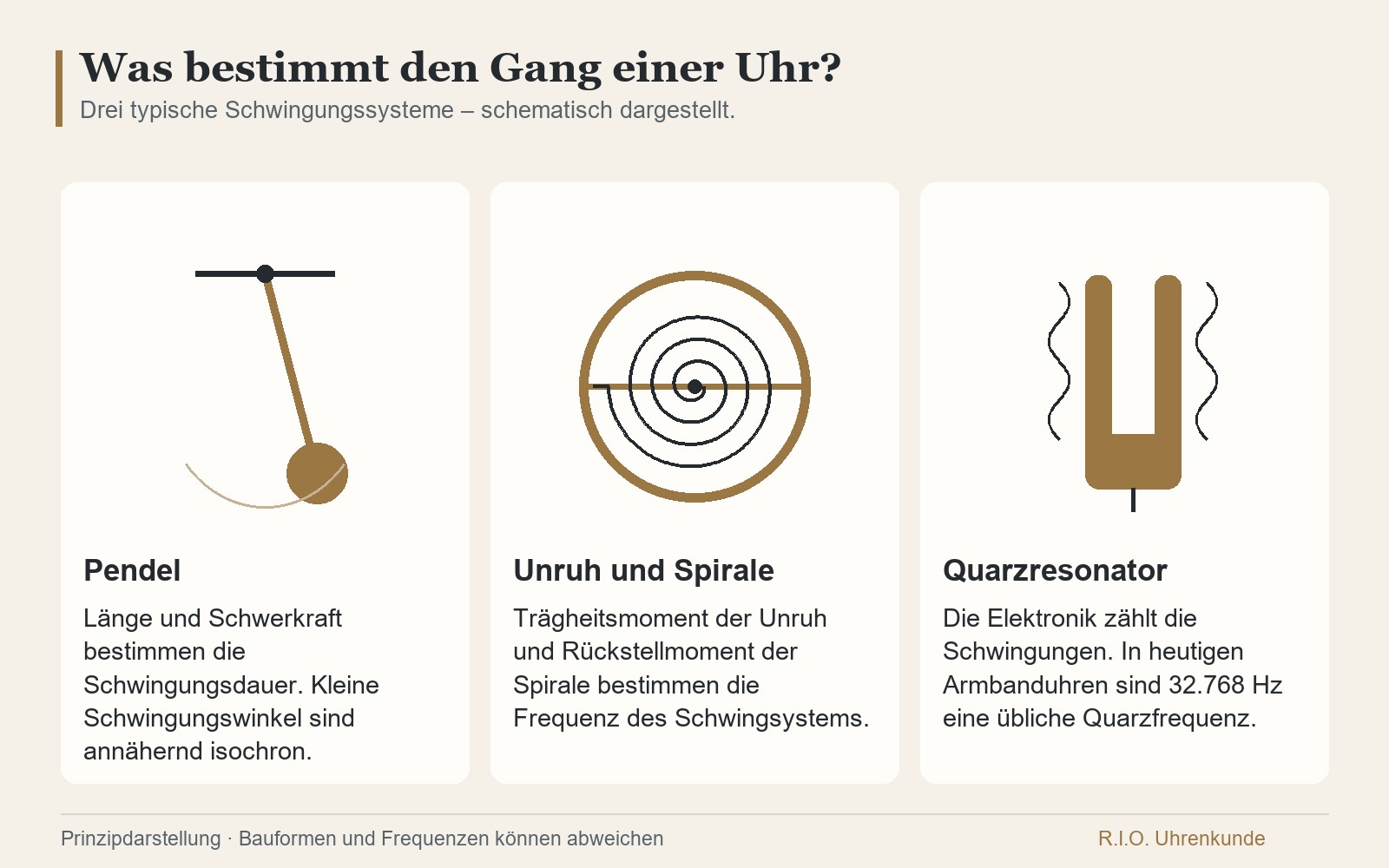
| 2010 | TAG Heuer shows the Pendulum Concept at Baselworld: permanent magnets provide the restoring torque of the balance instead of a hairspring. Its frequency is 6 Hz, corresponding to 43,200 vibrations per hour. It is a concept watch, not a model from 1957. |
| 2013 | Swatch presents the Sistem51: a mechanical automatic movement made from 51 parts with largely automated assembly. |
| 2020 | The craftsmanship of mechanical watchmaking and art mechanics in Switzerland and France is inscribed on UNESCO's list of intangible cultural heritage. |
Mechanics in motion
Many of the escapement principles mentioned here can be explored step by step in the Animations of escapements and movement mechanisms collection.
Sources for further reading
The technical cross-check drew on horological literature and the histories of manufacturers, museums and institutes. Historical attributions may differ between sources. Particularly traceable original sources for selected entries:
- Science Museum Group: Al-Jazari's book of 1206
- Clockmakers' Company: Royal charter of 1631
- Breguet: Tourbillon patent of 26 June 1801
- Breguet: Commission for the Queen of Naples' wristwatch
- Swatch Group / Breguet: Ordered in 1810, delivered in 1812
- Royal Collection: Mudge's watch for Queen Charlotte, dated 1770
- PTB: DCF77 time-signal transmitter
- PTB: Dissemination of time and frequency by DCF77, 1959–2009
- PTB: DCF77 carrier frequency, 77.5 kHz
- Zenith: Charles Vermot and the resumption of production in 1984
- DOXA: SUB 300T and the helium valve
- Röhm: The history of Plexiglas
- Junghans: From component factory to clock manufacture
- UNESCO: Mechanical watchmaking and art mechanics, inscribed in 2020