Complete Guide: Omega Speedmaster Calibre 861
A service report
The Omega calibre 1861, also known as the Lemania 1873, has accompanied me since my training; I completed part of my WOSTEP final examination on this movement. I then repaired and serviced it many hundreds of times in its various versions in the chronograph group at Omega. Now, ten years later, perhaps a thousand times or more.
General information:
The calibre 1873 movement, originally designed by Lemania, was initially used by various brands and can still be found today in some vintage Breitling or Sinn chronographs. Omega called the standard version of this calibre the „Omega 861“ and fitted the movement to the famous Omega Speedmaster Professional („Moonwatch“). The Omega movement differs very little from the version sold under the Lemania name, although there are Lemania versions with more finely toothed hour wheels and minute pinions.
The movement exists in several versions. The standard version, Lemania 1873 or Omega 861, is a manually wound chronograph with cam control, an hour counter, a 30-minute counter and a frequency of 21,600 vibrations per hour.
Technical specifications of calibre 861:
- Type: manually wound chronograph with hour counter
- Diameter: 27 mm or 12″ (Paris lignes)
- Height: 6.87 mm
- Frequency: 21,600 bph or 3 Hz
- Lift angle: 50°
- Power reserve: 45 h (50 h according to older technical documents)
- Jewels: 17 (18 from the newer 1861 version, with an additional jewel for the chronograph coupling yoke)
- Manual winding
- Cam-controlled system
Calibre family
- 860: chronograph, minute counter
- 861: chronograph, minute counter, hour counter
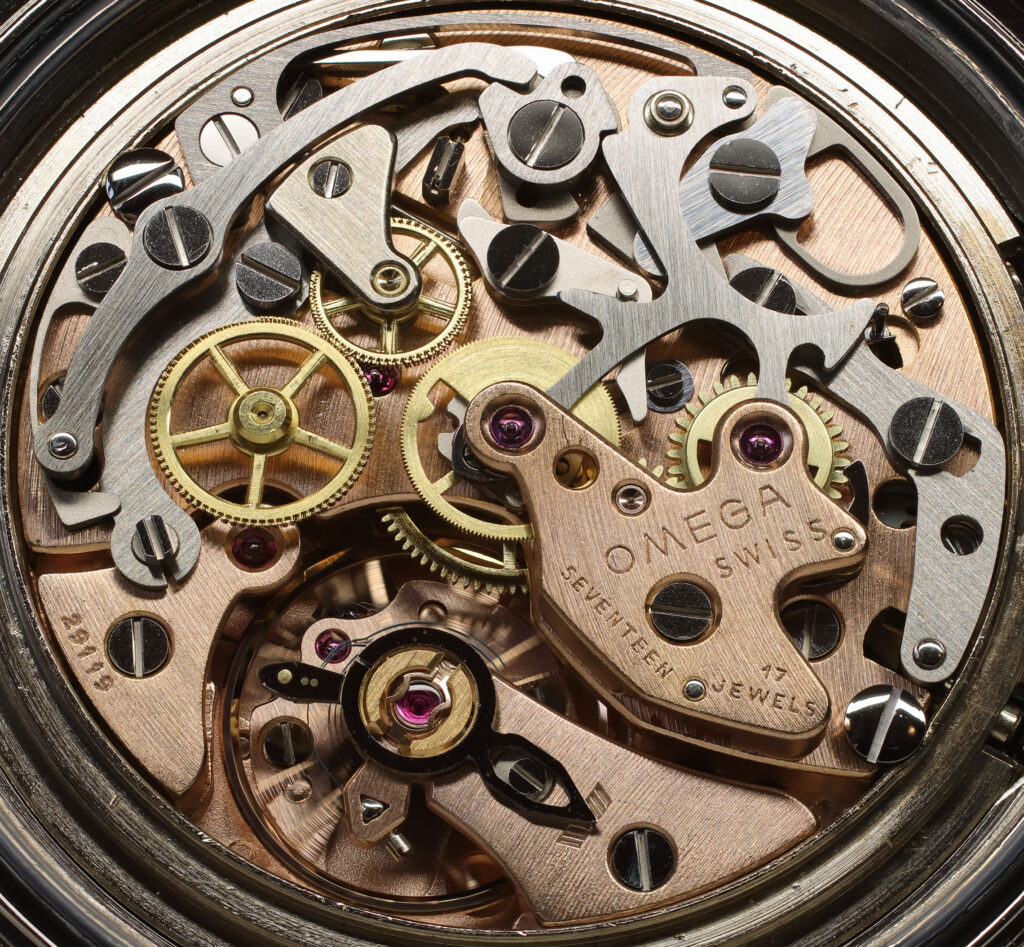
- 862: chronograph, minute counter, hour counter, 21-jewel version
- 863: chronograph, minute counter, hour counter, bevelling and decorative finishes on the movement for a display case back.
- 864: chronograph, minute counter, hour counter, bevelling and decorative finishes on the movement for a display case back, chronometer, found, for example, in Omega Speedmaster models with solid gold cases
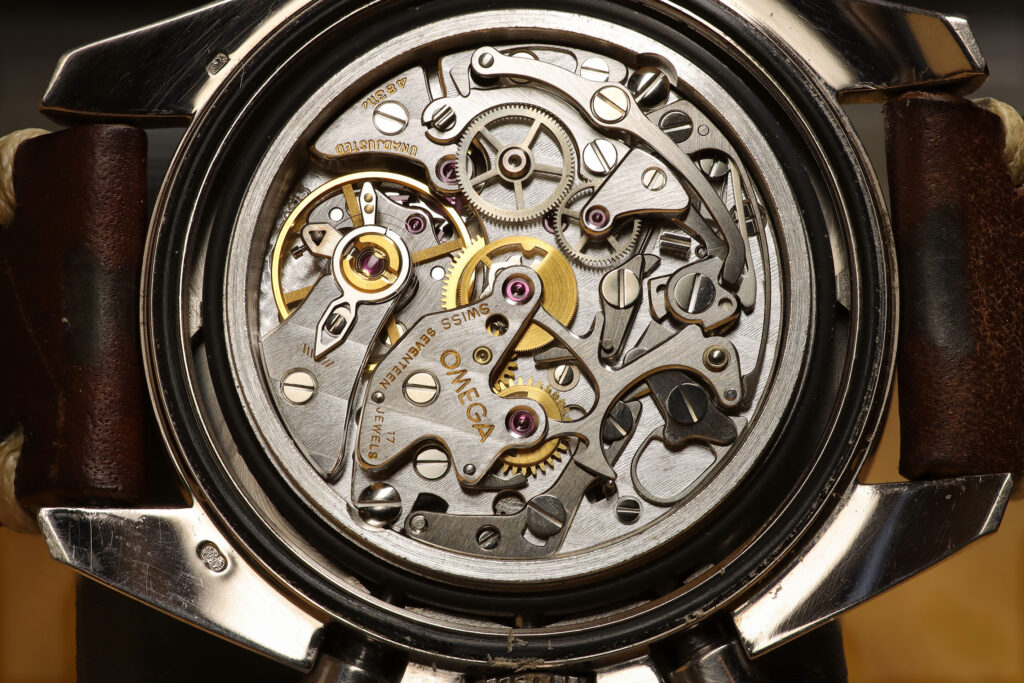
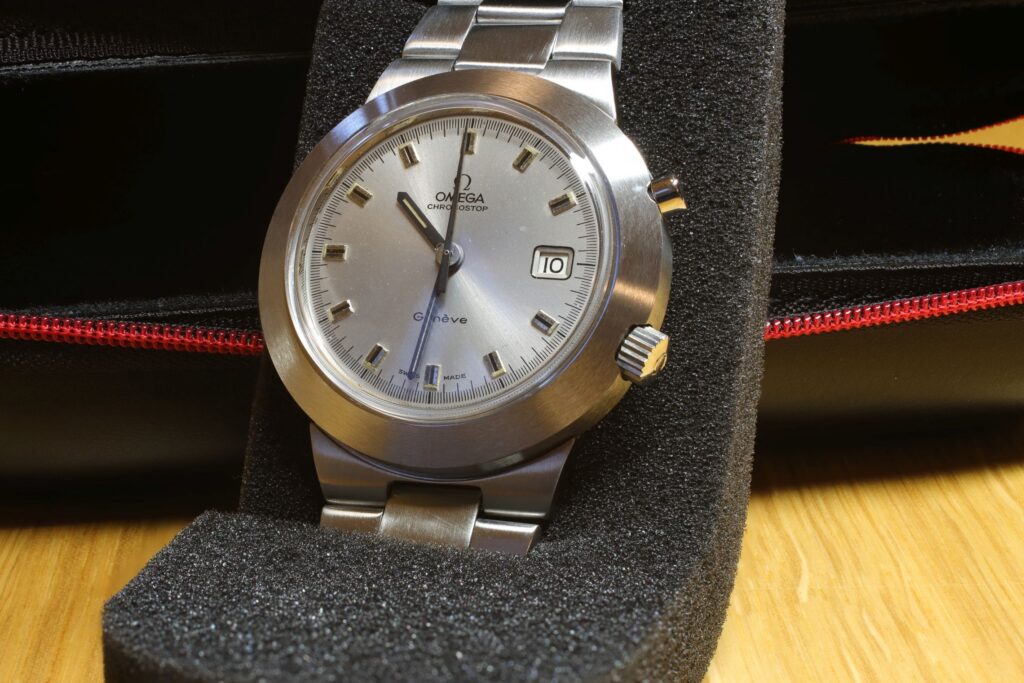
- 865: modified version for the Omega Chronostop, a seconds-only chronograph with reset and stop functions with only a chronograph seconds hand and no small seconds, monopusher.
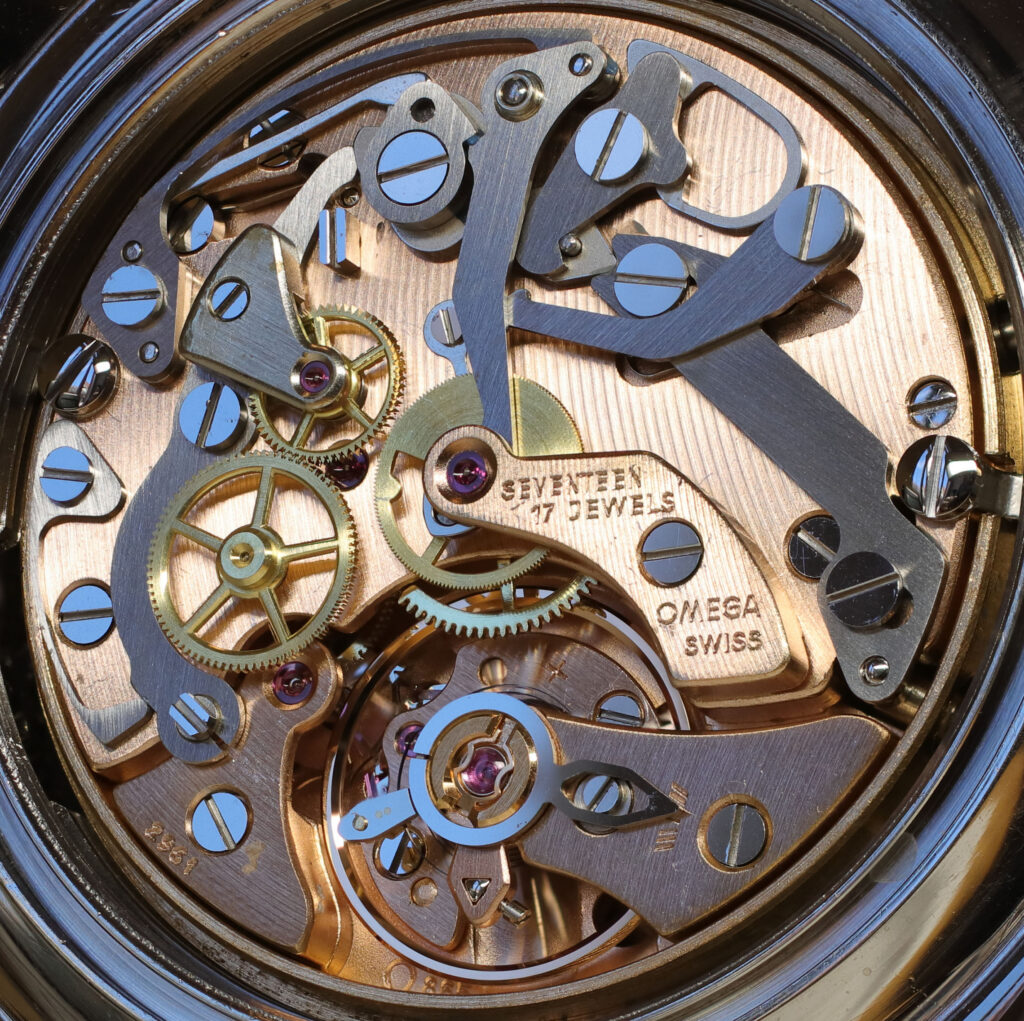
- 866: chronograph, minute counter, hour counter, moon phase (=Lemania 1883)
- 867: chronograph, minute counter, hour counter, skeletonised and decorative finishes, chronometer – very rare
- 910: chronograph, minute counter, hour counter, 24-hour indication instead of small seconds, second time zone (see Omega Flightmaster 145.013)
- 911: chronograph, minute counter, hour counter, second time zone (see Omega Flightmaster 145.026 and 145.036)
- 920 = 865 plus date
- 930 = 860 plus date (Omega Bullhead chronograph or rare De Ville models)
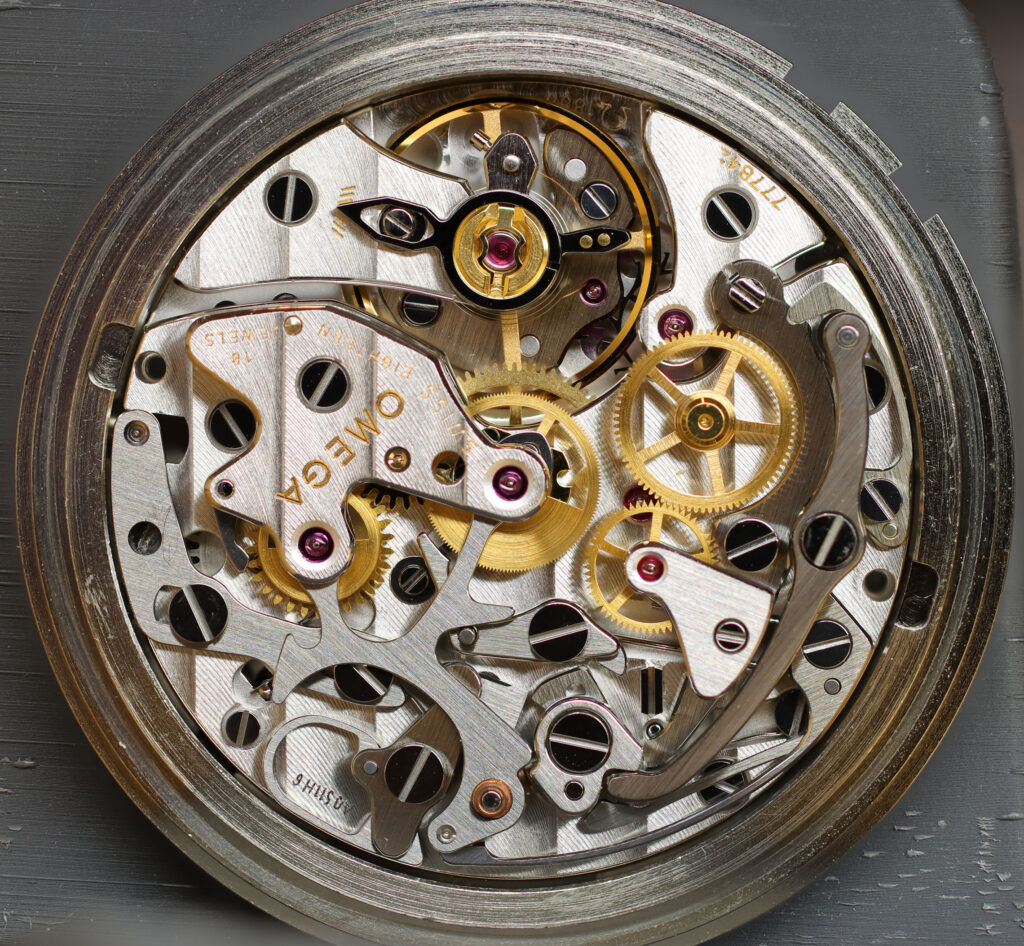
- 1861: new designation for the 861, with mainplates and bridges rhodium-plated (silver-coloured)
- 1863: new designation for the 863, with rhodium-plated (silver-coloured) mainplates and bridges, bevelling and decorative movement finishes for a display case back, and a steel brake lever instead of Delrin
- 1866: new designation for the 866, with rhodium-plated (silver-coloured) mainplates and bridges, plus bevelling and decorative movement finishes for a display case back
Genealogy
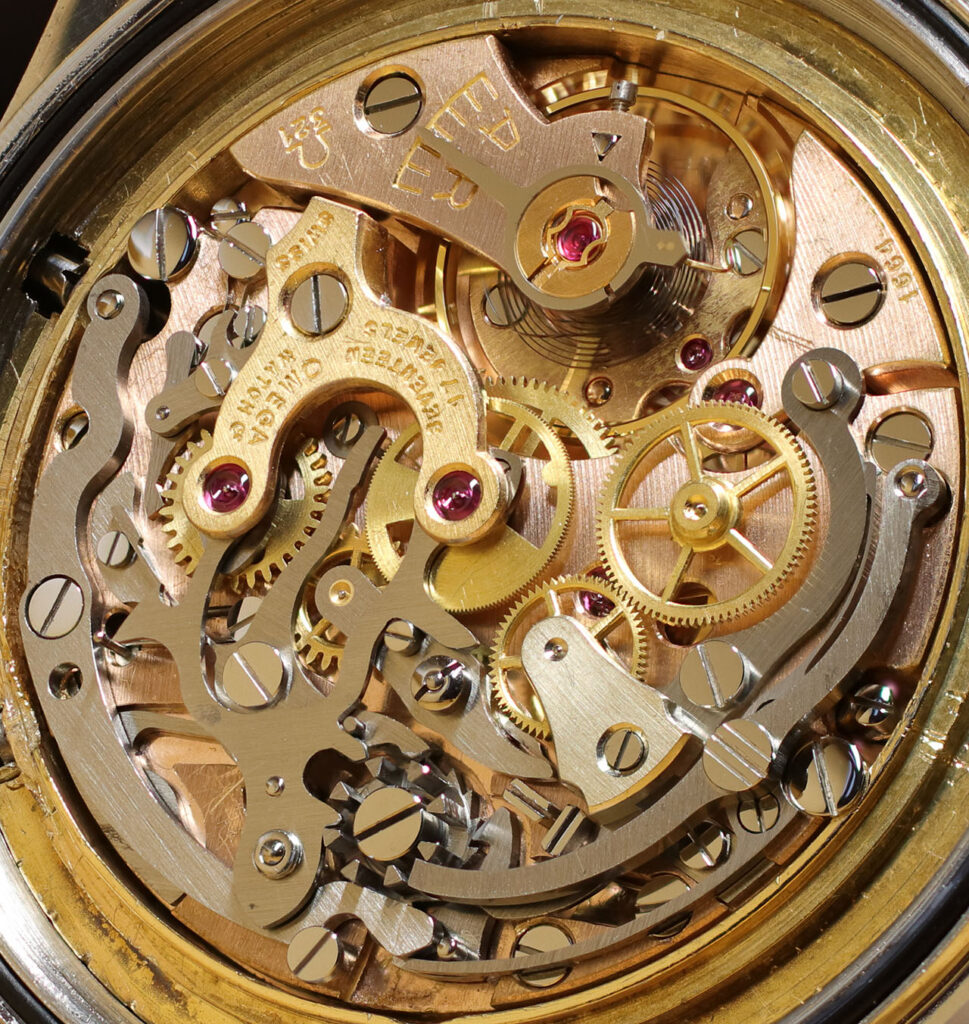
Predecessor: Omega 321 – A column-wheel chronograph. Many parts were also used unchanged in calibre 861, which is why many calibre 861 spare-part numbers still begin with 0321…
Successor: Omega 3861 – Like the 1861, but with a Co-Axial escapement and a silicon hairspring. Only a few screws and a small number of parts remain identical to those in the preceding calibre.
Development stages of calibre 861 / 1861:
Certain details allow the age of the movement to be determined. It developed as follows (from old to new in each case):
- Electroplating of the mainplate and bridges: rose gold –> yellow gold –> rhodium-plated
- Screw heads: flat-polished –> domed-polished
- Chronograph levers: straight graining –> bead-blasted
- Brake lever for the central chronograph wheel: two-piece steel –> one-piece Delrin
- Old balance version: blue hairspring, Greiner collet, regulating bend beyond the stud, rose-gold-plated balance rim, triangular stud holder
- New balance version: silver-coloured hairspring, laser-welded collet, no regulating bend beyond the stud, yellow-gold-plated balance rim, round stud holder
- Barrel arbor: short upper pivot –> long upper pivot
- Friction spring for the central chronograph wheel: Teflon coating (green) –> polished steel
- Operating lever for the hour-counter hammer, 0861 1784: with a hole –> without a hole
- Reset stem 093ST0016 and other lengths: old version fully cylindrical –> step before the tip
- Screw 2548 for coupling yoke 1724: low, flat-polished screw head –> tall, domed-polished screw head
- Several wheels in the movement: bead-blasted surfaces –> polished surfaces
The most beautiful versions of the movement are undoubtedly the first 861s, with rose-gold-plated mainplates, straight-grained levers, flat polishing on all screw heads, a steel brake lever for the central chronograph wheel and a blue hairspring. Such movements are now very rarely found in perfect condition, as improper repairs or inadequate maintenance usually result in some parts being replaced and a mixture of versions.
For a short period, a yellow-gold-finished version was produced that is already largely identical to the 1861 version – with a Delrin brake lever, domed-polished screw heads and bead-blasted chronograph levers instead of straight graining.
The latest version of the calibre, the 1861, achieves better rate results thanks to its modernised hairspring. At the same time, the ratchet wheel, crown wheel, setting wheels and click now have polished rather than matt surfaces, which considerably reduces wear on the brass bridges. Unfortunately, the steels in the newer versions are softer, so worn clicks are occasionally found, something that virtually never occurs in the earliest versions.
Workshop tips:
- The new balance cannot be used with the old stud without completely reshaping the regulating section of the hairspring. When replacing the balance with the new version, the stud holder must also be replaced!
- The barrel arbor in the old version has a short upper pivot, which tends to wear intothe bore in the train bridge. The new barrel arbor has a long pivot that uses the full depth of the bearing bore. The barrel arbor should therefore always be upgraded to the new version during servicing.
- If the operating lever for the hour-counter hammer sticks after operation, the part should be replaced with the new version without a hole.
- An impact on a pusher can deform the lower hour-counter bearing. Repair calls for extreme care and the principle of „less is more“. The bearing can be repaired carefully using a staking tool, but very little material must be moved. Careless work here will ruin the mainplate!
- If the pivot pin for the minute-counter jumper has broken, it can be pressed out and a new one made.
The service
Several points should be checked systematically when servicing the movement. Some areas are sensitive to impact if the case pushers are particularly exposed. A hard impact directly on a pusher can cause various types of damage of differing severity.
Since you never know exactly which unresolved problems you will find, there is a whole series of checks to work through when servicing this movement. Some faults appear only in every fiftieth, hundredth or two-hundredth service, or even less often. This report should cover all faults with an incidence of roughly one in two hundred. I will also try to give the likelihood of finding each fault, as a guide to how firmly that check should be kept in mind.
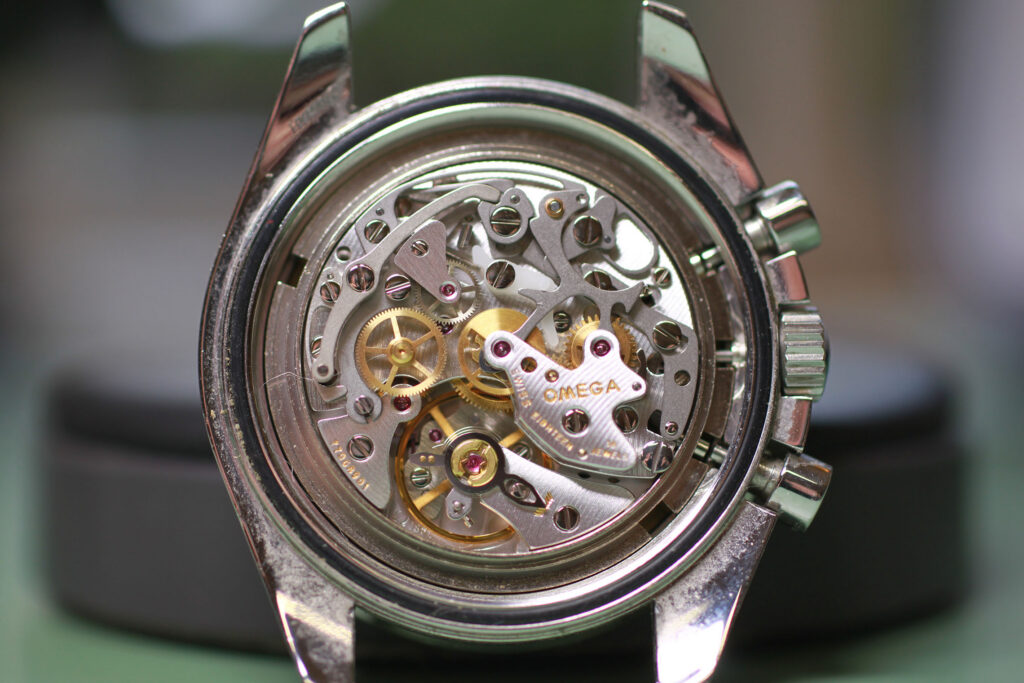
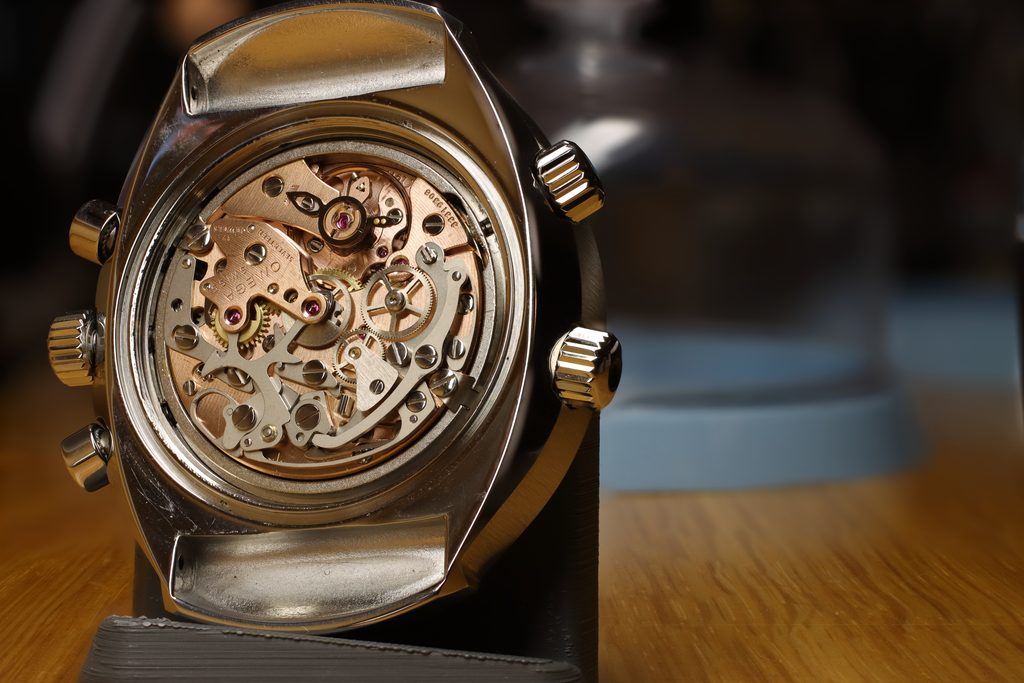
The starting point for the service is the movement still fitted in its case. This is a newer Omega Speedmaster with calibre 1861, identifiable by the rhodium plating on the movement.
A few checks are useful even before removing the movement. We check the operation of the chronograph, winding and hand setting, and look at the hairspring and obvious points. We keep every malfunction in mind so we can inspect the relevant area particularly closely.
On the dial side, we should check that the hour counter is at zero, because in rare cases (1/200) it runs while the watch is stopped. This mainly affects the older calibre 861 versions; the most common cause is a lack of clearance between the reset-pusher screw and the reset stem.
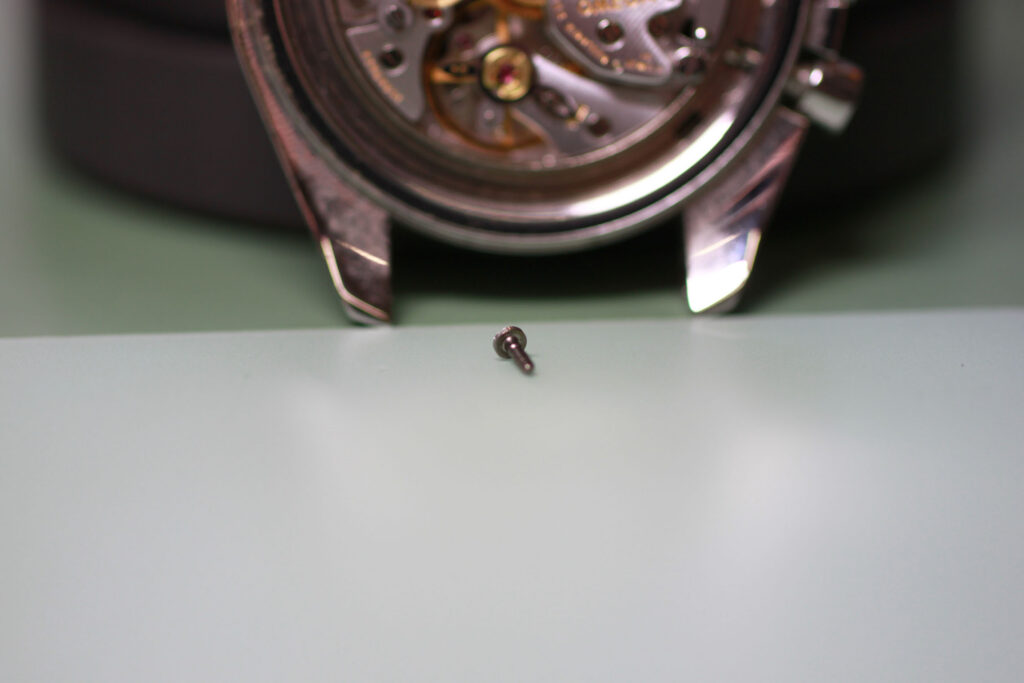
This screw falls out of the watch shown. Anyone looking closely could already see in the previous photographs that a movement retaining screw was missing from its position. When a watch does not run reliably, experienced watchmakers often take a quick look over all its screws. A broken screw head or a loose screw can stop a watch (1/200). On this movement, the hammer-locking stem also sometimes breaks, or even falls out after the watch has suffered an impact.
In this case, poor watchmaking was responsible: the movement retaining screw had not been tightened properly the last time the movement was cased. This impression is confirmed later in the movement itself, where many screws are insufficiently tight.
However, it would be a mistake here to tighten the screws „as firmly as possible“ , because the screws with flatter heads in particular are delicate in this calibre and regularly break if tightened without feel. Towards the end, each screw should therefore be tightened with particular sensitivity. If a screw suddenly feels even slightly soft, stop immediately; otherwise the head will break off and the remaining threaded portion is often difficult to remove.
Cracked screws can sometimes be recognised by looking at the bottom of the slot. If two fine cracks are visible where the threaded shank joins the head, the screw is certainly damaged. With flat-polished screws, a fracture is even easier to recognise if the two faces of the head separated by the slot reflect light differently.
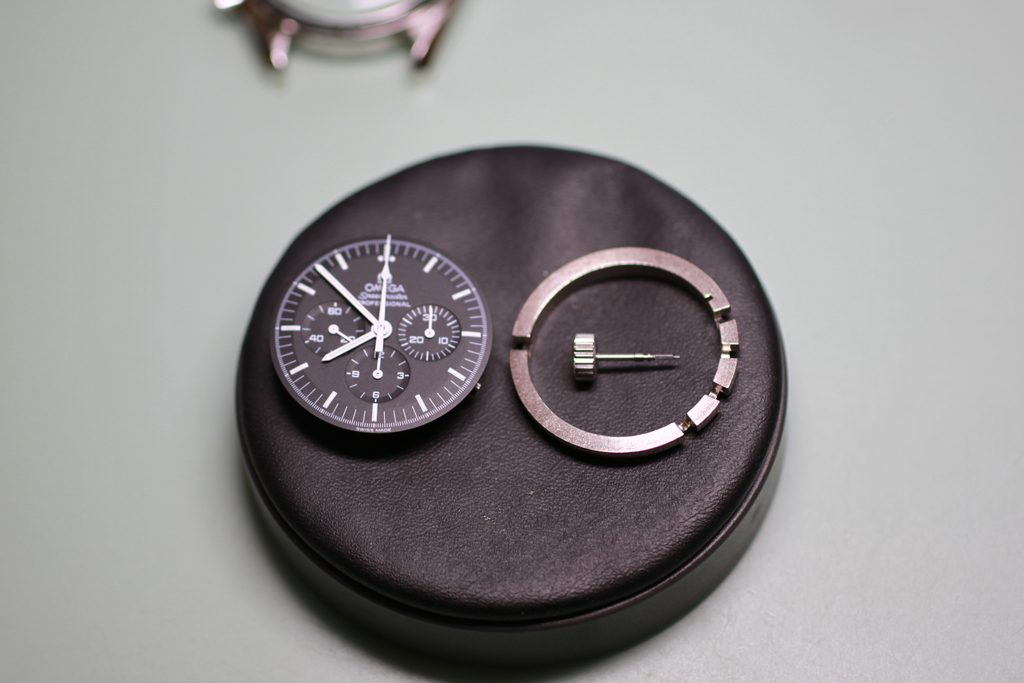
This is the uncased movement with its dial. The movement retaining ring on the right is the connecting element between the movement and the case.
After removing the hands, another problem comes to light:
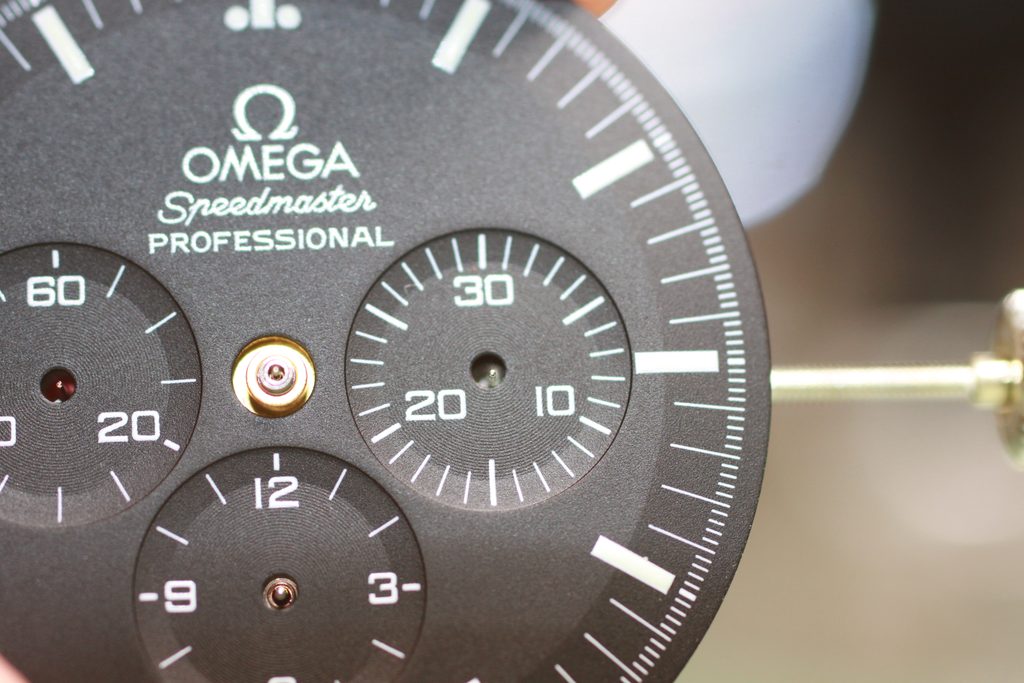
The dial has been knocked off-centre, probably because the watch was once dropped onto its side. To repair it, the dial is aligned very carefully with light taps from a wooden watchmaker's hammer at the 10 o'clock position. The movement is carefully supported on a suitable surface, such as hardwood.
If the dial feet are already cracked, they may break during centring, so a close inspection should always follow.
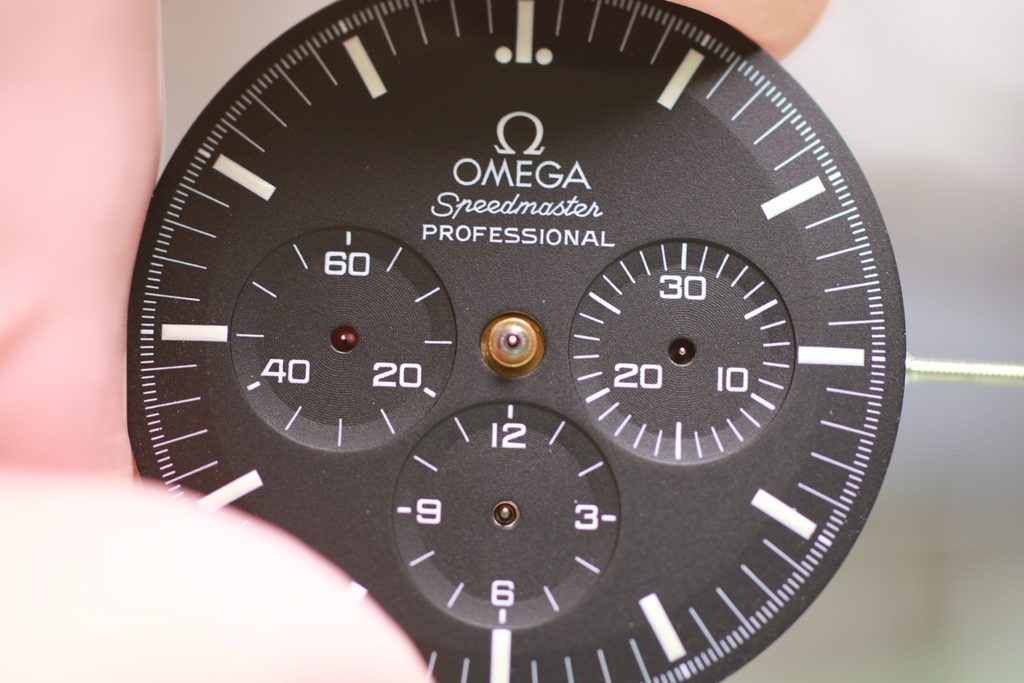
In this case, the feet hold and the centring succeeds without further consequences.
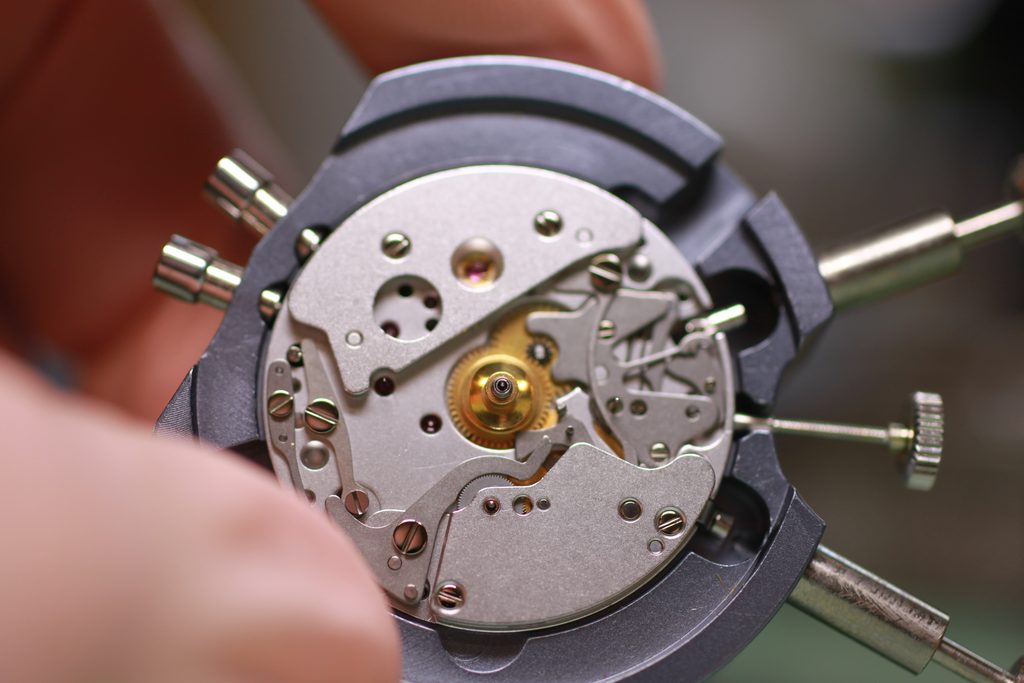
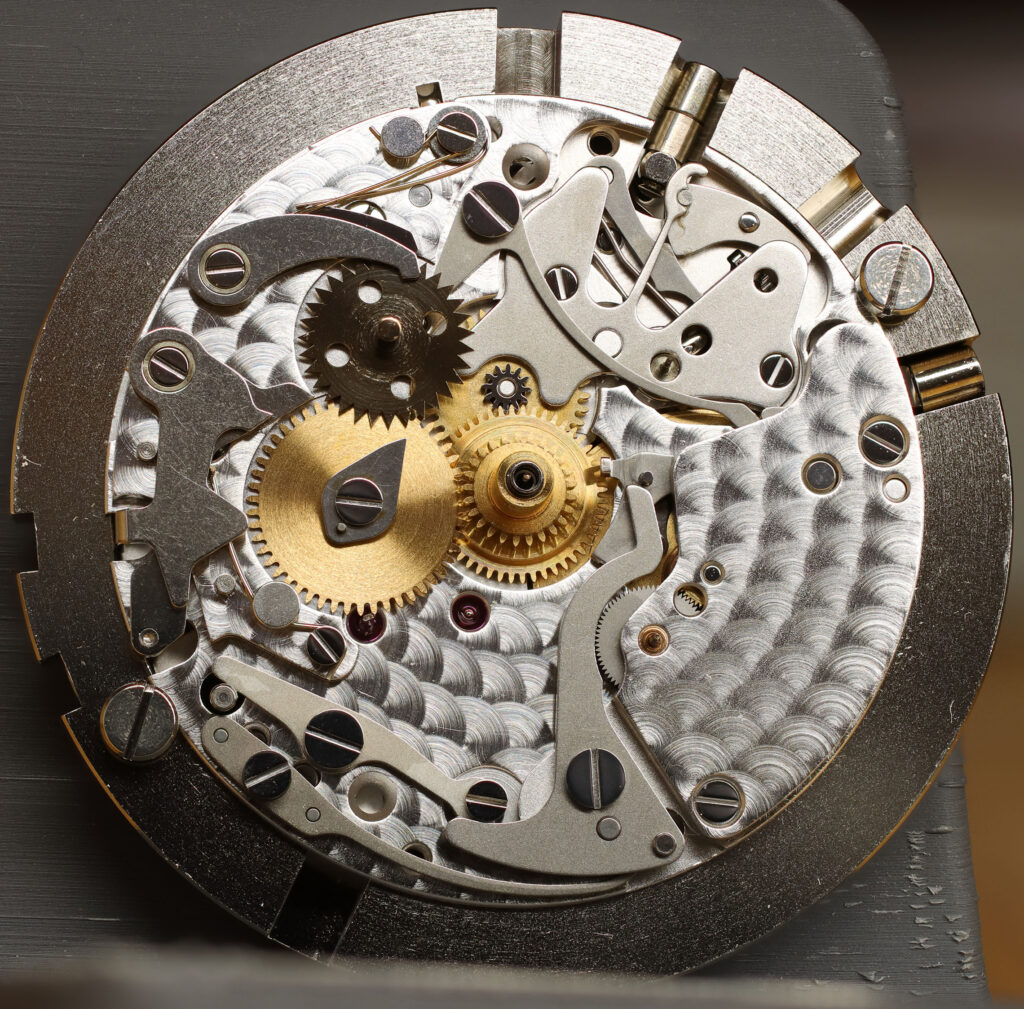
The dial is secured at its feet by two screws. Removing it reveals the dial side of the movement. On the right is the mechanism for switching to hand setting. At the bottom, beneath the bridge, sits the hour counter with its brake lever, reset hammer and operating mechanism (left), which transmits the action from the other side of the movement.
The hour counter is permanently driven by a small pinion on the barrel. It stops when a metal lever blocks the hour-counter wheel. In this state, the small pinion on the barrel continually slips, since it is held on the barrel only by a tension spring. Even in later movements such as the well-known ETA 7750, the hour counter still works on a similar principle.
The next inspection is of the movement side. No particular abnormalities are visible, so systematic disassembly, inspection and preliminary cleaning can begin.
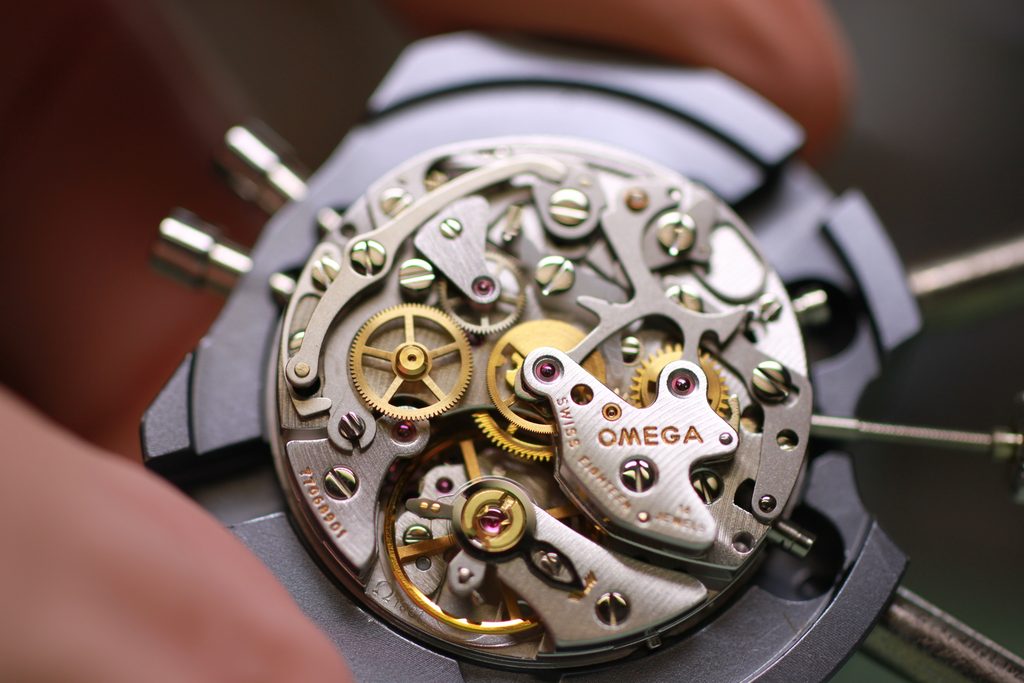
This article is still in progress; further content will follow soon. The service has only just begun.