The Digital Toolbox for Watchmakers
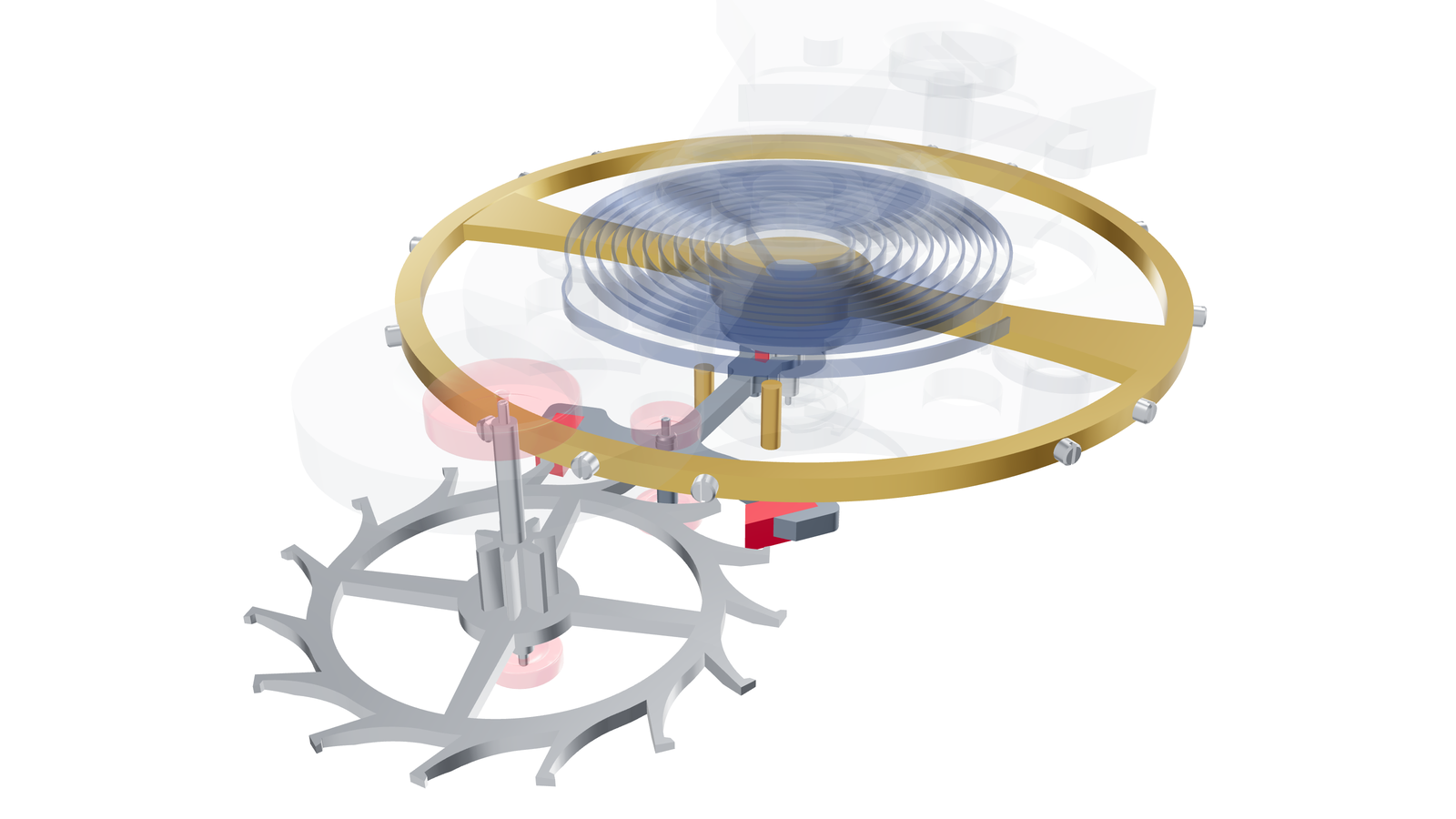
At the workbench, we repeatedly make the same calculations: Which mainspring should we order when the original is missing? Will an available spring fit the barrel? Through how many degrees must we turn the collet? How many turns does the rating nut need? This page brings together the calculators for these tasks and the interactive models from the blog. Each calculator shows its working so that the result can be checked.
The calculators follow the flow of power through the movement: power source, going train, escapement and oscillator. The escapement models come first because the pallet adjustment model is the most useful one at the workbench. It is worth bookmarking this page; every section has its own direct link.
Contents
- 1Models of the Swiss lever escapement
- 2Power source
- 3Going train
- 4Oscillator
- 5Rate checking
- 6Other tools
1 Models of the Swiss lever escapement
The models accompany the article The Swiss Lever Escapement and run in the browser, including on a phone. Clicking ‘Start model’ opens the model here in the article.
1.1 Pallet adjustment model
Adjust the pallets and banking pins and immediately see what happens to drop lock, total lock (locking depth) and run to the banking. It will accompany Part 2 of the Swiss lever escapement series.
1.2 Escapement test bench
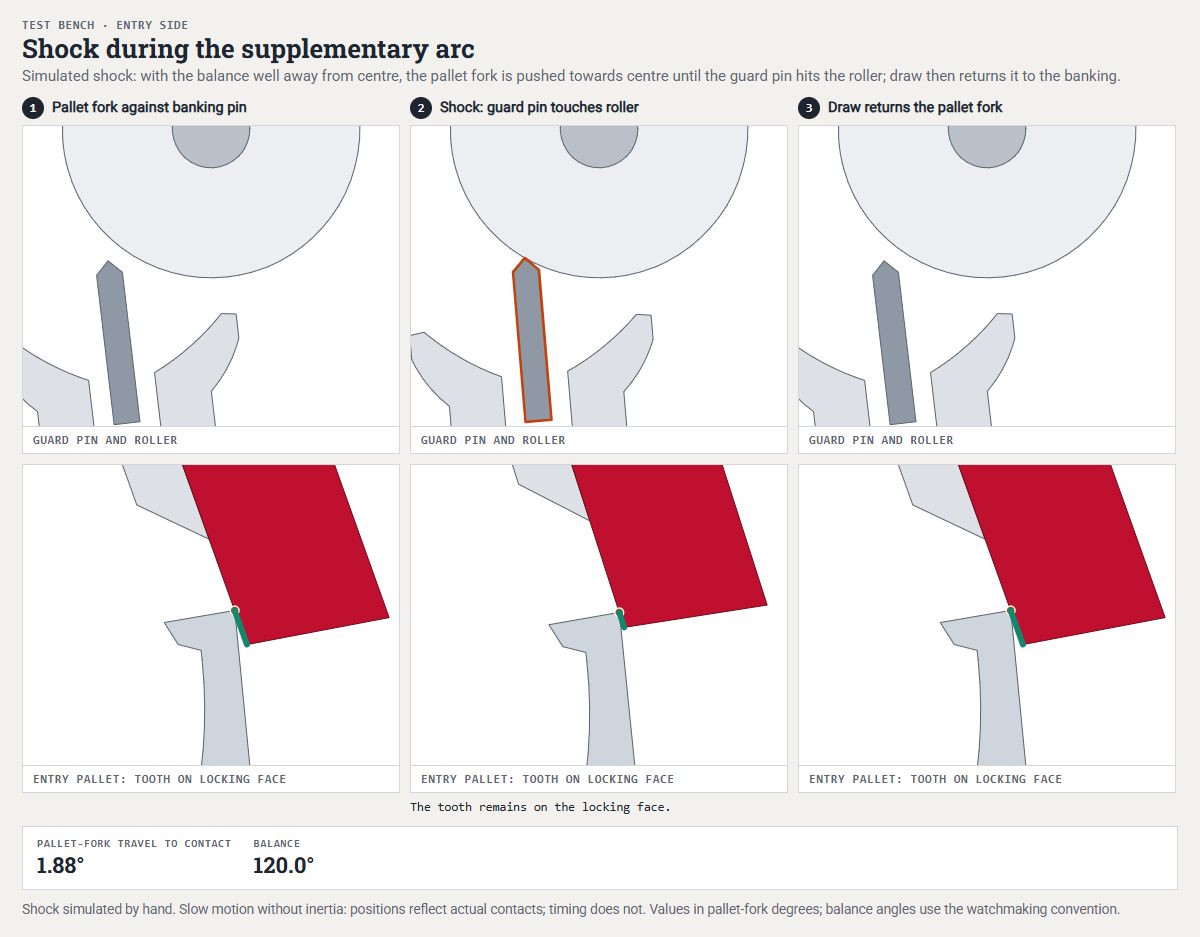
Escapement checks performed on the model: jewel pin freedom, total lock, draw test, fork horn clearance, guard pin clearance, instant of drop and more.
1.3 Lever escapement in 3D
Balance, pallet fork and escape wheel based on the simulator: choose views, set the amplitude and examine the movement frame by frame.
1.4 The five phases
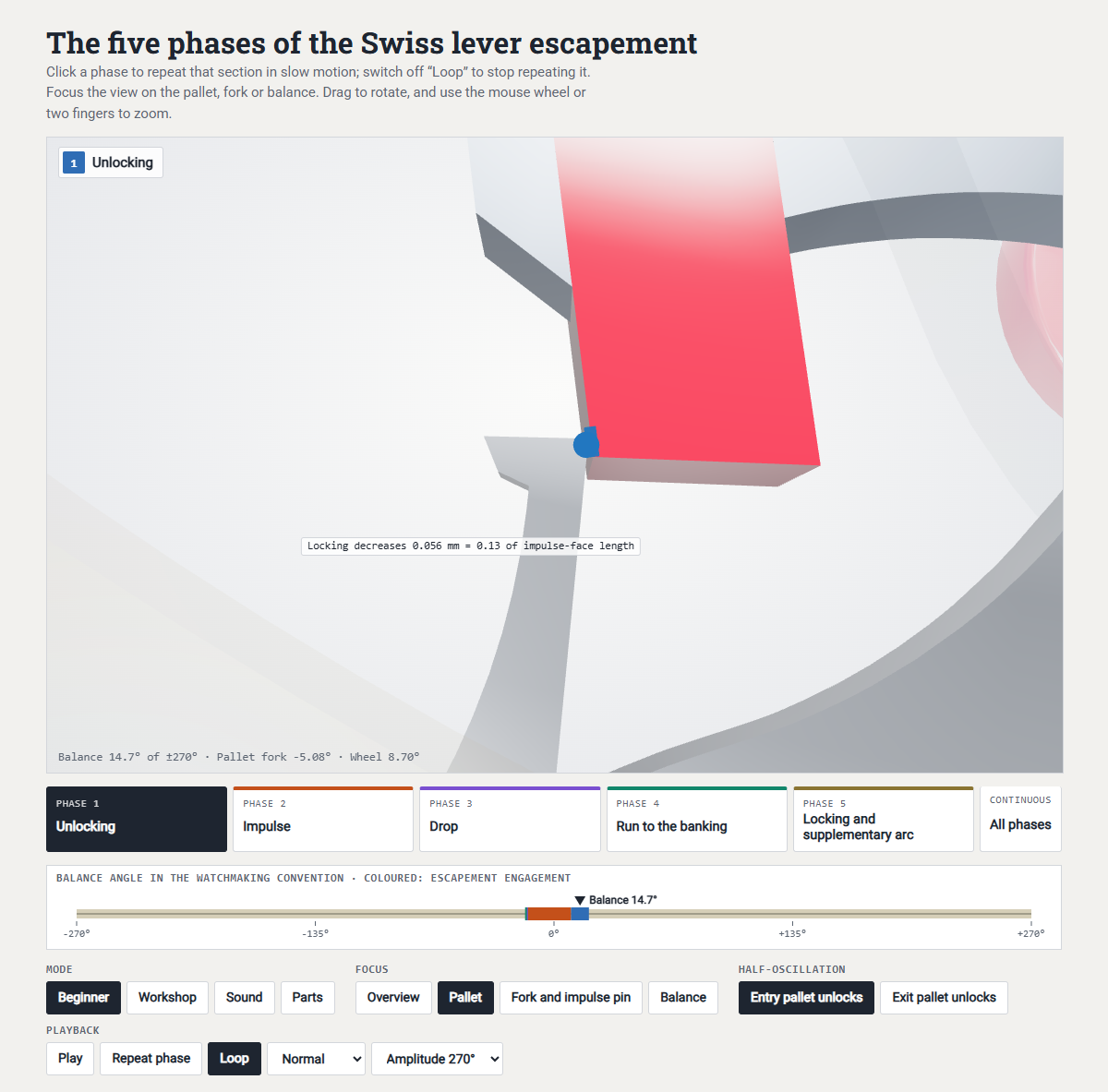
Unlocking, impulse, drop, run to the banking, lock and supplementary arc, with views of the pallet, fork and balance.
1.5 Balance amplitude
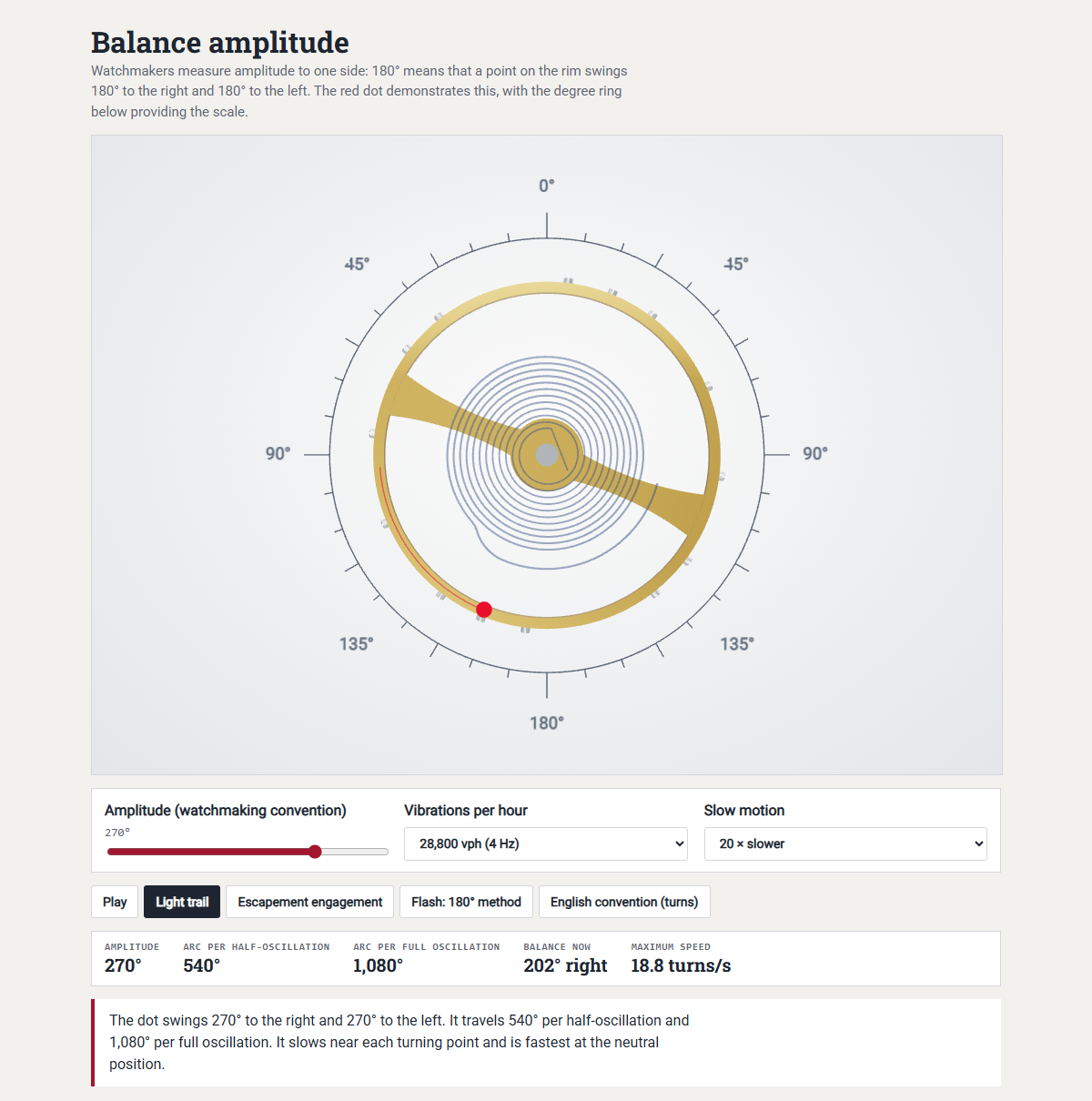
How watchmakers count amplitude: a balance with a degree scale and reference marker, together with the 180° method for checking the lift angle.
1.6 Fault atlas
Escapement faults demonstrated in the model, arranged by symptom, component or phase, with the correct condition for comparison.
2 Power source
2.1 Calculating a mainspring when the original is missing
If the mainspring is missing or broken, we need its width, thickness and length to order a replacement. The thickness follows two rules of thumb from the literature: the arbor radius should be 10 to 14 times the spring thickness, and the thickness should be between one hundredth and one seventieth of the barrel diameter. The ideal length fills half the available area inside the barrel, giving the greatest number of barrel turns. The original spring or the manufacturer's specification always takes precedence.
Calculation and assumptions
- The recommendation is the midpoint of the overlap between the two rules of thumb, rounded to 0.005 mm. If the arbor dimension is not given, arbor Ø = barrel Ø / 3.
- Young's modulus 200,000 N/mm²; allowable bending stress 1,800 N/mm². Torque after 24 hours is taken as 80% of maximum torque.
2.2 Checking and shortening an available mainspring
For clocks, we often shorten an available spring to the required length, or check whether a catalogue spring is an exact fit. The deciding quantity is the fill factor: the proportion of the available area inside the barrel occupied by the spring. In practice, 50 to 53% is used. A longer spring gives fewer barrel turns, so we shorten it.
Calculation and assumptions
- The number of turns is calculated from the unwound spring against the barrel wall and the wound spring around the arbor, ignoring friction and hooks. In practice, around 15% is added to the required number of winding turns to allow for friction.
- Young's modulus 200,000 N/mm²; allowable bending stress 1,800 N/mm².
3 Going train
3.1 Beat rate from tooth counts
If the beat rate is unknown, we count the wheel teeth and pinion leaves. We start with a wheel whose rotational speed is known, usually the centre wheel. If the movement has no true centre wheel, we use the fourth wheel or another wheel with a known speed. If there is no third wheel, leave a row blank. If the seconds hand is mounted directly on the escape wheel, its tooth count alone is enough. Each escape-wheel tooth gives two vibrations.
Calculation
- Blank rows are skipped. Each wheel-and-pinion pair increases the speed by the ratio of wheel teeth to pinion leaves.
4 Oscillator
4.1 Balance: beat error in degrees
The timegrapher shows beat error in milliseconds; on the movement, we adjust it in degrees. On pocket watches, we turn the collet on the balance staff. With a movable stud carrier, we turn the carrier together with the stud. The calculator gives the angle and, if the balance diameter is entered, the corresponding distance at the balance rim.
Turn through the full calculated angle, not half of it. The beat error displayed by the timegrapher is already half the difference between tick and tock, directly giving the displacement of the rest position from the centre of the escapement. If an instrument displays the full difference, halve its reading before entering it. A start-up test or a small initial adjustment shows the required direction.
Calculation
- Linear approximation for small beat errors. At normal values, the exact form including the unlocking angle differs by less than 1%.
4.2 Pendulum: adjusting the rating nut
We usually do not know a clock's beat rate. For regulation, the approximate pendulum length is enough, measured from the bending point of the suspension spring to roughly the centre of the bob. If the estimate is 10% out, the result is also only 10% out. If the clock gains, lower the bob; if it loses, raise it.
The calculation is idealised and assumes a simple pendulum. The empirical factor of 2.25 rather than 2 allows for the fact that only the bob moves during adjustment, while the rod also oscillates. This is itself an average drawn from practical experience. We measure again after making the adjustment.
Calculation
- Δl = L · (1 − ((86,400 + rate) / 86,400)²); bob travel = Δl · 2.25 / 2 with the empirical factor. Threads to DIN 13, estimated from the measured outside diameter, with coarse and fine pitches. Pendulum length from beat rate using g = 9.81 m/s².
5 Rate checking
5.1 Daily rate from time error
To check the rate over several days, we set the watch or clock to a time signal and later read off the deviation. A gain is positive; a loss is negative.
Calculation
5.2 Timegrapher for pendulum clocks
Rate and beat error of pendulum clocks measured through a microphone, with a suggested beat rate and a rating-nut calculator. It listens through the phone's microphone or any connected microphone, such as a lapel microphone on a computer. We are also testing a pickup of the type used on electric guitars.
6 Other tools
6.1 Lignes and millimetres
Movement sizes are given in lignes, written '''. One ligne measures 2.256 mm. The calculator converts in both directions.
6.2 Dew point at the crystal
If the inside of the crystal fogs up, the crystal is colder than the dew point of the air inside the case. The calculator shows the crystal temperature at which water starts to condense.
Calculation
- Magnus formula over water with a = 17.62 and b = 243.12 °C, commonly used from about −45 to +60 °C.
6.3 Amplitude from lift time
The timegrapher measures lift time and calculates the amplitude using the selected lift angle.
Calculation
- Applies to a lever escapement with the lift angle symmetrical about the dead point and approximately harmonic motion. We check the lift angle using the 180° method in the Balance amplitude model.