Master watchmaker course – Cutting speed
As a specialist lecturer at the Hessian School of Watchmaking, I teach on the master watchmaker course. A master watchmaker must be able to pass on all the knowledge covered in vocational training and possess still deeper knowledge in many fields.
Here I publish some of the material taught on the course.
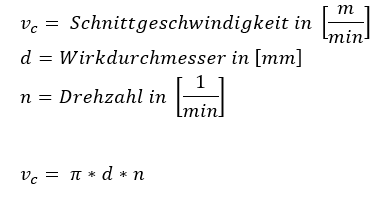
Definition
For turning, milling and drilling
Cutting speed is the speed at which the active cutting edge of the tool moves through the workpiece.
Since cutting speed is conventionally expressed in metres per minute, we generally add a further factor to the cutting-speed expression for rotary machining (turning, milling and drilling).
This is intended to simplify cancellation when using the equation in practical calculations.
Since the added factor cancels out completely, this does not change the equation:

Why is it important?
The definition of cutting speed allows an ideal rotational-speed range to be determined for machining. The machinist then knows which speed to set on the machine to maximise surface quality and minimise tool wear.
Practical tests have produced tables that specify the ideal cutting speed for different workpiece materials with particular cutting tools.
In practice, ideal rotational speeds are sometimes given directly. For example, many drilling machines have a speed table based on drill diameter, usually with several columns for different materials.
Speed tables become too large and unwieldy if they are to cover every tool (especially for milling), material (thousands of alloys) and diameter. Instead, only the ideal cutting speed for a tool according to the material is given*. The machinist can then calculate the ideal rotational speed:
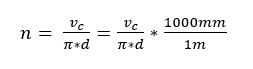
*Other machining parameters, such as feed and depth of cut, also play a major role. When drilling, the ideal cutting speed in the table therefore does not apply if we pull on the lever with all our strength or use only a minimal feed.
Likewise, when turning with very large depths of cut or very high feed rates, the cutting speed in the table may no longer apply and must be adjusted if necessary.
Significance in industry and one-off production
In industry, cutting speed is crucial to the efficiency and quality of machining processes such as turning, milling and drilling. It directly affects tool life, surface quality and productivity. An optimally chosen cutting speed minimises tool wear, prevents excessive heat generation and ensures precise machining. It also affects machining costs and duration, since a cutting speed that is too high or too low can impair tool performance and the quality of the finished work.
In series production , observing the correct cutting speed plays a greater role than in one-off production. In series production, choosing the correct cutting speed makes a large difference to cost, as it directly affects machining time, tool consumption and surface quality, whereas in one-off production we have more latitude: as long as we achieve good surface quality and the tool does not break, we do not need to calculate every cut exactly. As watchmakers, we regularly draw on practical experience instead.
Where can I find cutting-speed information?
There are many sources of guidance on cutting speeds, for example:
- Technical data sheets from manufacturers of turning tools or milling cutters
- Specialist literature such as „Fachkunde Metall“ or „Zerspanungstechnik“
- Standards for machining processes
- Data supplied by CNC manufacturing software
- Machine manufacturers' instructions
- Tables on plates attached directly to machines
- Forums, online articles and videos
- Trade journals and technical articles
Relationships
Higher cutting speeds:
- Soft or easily machined materials
- For watchmakers: brass
- Carbide cutting tools
- Finishing for high surface quality, typically combined with a small depth of cut
- When using cutting fluids
Lower cutting speeds:
- Hard or difficult-to-machine materials
- HSS tools (high-speed steel)
- Roughing (coarse machining)
- Delicate machines or workpieces
- Bearings and vibration behaviour of the watchmaker's lathe
- Small workpieces and arbors are the norm in watchmaking
- Dry machining (without cutting fluid)
Materials in watchmaking
Cutting speed with HSS tools
- „Silver steel“ 1.2210 or 115CrV3, unhardened: cutting speed vc ≈ 20 to 30 m/min depending on lubrication, tool, machines, workpieces, etc.
- Brass Ms58 or CuZn39Pb3: cutting speed vc ≈ 60 to 120 m/min
- Sandvik 20AP Cutting speed, unhardened vc ≈ 25 to 30 m/min
- Blue-tempered hardened steel (115CrV3 or comparable alloy steels) vc ≈ 8 to 15 m/min
Cutting speed with carbide tools
- „Silver steel“ 1.2210 or 115CrV3, unhardened: cutting speed vc ≈ 50 to 70 m/min depending on lubrication, tool, machines, workpieces, etc.
- Brass Ms58 or CuZn39Pb3: cutting speed vc ≈ 160 to 400 m/min
- Sandvik 20AP Cutting speed, unhardened vc ≈ 50 to 70 m/min
- Blue-tempered hardened steel (115CrV3 or comparable alloy steels) vc ≈ 25 to 40 m/min
Even when cutting speed is not followed exactly, some rules of thumb can be drawn from the recommendations.
- Brass is generally turned at three times the cutting speed used for steel
- When using carbide tools, double the cutting speed (the highest values apply to indexable inserts, higher still than for carbide turning tools)
- Blue-tempered hardened steel is generally turned at one third of the cutting speed used for normal steel. Because torque is low at very slow rotational speeds on the watchmaker's lathe, we regularly reduce the depth of cut and feed rate instead.
Note
In certain situations, cutting speeds can differ greatly, for example during finishing with a small depth of cut. In fine finishing, some of the stated values can be doubled. Common sense is needed for the particular situation; ultimately, the result is what counts!
Summary for drilling, turning and milling
Because we work on one-off pieces, frequently small workpieces, delicate machines (vibration), dry machining and mostly HSS tools, we watchmakers should generally stay below, or start below, general cutting-speed recommendations. We increase the cutting speed only when difficulties arise (usually by increasing rotational speed).
Exceptions include very small holes, very small depths of cut or very small workpieces, where we make full use of our machines' rotational-speed capacity within the bounds of common sense.
For holes below 0.3 mm or when turning pivots of 0.1 mm to 0.3 mm, we usually calculate rotational speeds far above our machines' maximum possible speeds. Feed and depth of cut should then be reduced. Some examples can be found further down under „Calculations and examples“.
Cutting speeds in other applications
Cutting speed can also be specified for filing, planing or sawing. In the equation, π*d is then replaced by 2*L, where L = workpiece length.
Calculations and examples
Exercise: what cutting speeds result from the following examples?
Drilling holes of 1 mm, 3 mm and 8 mm in 2 mm brass sheet
Drilling holes of 1 mm, 3 mm and 8 mm in 2 mm steel sheet
Turning a balance staff from blue-tempered hardened steel using HSS
Turning a winding stem from silver steel
Turning a 2 mm brass pillar for a pocket watch
Turning a 50 mm brass barrel
Turning a 3 mm and 6 mm arbor from Sandvik AP20
Drilling a 0.2 mm pivot hole: comparison between hardened and tempered material
Filing a brass workpiece 50 mm long