
My path to watchmaking
My fascination with watches and clocks has been with me since childhood. My father awakened it in me. Nevertheless, my path initially took me to Mainz University to study atmospheric physics. I enjoyed learning, while becoming increasingly certain that I wanted to become a watchmaker.
I chose watchmaking and moved to Pforzheim to learn the craft at the N.G. Hayek Watchmaking School. There, I found the combination of theoretical mechanics and fine handwork I had been looking for. My first table clock was made in my first year of training. In my third year, I worked on designing and building a flying tourbillon.
I completed my training as the German national watchmaking champion (2012). Alongside the German journeyman qualification, I earned the WOSTEP certificate. Work at Omega, my own workshop and the master watchmaker qualification followed. The desire to build my own watches and pass on knowledge has remained an integral part of my work ever since.
Milestones
- 1983: Born; grew up in Oppenheim.
- 2003: Completed secondary school. Military service with the paratroopers, followed by studies in atmospheric physics in Mainz.
- 2012: Completed watchmaking training at the N.G. Hayek Watchmaking School in Pforzheim; German national watchmaking champion (2012) and WOSTEP graduate. First handmade flying tourbillon.
- Further early career experience: An internship in prototype manufacture at Glashütte Original and work in Omega’s chronograph department.
- 2014: Opened my own workshop in Oppenheim on 1 February.
- 2015: Completed master watchmaker training at the Hessian Watchmaking School; master watchmaker since October.
- Teaching and the next generation: Technical watchmaking teaching on the master course at the Hessian Watchmaking School and apprenticeship training in my own workshop.
- Since 2023: Chairman of the support association of the Hessian Watchmaking School.
- 2025: Yannik Weber, who trained in my workshop, is awarded third place in the national watchmaking championship.
- 2025–2026: Expansion of in-house production into a manufacture. Since summer 2026, watch components have been made on the Primacon PFM 24 NGD in my workshop.
What shaped me
Training in Pforzheim
At the N.G. Hayek Watchmaking School, I learned the foundations on which my work still rests. Alongside repairing mechanical watches, training included chronographs, making balance springs and turning the finest watch components. The additional WOSTEP qualification deepened the standards required for work on high-quality mechanical watches.
I am very grateful to the school for this foundation. It gave me the practical and theoretical tools to attempt designs of my own.
View qualifications and certificates
Prototype manufacture and chronographs
An internship in prototype manufacture at Glashütte Original was among my earliest experiences in watch production. After training, I worked in Omega’s chronograph department, repairing chronographs of different ages and other Omega calibres.
Working on these movements further deepened my interest in chronographs. I encounter their mechanisms today in repairs, restorations and ideas for my own designs.
My own workshop in Oppenheim
On 1 February 2014, I opened my workshop in my home town of Oppenheim. From the outset, the focus was on repairing watches and clocks. With the tasks, the workshop, its equipment and the possibilities for making damaged or missing parts ourselves grew.
Complex repairs and restorations are a continual education: they reveal which designs prove themselves, where wear develops and what a replacement part must achieve. These experiences also inform my own watches.
Selected work
My first tourbillon – 2012
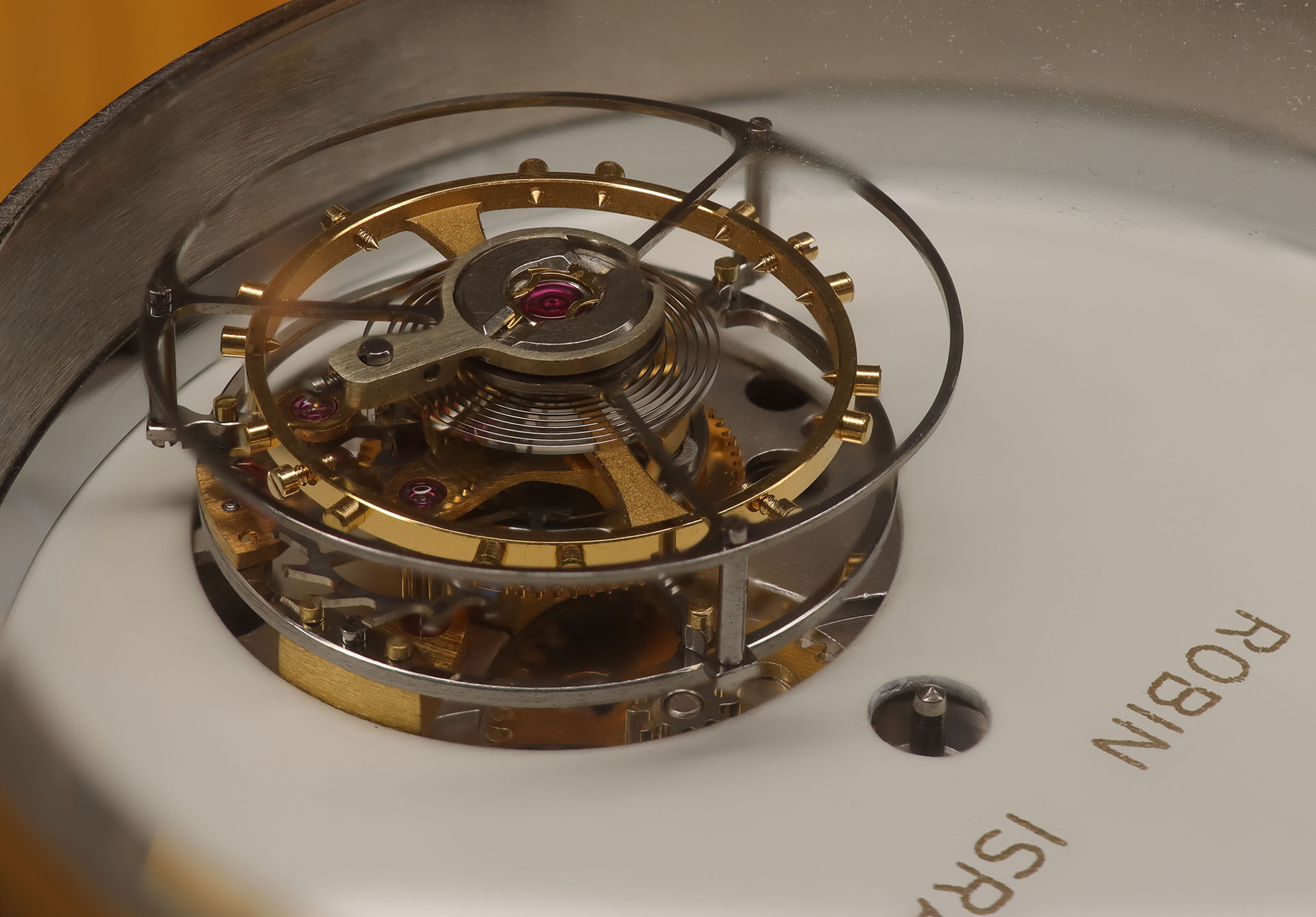
My first flying tourbillon was made in 2012. Designing and making it by hand presented a challenge whose outcome was by no means certain at the start. Many small components had to be made individually and coordinated until a functioning mechanism finally emerged.
This project shaped my subsequent path. Ever since, I have wanted to build complicated watches of my own. I documented the process in an extensive article.
Repair and restoration

One focus of my work is mechanical watches in which experience, fault-finding and the making of individual parts come together. This includes chronographs as well as extensive restorations, such as work on an Invicta minute repeater with chronograph.
In my workshop reports, I show the path through such work, from the opened movement and individual stages of work to the underlying technical relationships. The reports provide an insight into what lies behind a completed repair.
The path to my own manufacture
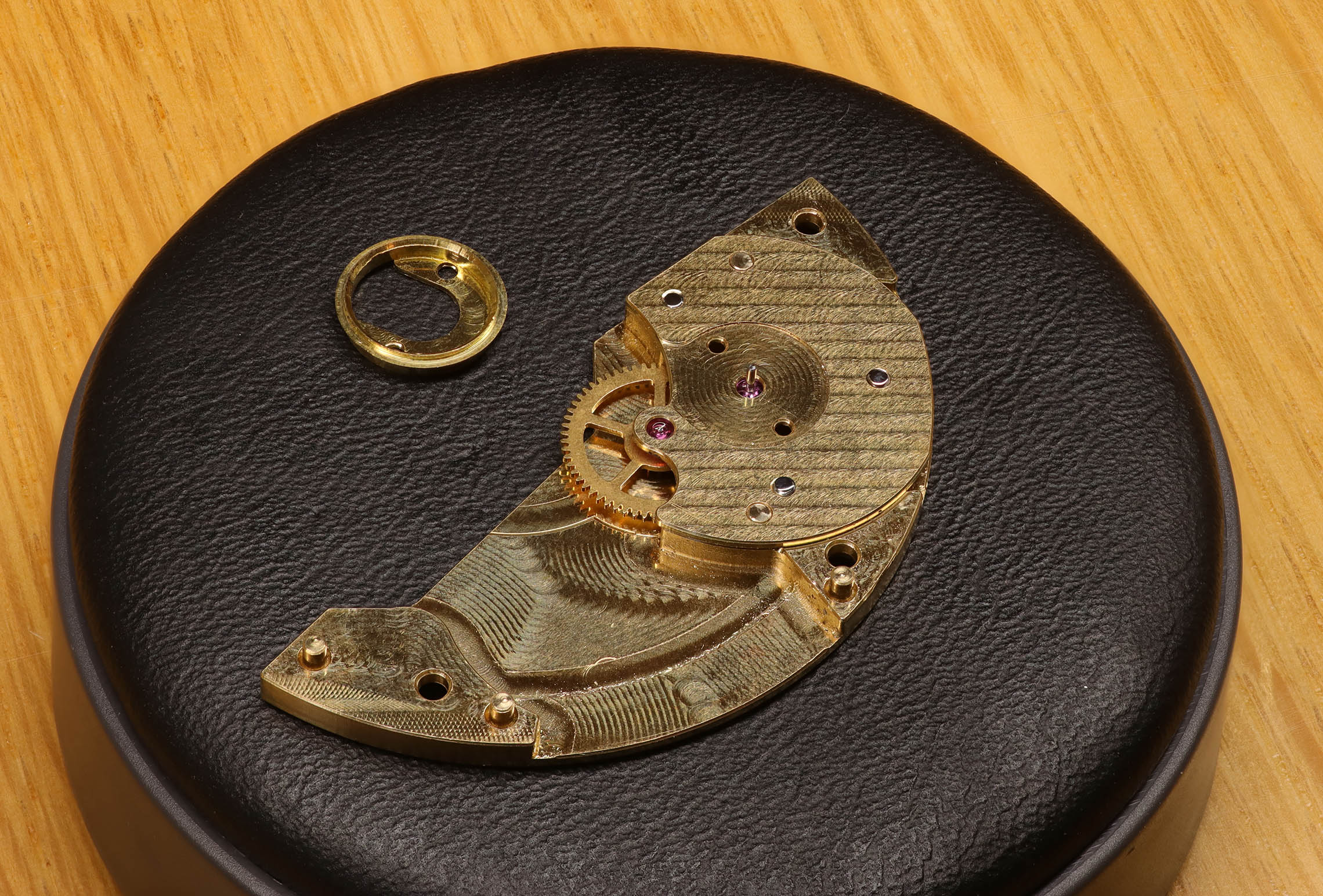
Building my own watches also meant creating the capability to manufacture their components. For years, I worked on design, CNC machining, machines and suppliers. Eventually, I found a Primacon PFM 24 NGD suited to my workshop’s requirements.
Bringing the machine into the workshop was a project of its own: over a tonne in weight, narrow passages and a transport operation that at times came down to centimetres. This was followed by modifications, a new compressed-air supply and learning the Heidenhain control. Since summer 2026, I have used it to manufacture high-precision watch components.
My own watches begin with the Vision Tourbillon as a limited Founders Edition. It builds on my first tourbillon from 2012. Further designs and ideas develop from this.
Passing on knowledge
Master school and training
In 2015, I completed my master watchmaker training at the Hessian Watchmaking School. I remained connected to the school afterwards: as a lecturer in technical watchmaking on the master course and, since 2023, as chairman of its support association.
Training is also part of my own workshop. Yannik Weber, who trained here, was awarded third place in the national watchmaking championship in 2025. You can find the corresponding certificate among our qualifications.
I want the knowledge and skills of our craft to be preserved and passed on. This requires people who learn, ask questions, try things for themselves and later train others in turn. I want my work to contribute to that.
Technical articles and insights
In my blog, I document repairs, restorations and my own projects. Some articles lead step by step through a job; others explore a movement or a technical detail in depth.
The articles are for watch enthusiasts and colleagues who want to look more closely. Photographs and explanations aim to make clear what happens inside a watch and what work its preservation requires.
Contact
Do you have a question about a watch or clock, an interest in a project of your own, or a wish to discuss technical matters? Please write to me. For repair enquiries, a brief description of the timepiece and your request is helpful; you can attach any photographs to your email.
Robin Israel
Master watchmaker · R.I.O. Watchmaking Workshop
Mainzer Str. 46
55276 Oppenheim
Personal contact and manufacture
robin.israel@uhrenkunde.de
Workshop and repairs
werkstatt@uhrenkunde.de
06133 9382998
WhatsApp 01579 2316708
You are welcome to share this page:
The future of our craft
I see traditional watchmaking in great danger, along with the whole profession and the knowledge of its classical methods. At the same time, it becomes impossible to protect the cultural heritage embodied by many watches and clocks if there are no qualified repairers left. There are only a few good watchmaking workshops remaining, and some colleagues are approaching retirement or looking for better-paid occupations. In recent years, a great many workshops among my acquaintances have closed. If too much of the foundation disappears, watchmaking will suffer irreversible damage and the traditional watchmaking workshop will die out.
The current wave of closures in watchmaking has many causes. Alongside the increasing difficulty of obtaining spare parts, due to the expensive certification required by most manufacturers, spare-part prices and overheads have generally risen so far that economically viable repairs are not easy. Many watchmakers actually live from watch sales and use these to finance their workshops. Little wonder that “it isn’t worth repairing” is heard so often.
In a one-person business, motivation for repairs declines, and the quality and range of repair work deteriorate badly; or the watchmaker closes. Jewellers working with this cross-subsidy calculation will pass only poor salaries on to the workshop and can often retain only unqualified or unmotivated watchmakers.
The other side is the continued existence of low-cost workshops offering miserable quality at an even worse value for money. This endangers the reputation of the whole industry and also severely damages the underlying substance of many watches and clocks.
Finally, demographics are also a major problem for watchmaking. In 2022, around 600 watchmakers retired, while only around 100 new journeymen qualified through the German chambers of industry and commerce and chambers of skilled crafts. By 2032, the number of watchmakers in Germany will have approximately halved.
Watchmaking needs to enter the present day: without an absolutely structured way of working and consistently good quality, a stable position in the market cannot be secured. Today’s administrative requirements are enormous, and the cost of machines and equipment for a modern watchmaking workshop is so high that using them alone becomes uneconomical.
The era of working alone seems to be over. A solution must be found to bring traditional watchmaking into the future … How I pass on knowledge