Regulating the rate of clocks
If a wall, longcase or table clock gains or loses a few minutes, this is no reason to take it straight in for repair. The rate can normally be adjusted at the bottom of the pendulum.
First, however, establish the ideal conditions (see below). Once the clock stands straight and its "tick-tock" sounds even (the clock is not out of beat), you can begin regulating it. (If it remains out of beat, please contact me briefly.)
Alternating gains and losses between windings cannot be adjusted away, nor can a clock gaining time for a few days and then losing time for a few days, so that it shows the correct time again at each winding. A clock is always regulated to gain or lose as little as possible over a fixed period (for example, seven days).
Measure the time error over a week
Always wind the clock at the same interval (for example, every Sunday) and set the time accurately. Establish how much it gains or loses and note this "time error" (for example, "five minutes fast over seven days"). Naturally, you must let the clock run for exactly one week before checking the error.
Adjust the pendulum nut
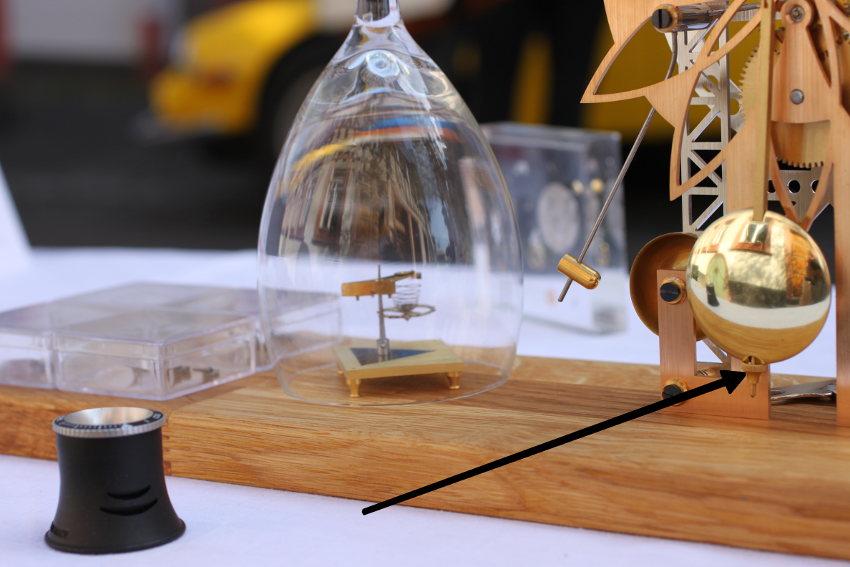
If the clock is fast, this can be reduced by "unscrewing" or "lowering" the small nut at the bottom of the pendulum (see photograph). The easiest way to determine how far to lower it is by trial. Turn the nut one full turn, then at the next winding establish by how many minutes that turn has changed the rate.
For example, if the clock gains five minutes a week and lowering the pendulum nut by one turn means that it gains only three minutes after a week, you now know that one turn changes the rate by two minutes. In this example, turn the nut another one and a half turns in the same direction to get as close as possible to the correct rate.
If the clock loses time, the same procedure can improve it, except that you turn the nut "upwards" (raising the pendulum bob).
Conditions for a consistent rate
- Always wind the clock on the same schedule, for example every Sunday morning.
- Good stability: a longcase clock stands best on a smooth tiled floor. A clock should not wobble or vibrate when you walk past it.
- Even temperature: a clock in an entrance area or an unevenly heated room will not run as consistently as one kept at a constant temperature. If a clock in a hallway is always about 10°C colder in winter than in summer, it will also gain more time in winter.
- Avoid moving the clock: every pendulum clock responds strongly to very small changes in position. Moving it, or turning it back and forth for dusting, can quickly change the rate by several minutes per week. It can, however, be regulated again in its new position using the instructions above. This is also why a watchmaker cannot complete the final regulation perfectly in the workshop: after transport, the clock can never be positioned in precisely the same way.
- The clock should stand as straight as possible, without leaning in any direction. If it stands straight but still ticks very unevenly (as if limping), transport or excessive movement has disturbed the pendulum’s beat setting. This can easily be readjusted at your premises, but it should be done by a watchmaker.
For instructions on setting up and starting a serviced wall or longcase clock, see the Setting-up instructions.