Technical terms
Some technical terms explained, from the old www.uhrenkunde.de website. More detailed descriptions of individual subjects will follow in separate blog articles.
Oscillator
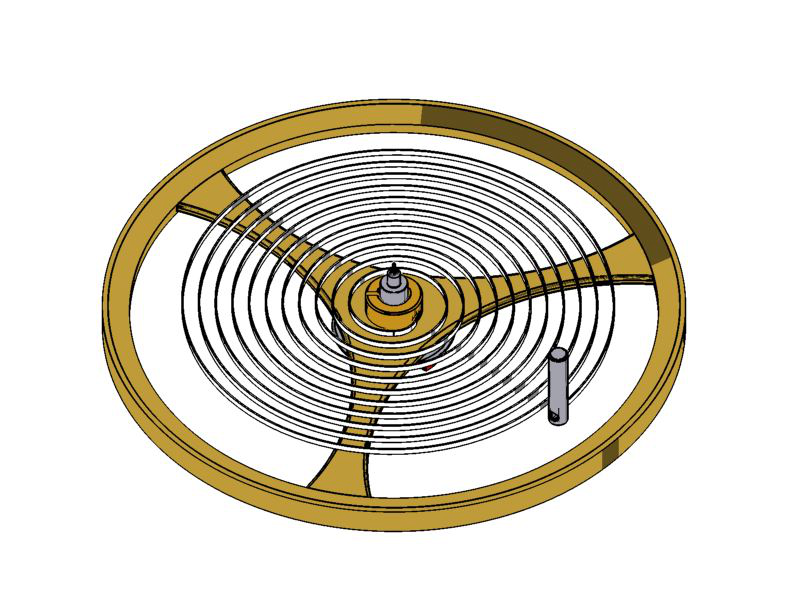
A clock or watch’s oscillator is the component of a movement capable of oscillating, which can maintain as constant an oscillation as possible through a continuous supply of energy from the energy store.
In a typical small mechanical timepiece, this component is called the "balance"; in clocks it is the pendulum, and in modern electronic watches the quartz crystal.
As its name suggests, the oscillator regulates the rate of the timepiece (the speed at which the wheel train runs), because the movement is designed to run in a fixed relationship to the oscillator’s frequency , allowing the time to be displayed through a suitable gear ratio to the hands.
Beat rate of the oscillator
The beat rate of a movement indicates how many oscillations its oscillator completes within a given time.
For small mechanical timepieces, the number of vibrations per hour is often given as the beat rate; 18,000 vibrations per hour is a common value. The reason for this scientifically outdated way of expressing oscillation is the clearly audible ticking of a mechanical timepiece, since the most widely used escapements in watches and clocks make one "tick" per half-oscillation. This makes the term easy to understand, with a direct connection to the audible ticking.
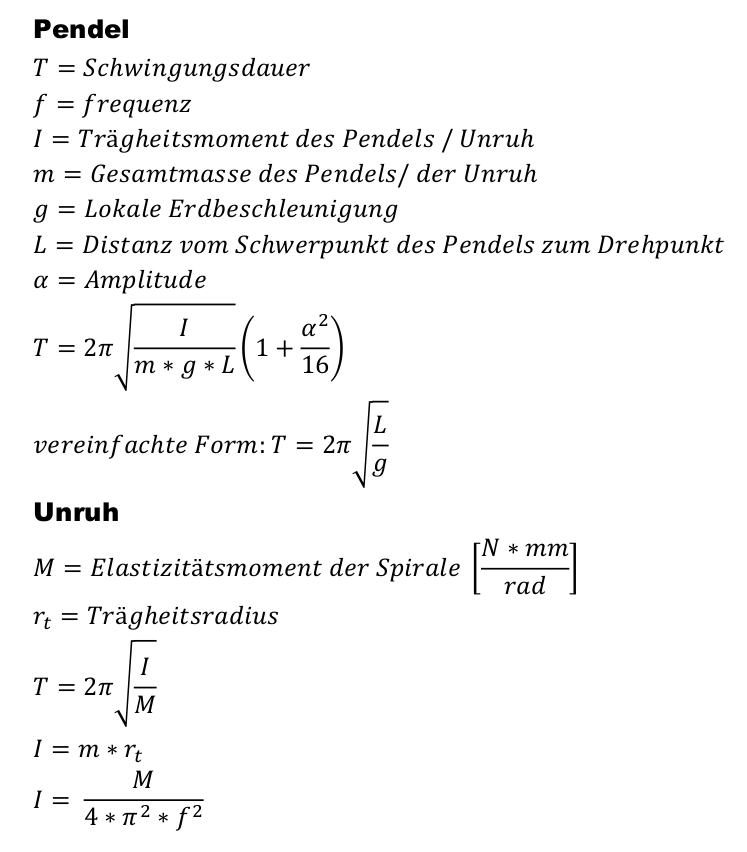
Because the amplitude is small, the formula for calculating pendulum oscillations is usually applied in a simplified form, omitting one term of the equation and making the calculation simpler.
Escapements
An "escapement" is the assembly in a clock or watch that allows the wheel train to run in steps or continuously. The escapement interacts closely with the oscillator and transfers the energy of the wheel train to it.
There are many different escapements for clocks and watches.

The Swiss lever escapement
Characteristics:
- Detached escapement
- One driving impulse per half-oscillation of the oscillator
- Has safety features to protect against shocks and is therefore suitable for wristwatches
- Cannot gallop
- Starts very easily after stopping
- With the typical steel–ruby material pairing, requires lubricant for correct operation and to prevent wear
- Low wear when the prescribed service intervals are observed
- Few components and therefore a lower probability of failure
- Few components and therefore moderate manufacturing costs
- Good rate performance relative to manufacturing effort (good cost–benefit ratio)
Description:
Today, the Swiss lever escapement is the small-timepiece escapement par excellence. It prevailed over many other escapements because it offered very good rate performance and high reliability relative to manufacturing costs.
The escapement consists of the escape wheel, mounted on its pinion, and the lever. A detailed examination of its operation must also include the double roller on the balance and the banking that limits the lever’s travel (banking pins or fixed banking).
The operation of different escapements is demonstrated in the interactive animations of escapements and movement mechanisms.