Epilame
An oil drop placed correctly during a service should stay there for years. This does not happen on its own: on clean steel, brass and ruby, watch oil spreads out and creeps away. Epilame prevents this. With good epilame treatment, an oil drop remains in place for decades.
An epilame is an extremely thin layer on a component that prevents oil and grease from spreading. The name comes from Greek and means “little skin”. Treating the parts is called epilame treatment. Epilame is not a lubricant: it changes the surface, not the oil.
Incidentally, the idea is almost a hundred years old: Woog presented the first epilame in 1925, based on stearic acid. Fluorinated epilames have been used since the 1970s. Their solvents had to be replaced after the CFC ban in the 1990s; today they are dissolved in fluorinated solvents that do not attack the ozone layer.
Why oil spreads
Oil spreads over any surface whose surface energy is higher than its own surface tension. Watch oils are around 30 mN/m, while clean steel, brass and ruby are far higher. On freshly cleaned parts, a drop therefore spreads out until only an extremely thin film remains. Grooves and roughness accelerate this because they act like tiny channels. The lubrication point then lacks oil, although the oil is still inside the movement.
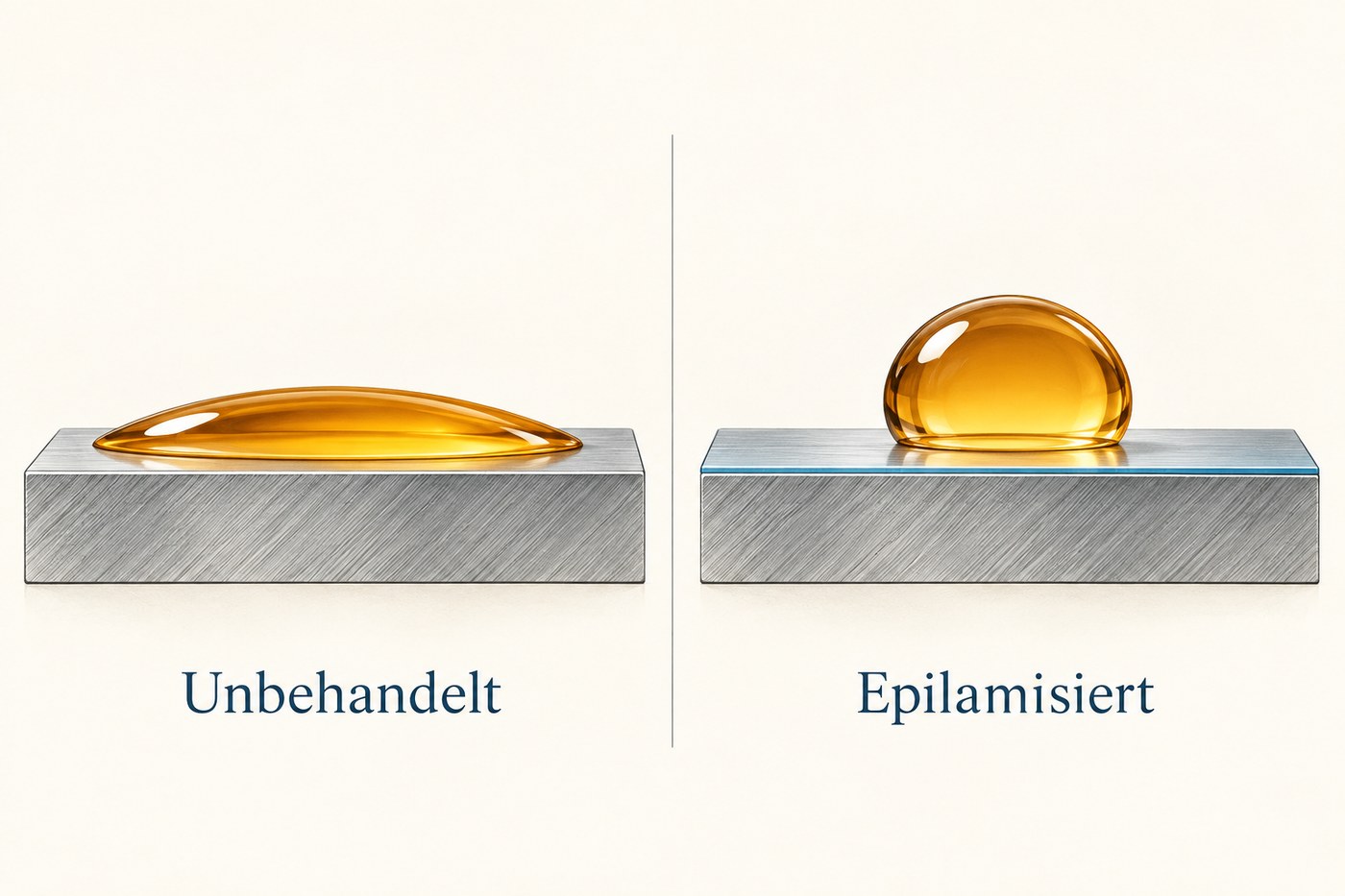
The underlying physics, including contact angle, capillarity and equations, is explained in the article Lubricants in watches.
What epilame does
Epilames consist of fluorinated polymers, chemically related to the non-stick coating of a frying pan. They lower the component's surface energy to around 20 mN/m. A watch oil with 30 mN/m can no longer spread on it and remains as a drop, with a contact angle of 55° or more.
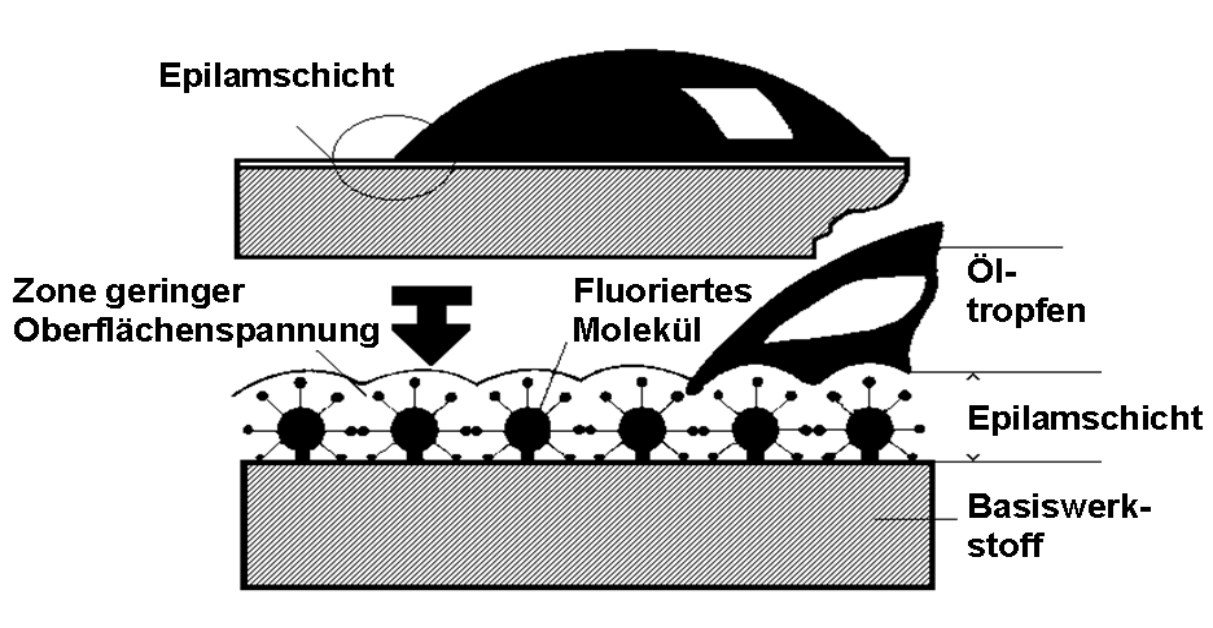
The layer is only a few nanometres thick: Tillwich specifies 10 to 40 nm, while Moebius gives 3 to 5 nm for Fixodrop ES/BS. It therefore does not alter fits or bearing clearance. The bath itself contains only 0.01 to 0.05% active ingredient; the remainder is solvent. Modern cleaning and rinsing solutions themselves leave a beneficial layer.
Application in the workshop
Epilame treatment follows cleaning and precedes oiling. The parts must be clean and dry, because the epilame should coat the metal rather than a film of dirt. The bath must also remain clean; a fibre carried into it will later become an oil bridge. Immersion is usual, spraying less common. Concentration and solvent vary by product: Tillwich's Antispread E2/50, for example, is four times as concentrated as E2/200.
For Fixodrop ES/BS, Moebius specifies at least 30 seconds of immersion with gentle movement, followed immediately by drying, preferably with warm air at around 60 °C. These instructions apply to this product, but are also a useful guide for applying other epilames. Epilame concentrates are adjusted only with the specified solvent. The bath should be closed promptly after use so that evaporation does not alter its composition uncontrollably.
There are substantial differences in evaporation rates: Episurf Neo epilame, for example, evaporates considerably more slowly and can therefore be considerably less expensive to use.
Above approximately 65% humidity, the solvent dries more slowly and leaves spots. Warm air lowers the relative humidity and thereby prevents spotting.
Which parts are treated also depends on the design and the required paths of the oil. In our workshop, the movement undergoes extensive epilame treatment with a few specific exceptions. According to most manufacturers' recommendations, the hairspring, regulator pins, automatic-rotor ball bearings and the shock-setting housing with its hole jewel should not be treated.
Take care with plastic parts, however: some epilames and solvents are unsuitable for them. The Lemania 5100 with its plastic components is a well-known example.
The special case of the escapement
On a pallet jewel, the escape-wheel tooth slides over a tiny impulse face. The oil should stay there rather than spread over the whole jewel. The solution is a short dry run: the tooth wears the epilame off its running track, while the surrounding layer remains intact. The oil moves into the bare track and is confined there by the epilame.
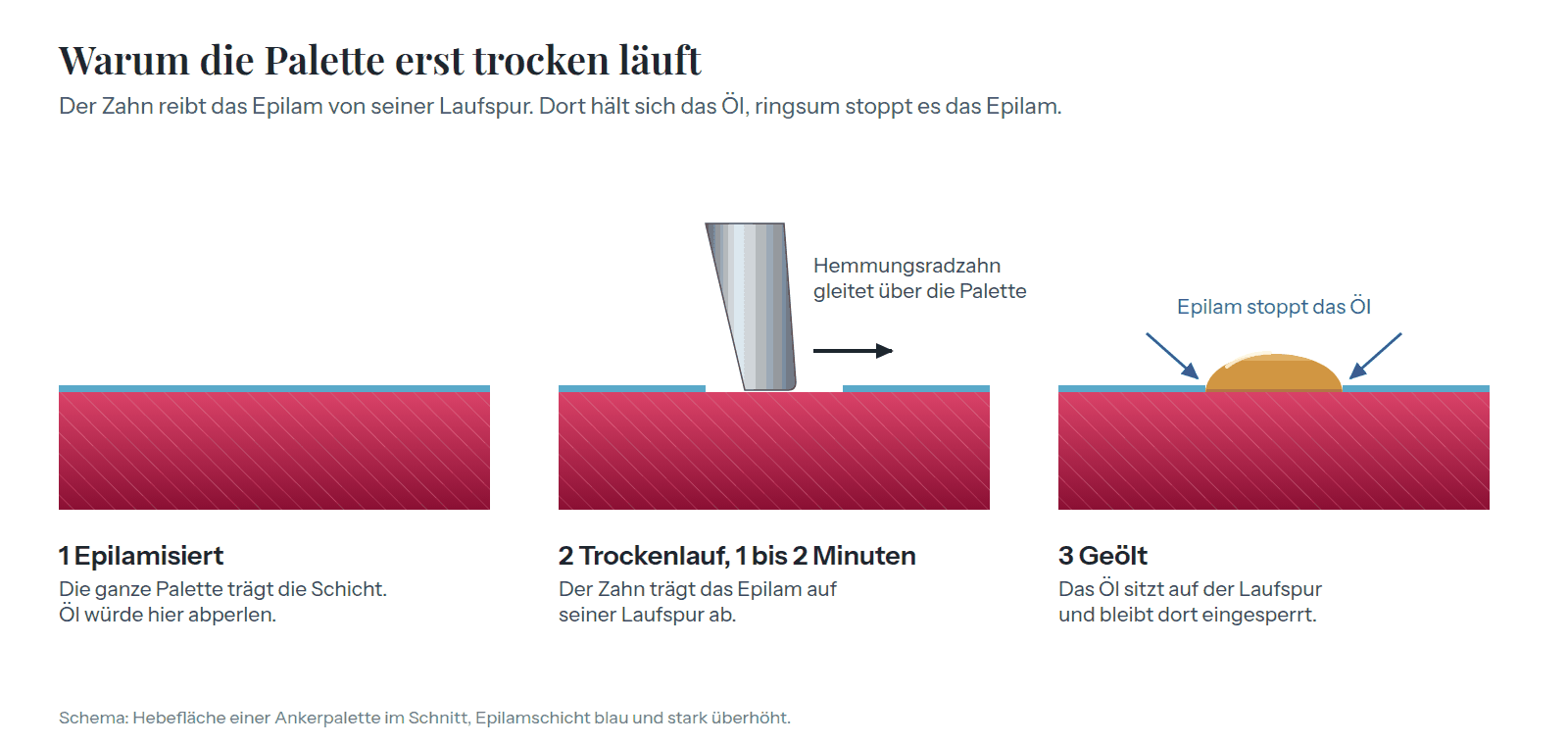
For pallet jewels treated with Fixodrop ES/BS, Moebius specifies, for example, an initial one to two minutes of dry running followed only then by lubrication. Anyone who does not generally use epilame should at least consider treating the escapement and pallet jewels, because this can considerably improve the life of the escapement lubrication.
The same confining effect occurs wherever a part wears a track into an epilame-treated surface: the oil moves precisely to the exposed working contact and remains confined there.
Checking the layer: test oil
A test oil shows whether the layer is present. Moebius offers six of them. Test oil 1 (9701) is fluorinated and indicates epilame positively: it spreads over the treated surface. Test oils 2 to 6 (9702 to 9706) indicate it in the opposite way: they spread over untreated surfaces and remain as drops on epilame. Their surface tension increases from test oil 2 to 6. Test oil 2 therefore spreads most readily and provides the strictest test.
Assess the test drop after 20 to 40 minutes, preferably in comparison with an untreated surface.
Limits, cleaning and maintenance
A good epilame layer survives five to ten cleaning cycles with organic solvents. It can be removed only mechanically or with strongly alkaline cleaners. An exception is water-based Fixodrop W-10, which can be washed off again with an aqueous or alcoholic solution. At ETA and Sellita, reused parts receive fresh epilame treatment during servicing; Fixodrop BS-10 (8981) is specified.
Epilame has one weakness: any contamination lays a new, thin film over the surface, and the oil creeps away over that film. Typical causes are wear particles from unlubricated or dry-running teeth, dirt entering through the crown, and moisture and condensation. Even a tiny dirt bridge is enough. On heavily contaminated parts, epilame is no miracle cure, and it cannot compensate for a worn pivot or an incorrect amount of oil.
If the movement is clean and sealed, however, the statement from Tillwich's training notes applies: “Epilame treatment ensures lifetime lubrication.”
What about a watch winder?
In the past, the recommendation became established that a watch should be moved and worn regularly. This was based on slightly better oil retention while the movement is running.
At rest, only the forces drawing the oil away act, continuously in the same direction. These include spreading, creeping along grooves and gravity. Movement repeatedly brings the oil back to the friction contact.
Today, however, epilame treatment considerably reduces this problem, so after a high-quality service the recommendation is outdated. A watch can safely be set aside for weeks or months. There can still be a slight redistribution of oil in the first few days after winding (“resting position” after prolonged storage versus “working position” after prolonged running), with a minimal effect on rate and amplitude. However, there is virtually no remaining risk of oil spreading away, provided that the oil reservoirs are not excessively overfilled.
Sources
- Susanne Beyer-Faiß (Managing Director of Dr. Tillwich GmbH Werner Stehr): Lubricants for watchmaking – Properties and testing.
- Moebius: Fixodrop ES/BS 8980–8982, technical data sheet.
- Moebius: Product catalogue with epilames and test oils, and Description of test oils 9701 to 9706.
- Tillwich: Antispread products and concentrations.