Lubricants in watches
An entire watch movement needs only two to four microlitres of lubricant, barely a tenth of a drop of water. For years, this tiny quantity must stay precisely in place at dozens of contacts where metal rubs against ruby or metal.
In the past, the main obstacle was ageing: the oil became gummy and combined with wear particles to form an abrasive paste. Today's oils last many times longer chemically; their problem is migration. A drop that has migrated leaves a dry bearing while the surrounding movement still gleams with oil. In brief: ageing in the past, migration today.
What load does a lubrication point carry, how fast does it move, does the oil stay there and how long does it last? The name on the oil bottle alone does not answer these questions. The following sections explain the relationships without assuming prior knowledge of physics.
Go straight to the lubricant table, to the physics of lubrication with equations, worked examples and questions for the master watchmaker course, or to the alternatives to Rolex lubricants.
What happens at a lubrication point
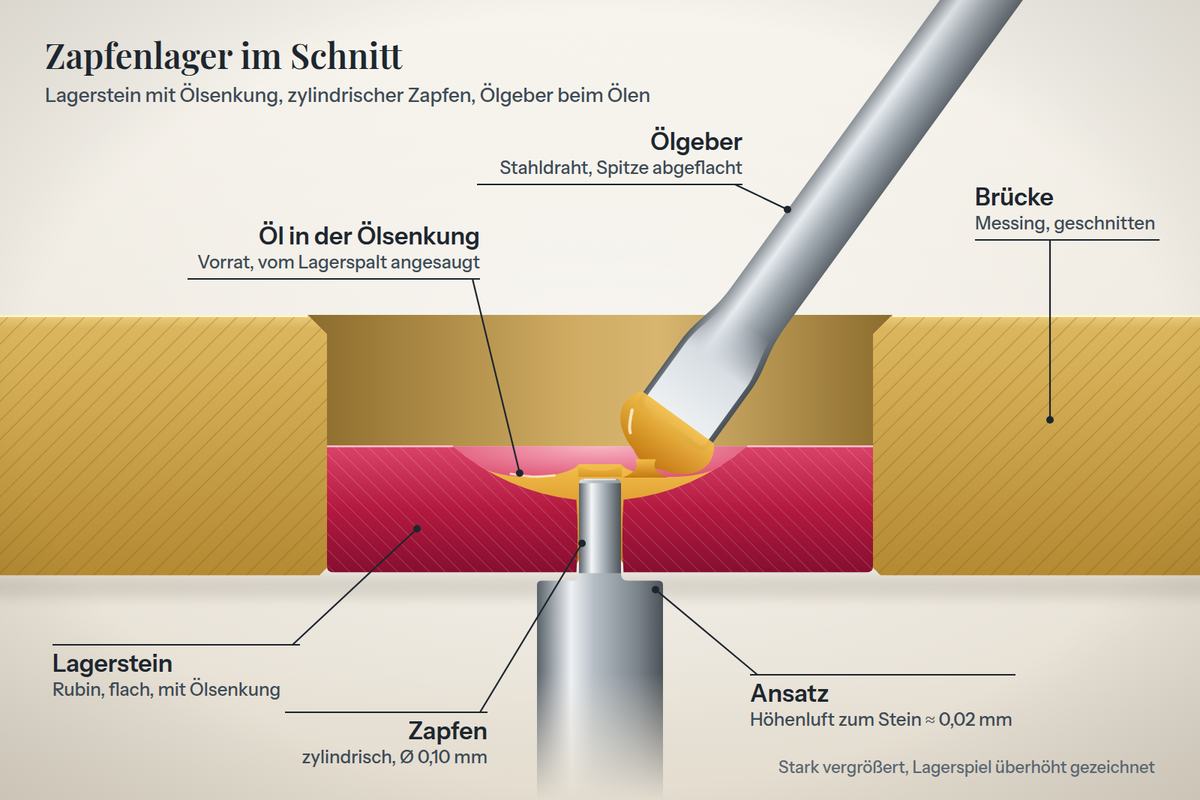
A pivot is the thin, cylindrical end of a wheel arbor, often only 0.1 mm in diameter in a wristwatch. It runs in the bore of a hole jewel made of synthetic ruby. On the outside, the jewel has an oil sink, a shallow recess that serves as an oil reservoir. The oil is applied with an oiler: a fine wire flattened at the end, to which a tiny drop adheres. Depending on the lubrication point, the tip is about 0.14 to 0.7 mm wide for wristwatches. When the drop touches the sink, it transfers, and capillary action draws the oil into the gap between pivot and jewel.
Oil is liquid and therefore reaches even the narrowest gap. Grease, by contrast, is oil in a sponge: a thickener, usually a metallic soap, holds the base oil and releases it gradually at the friction contact. Grease therefore stays even where oil would flow away.
A useful rule of thumb is: rotating pivots receive oil. Surfaces that slide, engage detents or carry high loads receive grease, for example the winding stem, sliding pinion, yoke and motion work.
A special case is thixotropic grease. It is solid at rest, becomes fluid in motion and solidifies again afterwards. Escapement grease 9415 uses this property: on the impulse face of the pallet jewel it lubricates like an oil, while beside it the grease stays in place and cannot spread.
Almost every lubricant contains additives. They protect against oxidation, corrosion and wear. Solid lubricants such as molybdenum disulphide (MoS2), graphite or boron nitride support the contact where the oil film breaks down. Moebius uses MoS2 in grease 8201, for example, graphite in 8207 and boron nitride in 9504. The Microgliss D-series oils contain a molybdenum-based extreme-pressure additive.
Viscosity: how thick is the oil?
Water flows readily, honey sluggishly. This internal resistance of a liquid is called viscosity. When a pivot rotates in its bearing, the layers of oil must slide past one another, which requires force.
As a rule of thumb, the more viscous an oil, the better it withstands pressure and the more drag it produces itself. Fast, lightly loaded parts therefore receive thin oil, particularly the balance, pallet fork and escape wheel, which are usually lubricated with 9010. The gear train, with its higher pivot loads, receives high-pressure oils such as HP 1000 or HP 1300, which are seven to eight times as viscous.
The dynamic viscosity η describes shear resistance directly. Dividing it by the density ρ gives the kinematic viscosity ν, which for watch oils is often specified in cSt (pronounced “centistokes”). 1 cSt equals 1 mm²/s, the viscosity of water at 20 °C. Watch oil 9010, at 150 cSt, is therefore about 150 times as viscous as water.
Oil becomes thinner when warm and more viscous when cold. Viscosity figures therefore apply at a specified temperature, 20 °C for watch oils. Particularly thin oils are available for watches that must withstand severe cold: 9030 at 60 cSt down to −40 °C, and 9040 at 24 cSt down to −52 °C. Thin oil migrates faster, so these oils belong on epilame-treated parts.
Wetting and spreading: why oil spreads out
The molecules of an oil attract one another; this is called cohesion. At the same time, the component's surface attracts the oil molecules; this is adhesion. If cohesion predominates, a drop remains in place. If adhesion predominates, the oil spreads out until only an extremely thin film remains. This process is called spreading or spread.
It can be measured through the surface tension of the liquid and the surface energy of the solid, both in millinewtons per metre (mN/m). Water has 72 mN/m, polyglycol oils around 38, mineral oil 30 and silicone oil 21 mN/m. Clean steel, brass and ruby are considerably higher than any oil.
Rule to remember: Oil spreads over any surface whose surface energy is higher than its own surface tension.
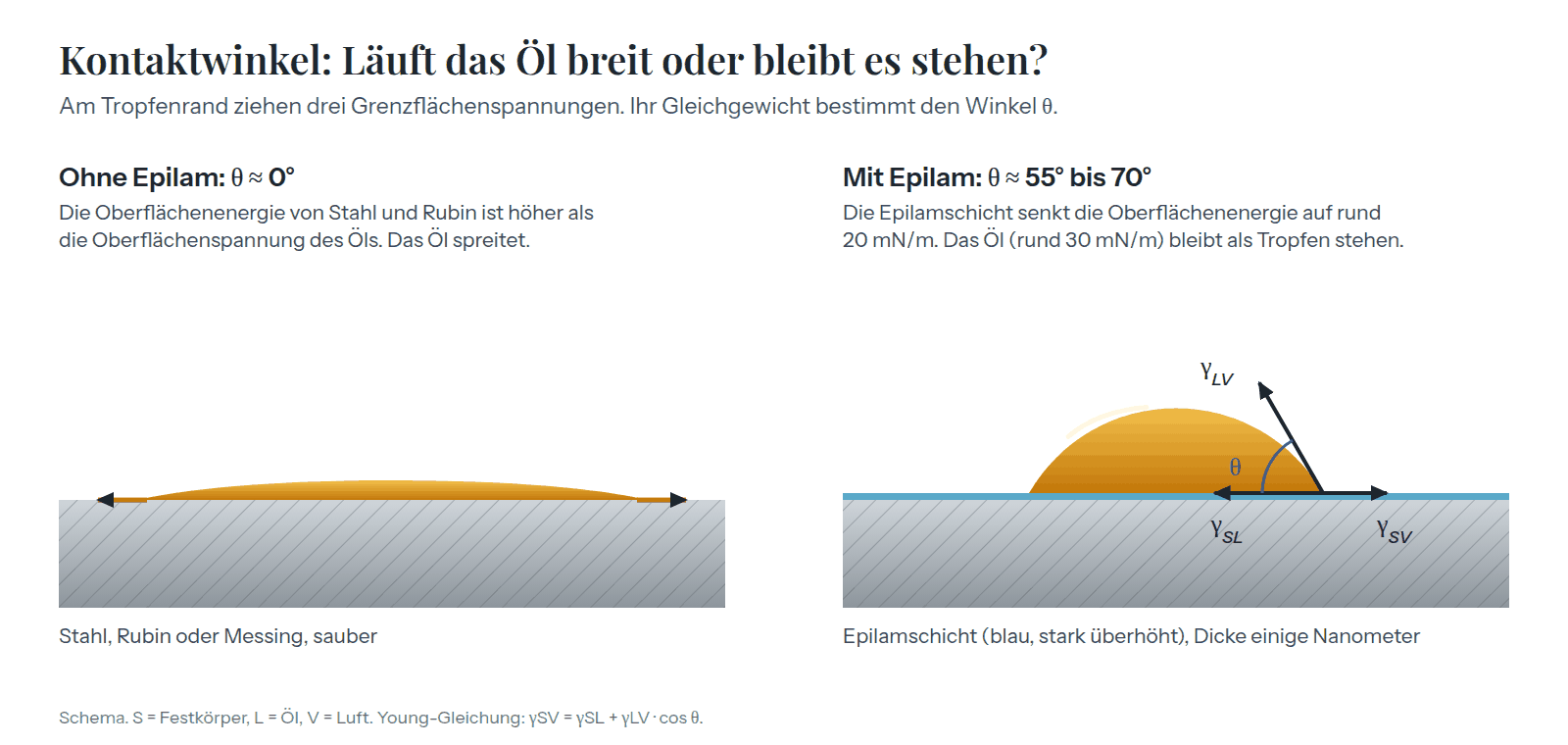
This is precisely where epilame treatment comes in. The epilame coats the component with a layer only a few nanometres thick, at around 20 mN/m. A watch oil at around 30 mN/m can no longer spread on it and remains as a drop. The oil itself remains unchanged.
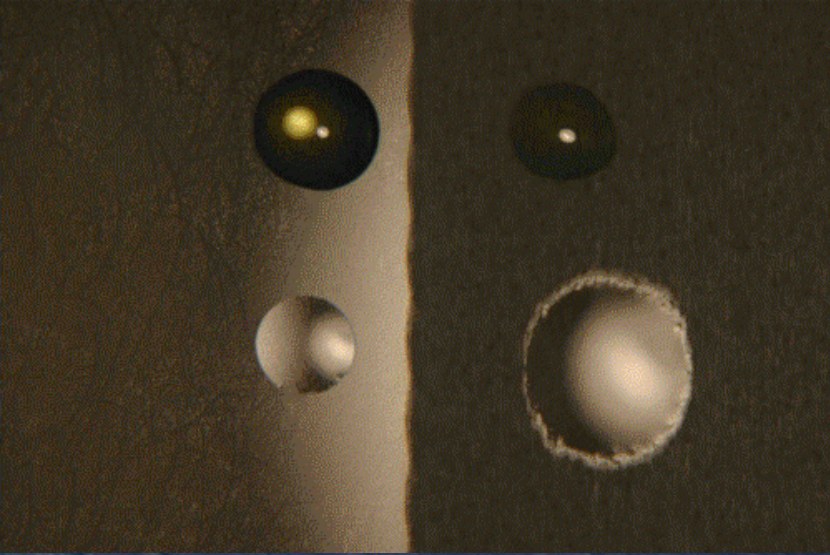
The degree to which a drop wets a surface is shown by the contact angle between the surface and the edge of the drop. For watch oil on clean steel, it is close to 0°: the oil spreads. On a good epilame layer, the drop stands at 55° to 70°.
The surface itself also plays a part. On a wettable surface, grooves and roughness act like tiny channels along which the oil creeps away. A well-polished surface retains oil better.
A film of old oil, skin grease or cleaning residue forms a bridge over which fresh oil creeps away, even across epilame. That is why every good lubrication begins with thorough cleaning.
Capillarity: how oil travels through gaps
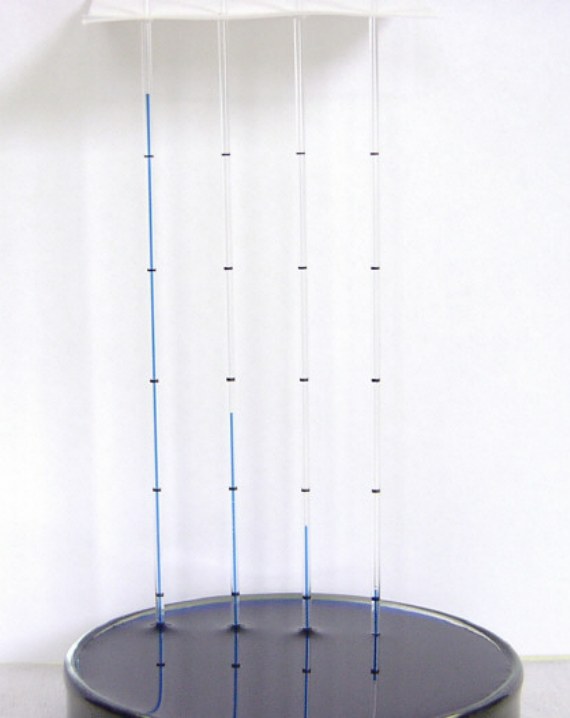
In a narrow gap, surface tension draws a wetting liquid upwards against gravity. We know this from a sugar cube dipped in coffee. This effect is called capillarity, and it becomes stronger as the gap narrows. In a gap of 0.02 mm, watch oil could theoretically rise more than 30 cm.
Inside a watch, this force is stronger than gravity. The surface forces acting on a 0.5 mm oil drop are about 15 times stronger than its weight. It therefore does not simply run downwards, but goes where the gap is narrower and the surface more wettable.
Capillarity retains oil in the bearing because the gap between pivot and jewel draws the drop in. However, the same force also draws oil into any other narrow gap: between the pivot shoulder and jewel, between two contacting parts, or along a fibre. Designers use this deliberately. A gap that narrows towards the lubrication point guides the oil there. A sharp outward-projecting edge acts as an oil barrier that the drop cannot cross. The oil sink serves as a reservoir.
Two workshop rules follow from this. Do not overfill: an oversized drop reaches the next edge or gap and drains away. And keep fibres away: a single strand acts as a wick and empties the lubrication point. This is also why even the best wristwatch lubrication eventually fails: wear particles from unlubricated teeth, particles from seals or incoming dirt eventually form a thin dust layer throughout the movement, providing a bridge for the lubricants.
Viscosity determines only the speed of this process. A thin oil creeps faster, a viscous oil more slowly. In the same time, 9010 penetrates almost three times as far into a gap as HP 1300. A more viscous oil therefore does not prevent migration; only a surface on which the oil does not spread can do that.
Rule to remember: Viscosity determines the speed; thick (high-viscosity) oils spread too.
Friction: what the lubricant film can do
How well a lubricant film separates the surfaces depends on speed, load and viscosity. Three regimes are distinguished:
- Boundary friction: The surfaces touch at their asperities. Only a thin molecular layer adhering to the metal and the additives provide protection.
- Mixed friction: The oil film carries part of the load, but the surfaces still touch at individual points.
- Fluid friction: A load-bearing oil film completely separates the surfaces; friction occurs only within the oil.
The transition can be imagined like waterskiing. When the boat is stationary, the skier sinks. Only above a certain speed does sufficient supporting pressure develop beneath the skis. In the same way, a plain bearing floats on its oil film only above a minimum speed. The Stribeck curve shows this progression: as speed increases, friction initially falls, reaches its minimum when the surfaces become fully separated, and then rises again through shearing of the oil.
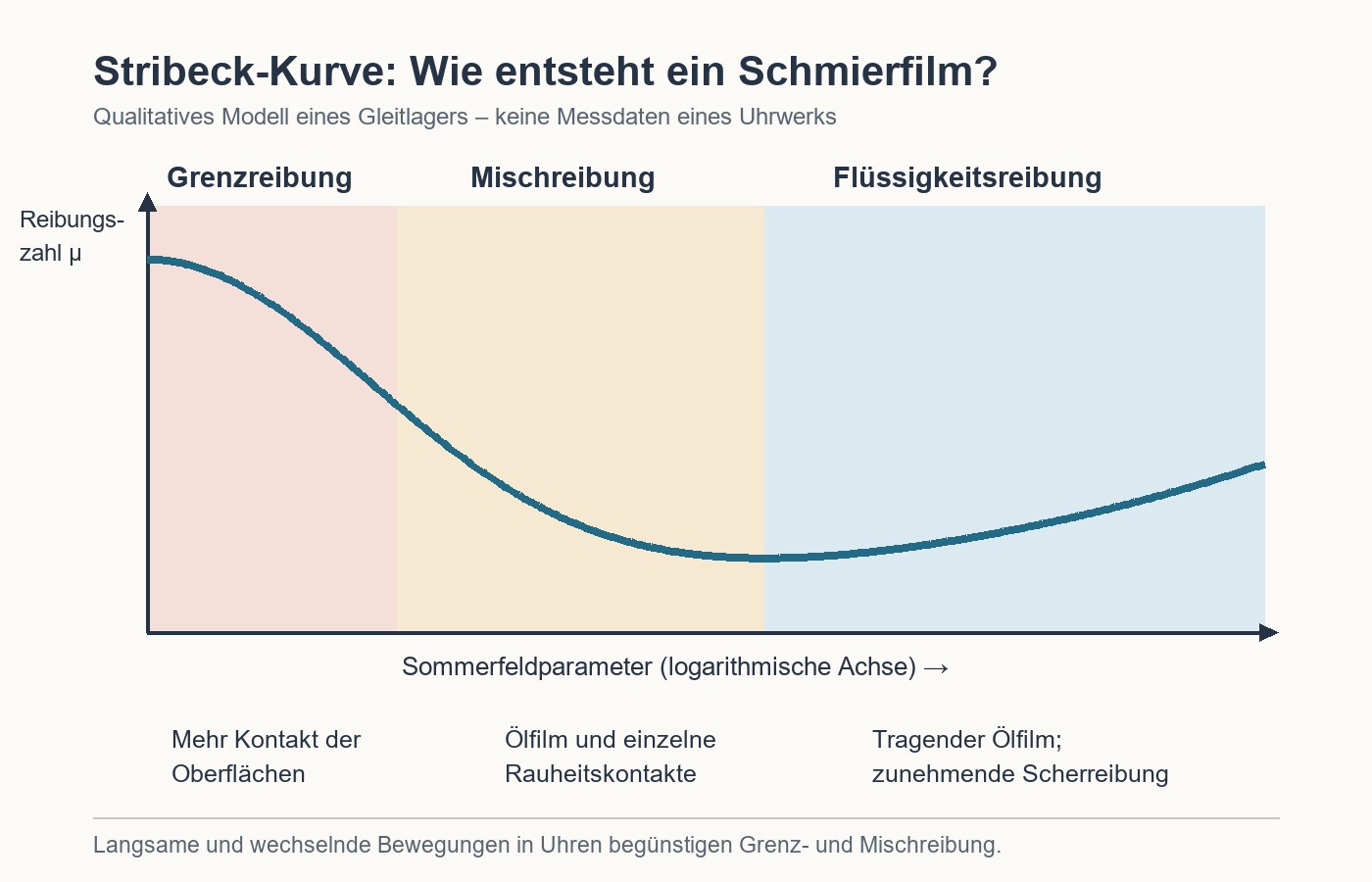
A watch movement is far too slow to develop a fully supporting oil film. Even the balance pivots, the fastest bearings in the watch, barely reach 7 mm per second and reverse direction eight times per second. The fourth wheel rotates once per minute. Watch bearings therefore operate in boundary or mixed friction, and the lubricant has a different task there: it reduces friction and protects against wear and corrosion.
Since no load-bearing film forms, solid-contact friction matters. Its torque is frictional force multiplied by lever arm, and the lever arm is the pivot radius. That is why watch pivots are so thin: at the same load, a pivot 0.1 mm in diameter produces only one tenth of the friction torque of a 1 mm pivot.
When the watch is horizontal, the balance rests on the slightly domed end face of a pivot, supported by the cap jewel. The contact area has a radius of only about 1 µm rather than the pivot's 50 µm. Friction therefore falls to roughly one sixtieth, and the watch has a higher amplitude in horizontal than in vertical positions.
Slow sliding motion over larger contact areas can produce stick-slip: the part sticks, releases abruptly and sticks again. This is felt as jerking when setting the hands. Greases in which static and sliding friction are close to one another, and fluid greases with a defined yield stress, provide a remedy.
Rule to remember: Watch bearings never float on a supporting film. The lubricant does not separate the surfaces; it protects them.
Ageing: how oil deteriorates
Oil ages mainly through exposure to oxygen. Oxidation forms acids and resinous residues; the oil becomes dark, thick and finally sticky. Copper and brass accelerate this reaction as catalysts, and the acids attack the metal. This produces copper soaps, visible as a greenish discolouration in old oil. Together with wear particles, they form the dreaded abrasive paste.
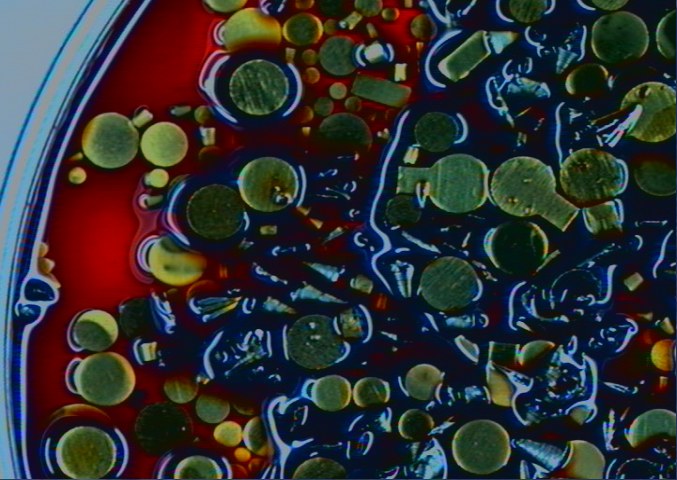
An accelerated ageing test from Tillwich's training notes shows how quickly this occurs: a thin oil layer is kept on brass and steel at 120 °C until it is unusable. After 32 days, a PAO sample containing additives was still liquid, but its viscosity had risen by 250%. Outgassing from adhesives and varnishes also accelerated ageing.
To extrapolate to the watch, the rule of thumb is used that a chemical reaction runs only half as fast for every 10 °C reduction in temperature. From 120 °C to 30 °C on the wrist, this means nine halvings, a factor of 512. A traditional watch oil that fails after 5 days in the oven therefore lasts about 7 years. Modern instrument oils last 48 days in the oven, giving a calculated 67 years; fully synthetic watch oils at 78 days give 109 years.
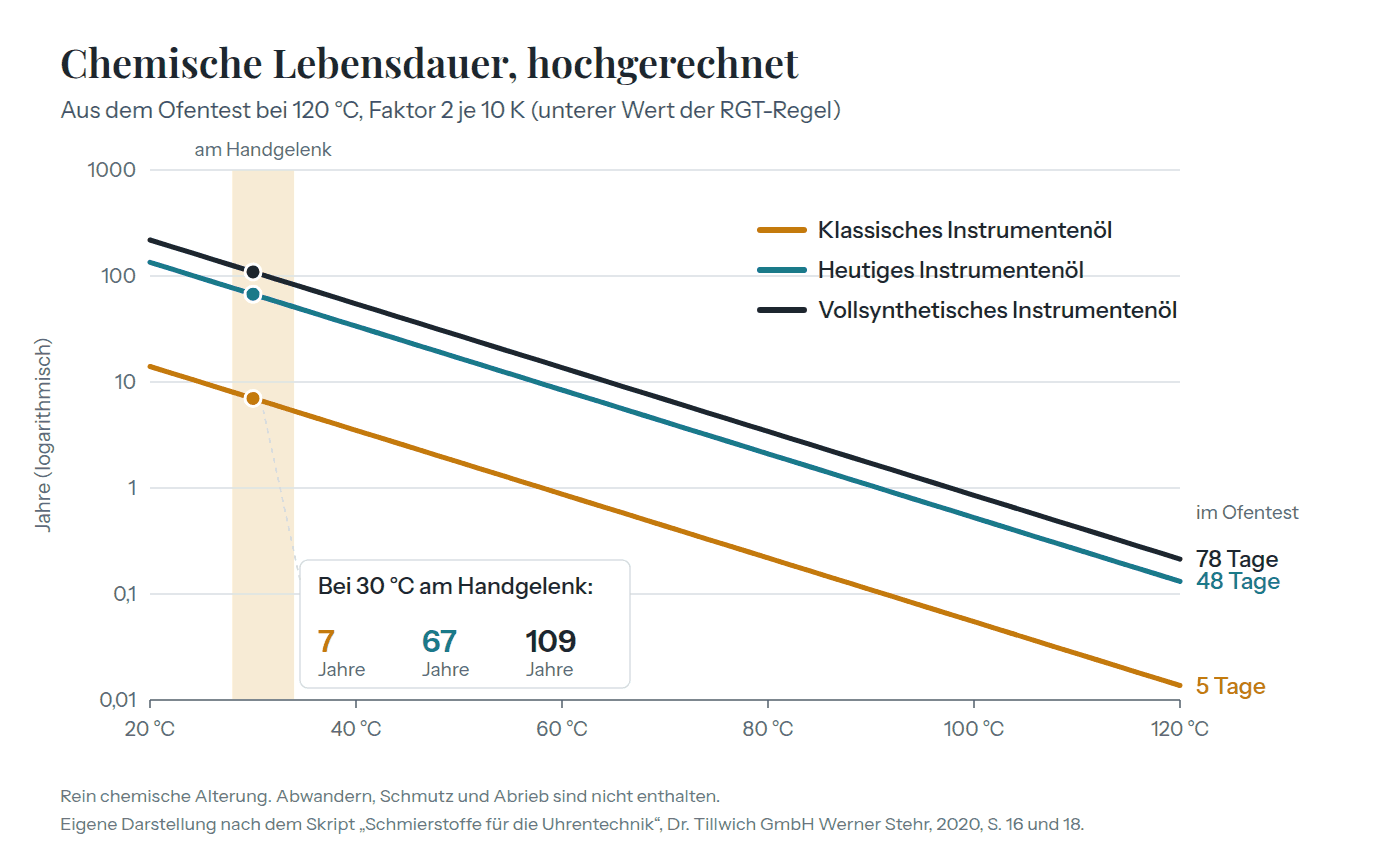
Rule to remember: Today, chemical ageing hardly limits the service interval. Migration, contamination and wear are the limiting factors.
Anyone looking for oil in a dry watch often suspects it has evaporated. However, even at 100 °C over several days, watch oils lose less than 1% of their weight. The oil has not evaporated; it has migrated.
Natural, mineral, synthetic: how watch oils are made
The first watch oils were natural oils from plants and animals. Neatsfoot oil, rendered from cattle feet and remaining liquid even in the cold, was particularly prized. On this basis, watchmaker Hermann Moebius founded his oil manufacturing business in Hanover in 1855, from which today's Moebius company developed. Chemically, vegetable and animal oils are triglycerides: three fatty acids attached to a glycerol molecule. Their double bonds are points of attack for oxygen, which is why they become gummy quickly.
Mineral oils are distilled from petroleum. For watch oils, a suitable fraction is selected and extensively purified: refining and hydrogenation remove sulphur, aromatic compounds and reactive double bonds. The result remains a mixture of thousands of different hydrocarbons.
Synthetic oils are instead built deliberately from small molecules. For polyalphaolefins (PAO), ethylene gas is first combined to form 1-decene, and this into larger molecules that are then hydrogenated. Since all molecules are formed from the same building block, viscosity and low-temperature behaviour can be precisely controlled. Esters are formed from alcohols and acids. They are polar and therefore adhere well to metal; Moebius braking grease 9500, for example, is based on a polyol ester. According to the manufacturer, synthetic Moebius oils such as 9010 are built from compounds containing ether and alcohol groups.
Perfluoropolyethers (PFPE) and silicone oils are almost chemically indestructible, but lubricate steel poorly. With its 21 mN/m, silicone oil also creeps over almost any surface, even epilame. In watches, silicone is therefore found in seal greases, not bearings.
Semi-synthetic lubricants mix synthetic with mineral or natural base oils, such as Tillwich products Types 1 to 3 and B52. Today, traditional Moebius oils such as 8000 and the Microgliss range consist of highly refined vegetable oils, special mineral oils and additives.
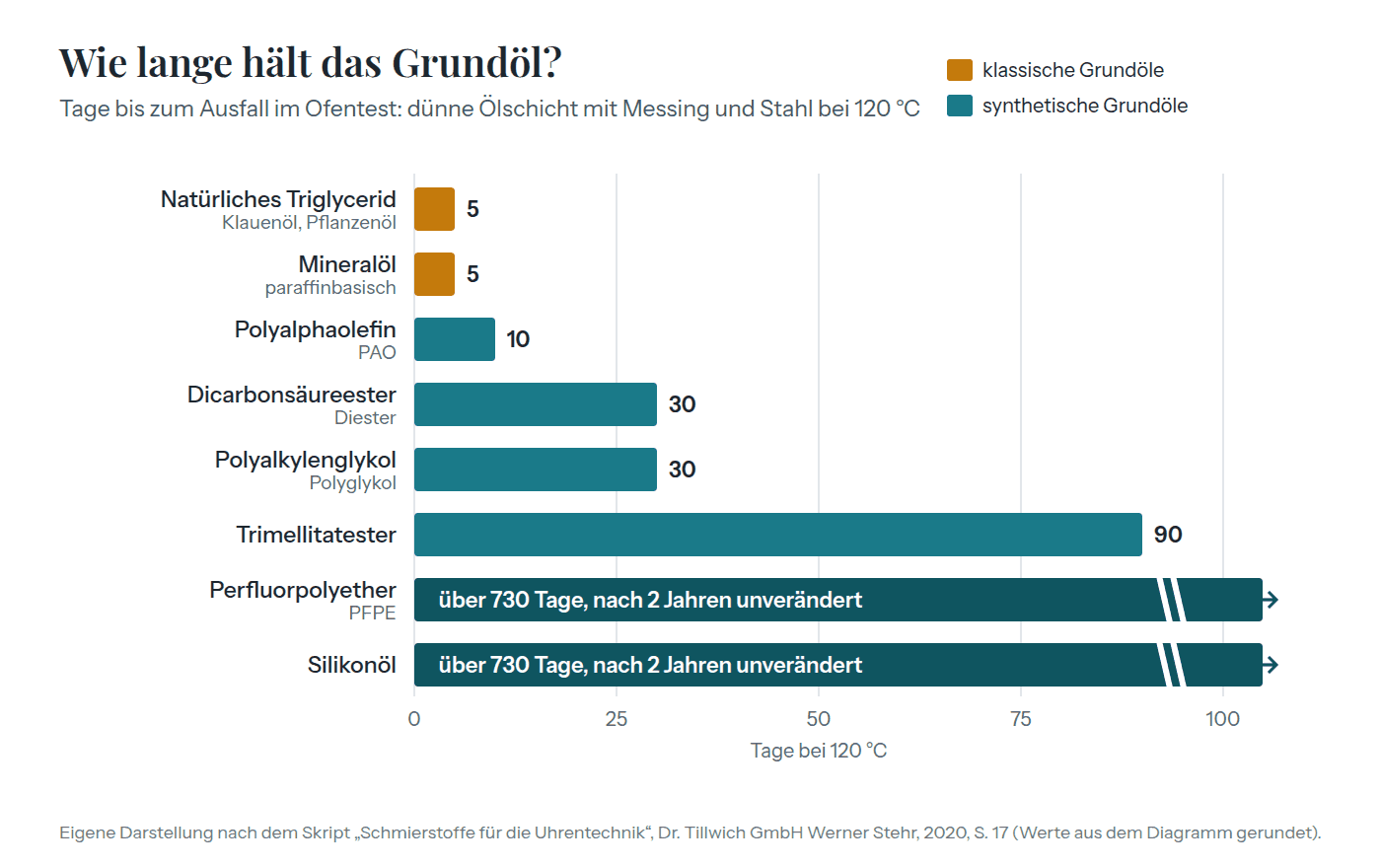
The oven test at 120 °C shows how large the differences between base oils are:
Neatsfoot oil, BSE and why synthetics are used today
Until the 1990s, many traditional watch oils still contained neatsfoot oil. It disappeared with the BSE crisis in the late 1990s: cattle-derived raw materials became a risk, and manufacturers replaced the animal content. Today, even traditional Moebius oils consist of vegetable oil, mineral oil and additives.
ETA took the next step. From January 2005, it replaced traditional Microgliss D5 with fully synthetic HP 1300 at numerous lubrication points because of its better resistance to ageing and at least equivalent lubricating properties. Source: ETA Specific Information 54.
Incidentally, synthetic watch oil predates its breakthrough: as early as 1952, Moebius and the Swiss Watch Research Institute introduced the synthetic Synt-A-Lube. The 9010 is still sold under this name today.
So why use synthetics today? The oven tests are clear: fully synthetic watch oils age around 15 times more slowly than traditional oils. Together with epilame, which keeps them in place, this enables a lubrication point to remain functional for many years.
Common lubricants at a glance
The tables summarise widely used watch oils and greases. Viscosities and temperature ranges are manufacturer specifications, as of October 2026.
Oils
| Oil | cSt at 20 °C | Temperature in °C | Application |
|---|---|---|---|
| Moebius 9010 (Synt-A-Lube) | 150 | −30 to +70 | Balance, pallet fork, escape wheel, fast wheels with low torque |
| Moebius 9020 | 270 | −25 to +80 | Slower wheels with higher loads, clocks |
| Moebius 9030 | 60 | −40 to +60 | Balance at low temperatures, on epilame |
| Moebius 9040 | 24 | −52 to +120 | Extreme cold, on epilame |
| Moebius 941 | 105 | −35 to +70 | Impulse faces of the escapement |
| Synt-HP 500 (9101) | 500 | −30 to +100 | Gear train with medium torque |
| Synt-HP 750 (9102) | 750 | −35 to +100 | Gear train |
| Synt-HP 1000 (9103) | 1000 | −30 to +100 | Gear train and automatic winding; gear train in Rolex watches |
| Synt-HP 1300 (9104) | 1250 | −25 to +100 | Gear train with high torque; ETA replacement for D5 |
| Microgliss D-4 | 330 | −15 to +80 | Brass bearings |
| Microgliss D-5 | 1200 | −5 to +80 | Gear train and brass bearings, with a molybdenum additive |
| Moebius 8000 | 95 | −15 to +80 | Traditional universal oil for moderate pressure |
| Moebius 8141 | 1250 | −4 to +100 | Viscous traditional oil, mainspring |
| Moebius 9000 | 100 | −35 to +65 | Quartz movements |
According to Moebius, Synt-HP oils are preferably used in ruby bearings; for brass bearings, Moebius recommends Microgliss D-4 or D-5. The appropriate gear-train viscosity depends on torque and power reserve. The number in the Synt-HP oil name roughly corresponds to its viscosity; according to the catalogue, HP 1300 has 1250 cSt.
Greases
For greases, the manufacturer specifies penetration rather than viscosity: a standardised cone sinks into the grease at 20 °C, measured in tenths of a millimetre. The larger the value, the softer the grease. A barrel has special requirements: lubrication of the mainspring and barrel arbor, and, where applicable, a defined braking action at the slipping bridle.
| Grease | Penetration in 1/10 mm | Application |
|---|---|---|
| Moebius 9415 | 405 | Thixotropic escapement grease for pallet jewels and the escape wheel; base oil 110 cSt |
| Moebius 9501 | 400 | Slightly thixotropic; hand setting, cannon-pinion friction, steel parts with high friction; base oil 176 cSt |
| Moebius 9504 | 330 | Retains its consistency under high pressure, with boron nitride; cannon-pinion friction, levers, chronograph parts; base oil 305 cSt |
| Moebius 9500 | 185 | Polyol-ester-based braking grease for the barrel wall |
| Moebius 8217 (Glissalube 20) | 330 | Soft braking grease for all barrels |
| Moebius 8212 (Glissalube B) | 185 | Braking grease for aluminium barrel walls |
| Moebius 8213 | 75 | Very firm braking grease for brass barrel walls |
| Moebius 8200 | Semi-fluid | Thixotropic; mainspring, large friction surfaces; base oil 20 cSt |
| Moebius 8201 | 400 | Like 8200, with MoS2 more resistant to pressure |
| Moebius 8300 | 270 | Very firm; winding mechanism, springs, pushers |
| Molykote DX | – | Mineral oil, lithium soap and white solid lubricants; heavily loaded steel-on-steel contacts |
| Tillwich B52 | – | Semi-synthetic precision grease; winding and hand setting |
| Moebius 8513 / 8516 | 180 / 200 | Silicone greases for seals, not bearings |
From our workshop: 9501 is designed for cannon-pinion friction; the more widespread 9504 is equally suitable. 9501 also replaces Jismaa 124 and Rolex MR 4, with slightly better stability under pressure. Used alone, 8200 is suitable for mainsprings, but not for the barrel wall. Mixing it with 30% Molykote DX produces a more pressure-stable grease similar to MR 4. The Lemania 5100 formerly specified 8200; HP 1300 is now used at those points. DX itself is used for heavily loaded steel-on-steel contacts.
For clocks, Tillwich offers the fully synthetic Clock 859 oil at 150 cSt and the fluid grease Clock 859-8.
Epilames such as Fixodrop, Episurf or Antispread are not lubricants. They change the surface so that the lubricant stays in place. More on this in the article Epilame.
Workshop rules
- First: Pivots, bearings, clearances and surfaces must be in good condition.
- Clean thoroughly: Remove old oil, wear particles and cleaning residues, then dry cleanly.
- Optimise oil retention: Treat the appropriate components with a suitable epilame.
- Apply the correct lubricant in the correct quantity: Follow the lubrication chart, application method and oil quantity. More lubricant does not automatically mean a longer-lasting reserve.
- Check: Observe or test the position of the lubricant and its behaviour in operation.
- Store and work cleanly: Close the bottles, note the opening date, and protect oilers and oil cups from dust. Once removed, oil must not be returned to the stock bottle.
Moebius recommends clean, dry storage protected from light, in the original packaging, preferably at 15–26 °C, and storage for no more than twelve months after opening. Other manufacturers may have their own requirements.
physics of lubrication
This section explores the relationships in greater depth for master watchmaker students, physicists and engineers. The worked examples are simplified and use typical wristwatch-movement values: balance pivots 0.10 mm in diameter and 0.15 mm long, 5 µm radial bearing clearance, balance and hairspring weighing 0.5 g, 28,800 vibrations per hour (4 Hz) and 300° amplitude.
Viscosity and shear
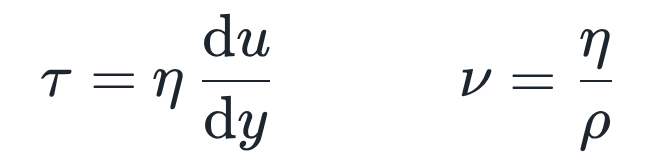
τ is the shear stress in Pa, η the dynamic viscosity in Pa·s, du/dy the velocity gradient across the flow in 1/s, ν the kinematic viscosity in m²/s and ρ the density in kg/m³. Oils obey this Newtonian law; greases flow only above their yield stress.
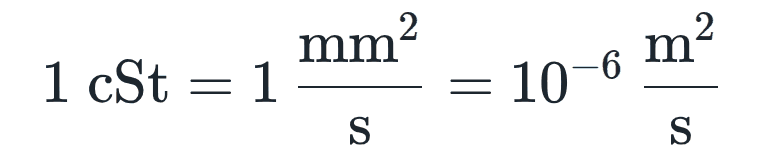
Example: 9010 has ν = 150 cSt. With ρ ≈ 900 kg/m³, η = ρ · ν = 900 kg/m³ · 150 · 10−6 m²/s = 0,135 Pa·s.

In the bearing gap of height h, velocity falls from U at the pivot surface to zero at the jewel wall. The shear stress acts over the cylindrical surface area π · d · L of the pivot, with a lever arm of d/2. Mη is the torque required to shear the oil.
Balance pivot example: The maximum angular velocity of the balance is ω = 2π · f · φ0 = 2π · 4 Hz · 5,24 rad ≈ 132 rad/s. At the pivot circumference, this gives U = ω · d/2 ≈ 6,6 mm/s. With h = 5 µm, τ = 0,135 Pa·s · 6,6 · 10−3 m/s / (5 · 10−6 m) ≈ 178 Pa and Mη = 178 Pa · π · 0,10 mm · 0,15 mm · 0,05 mm ≈ 4,2 · 10−7 N·mm per pivot.
Solid-contact friction at the pivot in a vertical position is, at 1,5 · 10−5 N·mm, around 35 times greater (see Friction and the lubricant film). With HP 1300 (1250 cSt) instead of 9010, however, the shear contribution would rise to 3,5 · 10−6 N·mm, a quarter of the friction. In a horizontal position, where solid-contact friction almost disappears, it would be the greatest loss. That is why the balance receives thin oil.
Wetting and spreading
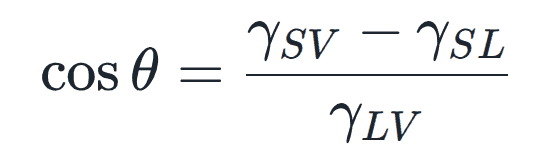
Young's equation describes the equilibrium of the three interfacial tensions at the drop's contact line (see the image in the section Wetting). γSV refers to the solid/air interface, γSL to solid/oil, and γLV to oil/air, each in N/m = J/m². θ is measured through the liquid.

The spreading coefficient S compares the dry surface with the wetted surface. When S ≥ 0, the wetted surface is energetically more favourable and the drop spreads into a film. When S < 0, a drop with a finite contact angle remains.

Zisman found empirically that every surface has a critical surface tension γc . Liquids with γLV ≤ γc spread completely; above this, the contact angle increases almost linearly. b is a constant of about 0.03 to 0.04 m/mN. This is the rule from the first section in its exact form.
Example: Watch oil with γLV = 32 mN/m on epilame with γc = 20 mN/m and b = 0,035 m/mN: cos θ ≈ 1 − 0,035 · 12 = 0,58, so θ ≈ 55°. On clean steel, γc is higher than the surface tension of any watch oil, so the oil spreads.
Roughness amplifies the respective behaviour (Wenzel model): on a wettable surface, oil spreads still more on a rough surface, and grooves also act as capillaries.
capillarity
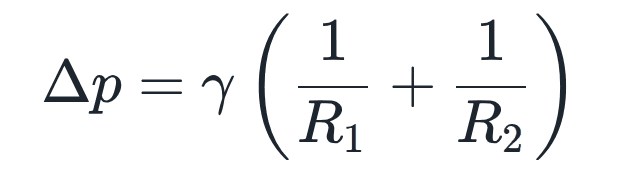
At a curved liquid surface, the pressure changes by Δp (Young–Laplace). R1 and R2 are the two principal radii of curvature of the surface.

In a tube of radius r, the meniscus has spherical curvature (R1 = R2 = r/cos θ); in a flat gap of width s, it curves in only one direction (R1 = s/(2 cos θ), R2 → ∞). A gap of width s therefore draws liquid as strongly as a tube of radius s. g = 9,81 m/s² is gravitational acceleration.
Example: Watch oil with γ = 0,032 N/m, θ = 20° and ρ = 900 kg/m³ in a gap s = 0,02 mm: hSpalt = 2 · 0,032 · 0,94 / (900 · 9,81 · 2 · 10−5) m ≈ 0,34 m. Inside the watch, only the supply is lacking; the force is there.
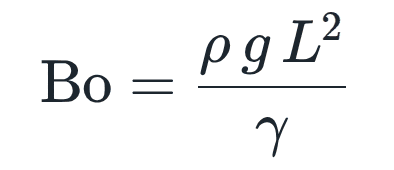
The Bond number compares gravity with surface forces. Here, L is the characteristic length, such as the drop diameter. For Bo ≪ 1, surface forces determine the shape and path of the oil.
Example: Drop with L = 0,5 mm: Bo = 900 · 9,81 · (5 · 10−4)² / 0,032 ≈ 0,07. Surface forces are about 15 times stronger than the weight; at L = 0,1 mm, about 360 times. In a watch, gravity acts only as a weak but persistent pull in one direction.
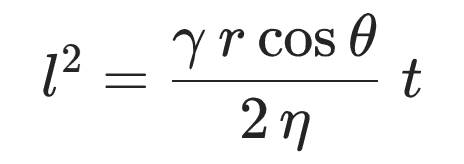
The Lucas–Washburn equation describes how far a liquid has penetrated a horizontal capillary of radius r after time t. Viscosity appears only here, not in the rise height: it determines the speed, not the destination. Four times the time gives twice the distance.
Example: 9010 (150 cSt) versus HP 1300 (1250 cSt), with all other conditions equal: l9010 / lHP 1300 = √(1250/150) ≈ 2,9.
Friction and the lubricant film

μ is the coefficient of friction, FN the normal force on the pivot, and rZ the pivot radius. Friction torque increases linearly with pivot radius.
Vertical-position example: The balance and hairspring weigh 0.5 g, so each of the two pivots carries FN = 2,45 mN. With μ = 0,12 for steel on ruby and rZ = 0,05 mm, MR = 0,12 · 2,45 · 10−3 N · 0,05 mm ≈ 1,5 · 10−5 N·mm per pivot, together 2,9 · 10−5 N·mm.
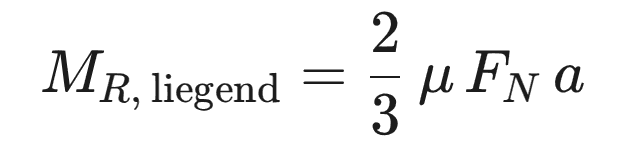
In a horizontal position, the domed end face of one pivot carries the entire weight on the cap jewel. The contact area is a circle of radius a. Under uniform pressure, the frictional force acts on an average lever arm of 2/3 · a.
Horizontal-position example: FN = 4,9 mN. For an end face with a curvature radius of 0,065 mm on the ruby cap jewel, Hertzian contact gives a ≈ 1,2 µm. This gives MR ≈ 2/3 · 0,12 · 4,9 · 10−3 N · 1,2 · 10−3 mm ≈ 4,7 · 10−7 N·mm. This is roughly one sixtieth of the vertical-position value and explains the higher amplitude in horizontal positions. Oil shear at both pivots, together 8,4 · 10−7 N·mm, is actually greater than solid-contact friction in a horizontal position. Oil that is too viscous or aged therefore has its strongest effect in horizontal positions.

The Sommerfeld number S0 determines whether a plain bearing supports its load hydrodynamically. n is the rotational speed in 1/s, p̄ the mean bearing pressure in Pa, r the pivot radius and c the radial bearing clearance. A hydrodynamically supporting engine bearing operates at S0 around 0.1.
Example: At the zero crossing, the balance pivot reaches n = ω/2π ≈ 21 s−1. With F = 2,45 mN, d = 0,10 mm, L = 0,15 mm and 9010, this gives S0 ≈ 1,7 · 10−3. The fourth wheel, with n = 1/60 s−1, F = 20 mN, d = 0,12 mm, L = 0,15 mm and HP 1000 (η ≈ 0,9 Pa·s), reaches S0 ≈ 2 · 10−6. Even at its fastest instant, the balance remains about 60 times below the supporting region, and the gear train almost five orders of magnitude below it.
Ageing and temperature
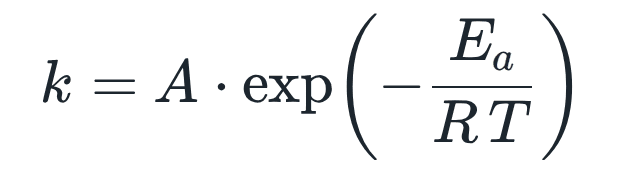
According to Arrhenius, the rate constant k of a chemical reaction increases exponentially with temperature. T is the absolute temperature in K, Ea the activation energy in J/mol, R = 8,314 J/(mol·K) the gas constant and A a pre-exponential factor. Time to failure is inversely proportional to k.
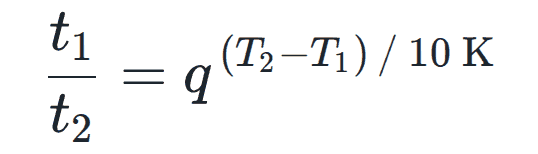
The RGT rule (reaction-rate–temperature rule) is its rule-of-thumb form: for every 10 K rise in temperature, a reaction runs q times faster, with q between 2 and 4. The training notes use a conservative q = 2.
Example: Oven test at T2 = 120 °C, watch at T1 = 30 °C: t1/t2 = 29 = 512. Traditional oil: 5 days · 512 ≈ 7 years. Instrument oil: 48 days · 512 ≈ 67 years. Fully synthetic watch oil: 78 days · 512 ≈ 109 years. At 40 °C, the values halve to 3.5, 34 and 55 years.
Questions for the master watchmaker course
Click a question to open the answer.
1. Why does the balance receive 9010 rather than the more pressure-resistant HP 1300?
The balance pivots are the fastest and least heavily loaded bearings in the watch. They need very little pressure resistance, whereas any additional viscosity costs amplitude. With HP 1300, the shear contribution would increase more than eightfold and would be the greatest loss in a horizontal position.
2. After several cleaning cycles, an epilame layer has degraded to γc = 28 mN/m. What contact angle does an oil with 32 mN/m form (b = 0,035 m/mN)?
cos θ ≈ 1 − 0,035 · (32 − 28) = 0,86, so θ ≈ 31°. The drop is considerably flatter and less well retained. On intact epilame at 20 mN/m, the angle is 55°.
3. A customer asks whether a more viscous oil lasts longer because it does not migrate as quickly. What do we answer?
A more viscous oil creeps more slowly, but to the same place. Surface tension, contact angle and gap geometry determine where the oil moves, not viscosity. Epilame prevents migration. An excessively viscous oil, by contrast, continuously costs amplitude.
4. How high does watch oil (γ = 0,032 N/m, θ = 20°, ρ = 900 kg/m³) rise in a gap of 0.05 mm?
h = 2 · 0,032 · 0,94 / (900 · 9,81 · 5 · 10−5) m ≈ 0,14 m, or around 14 cm. Rise height is inversely proportional to gap width.
5. An oil lasts 30 days in an oven test at 120 °C. What lifetime does the RGT rule with q = 2 give at 30 °C?
t = 30 days · 29 = 15,360 days, or about 42 years.
6. Why does a watch bearing never float on a load-bearing oil film?
Even at the balance's zero crossing, the Sommerfeld number is 1,7 · 10−3, and in the gear train 10−6 or lower. Hydrodynamically supporting bearings require values around 0.1. The balance also reverses direction eight times per second. Watch bearings operate in boundary and mixed friction, so additives, the material pairing and surface quality matter.
7. Why does a watch show more amplitude in horizontal than in vertical positions?
In a vertical position, friction acts at the pivot circumference with a lever arm rZ = 50 µm; in a horizontal position, only at the tiny contact area of the pivot end face, with a ≈ 1 µm. Friction torque therefore falls to roughly one sixtieth.
8. After servicing, the drop has disappeared from an oil sink. What are the possible causes?
Missing or worn epilame, cleaning-agent or old-oil residues, an overfilled drop that has reached the next edge, a fibre acting as a wick, a narrow gap to a neighbouring part, or a rough surface.
Appendix: Rolex lubricants and freely available alternatives
Rolex does not make its own lubricants freely available. The table gives a freely available alternative for each Rolex lubricant. The application points follow the Rolex lubrication chart for calibres 1530 to 3135.
| Rolex | Application at Rolex | Freely available alternative |
|---|---|---|
| 9010 | Balance jewels in the shock setting, pallet-arbor and escape-wheel pivots | Moebius 9010, identical |
| RL 2 | Escapement grease for the pallet jewels, with the amount between minimum and maximum | Moebius 9415 |
| HP 1000 | Gear-train pivots with higher pivot loads, automatic-winding bridges, rotor bearings | Moebius Synt-HP 1000 (9103), identical |
| TEPA | Barrel wall | Moebius 8217 (Glissalube 20) |
| MR 4 | High-viscosity grease for the barrel arbor, winding stem, sliding pinion, setting lever, yoke, jumpers, motion work, date mechanism, crown wheel, cannon pinion and cannon-pinion friction | Moebius 9501, slightly more pressure-stable; alternatively, 8200 with 30% Molykote DX |
Sources
- Susanne Beyer-Faiß (Managing Director of Dr. Tillwich GmbH Werner Stehr): Lubricants for watchmaking – Properties and testing.
- Moebius: Product catalogue, Oils, Greases and Company history.
- Tillwich: Lubricant selection for watches and clocks, 13 September 2023 and Clock 859.
- ETA: Specific Information 54, replacement of D5 with HP 1300.
- MOLYKOTE DX Paste, data sheet; Chevron Phillips: Manufacture of polyalphaolefins.
- E. W. Washburn: The Dynamics of Capillary Flow, Physical Review 17, 1921; W. A. Zisman: Relation of the Equilibrium Contact Angle to Liquid and Solid Constitution, Advances in Chemistry 43, 1964.
- MIT: Interfacial Phenomena; NPTEL: Plain-bearing design and the Sommerfeld number.
- Wikipedia: viscosity, Wetting, capillarity and RGT rule.
Comments
Epilame – R.I.O. Uhrenkunde Blog · 2026-10-02