Your longcase clock
Setting up, winding and regulating – a practical guide
“At a glance” covers the essentials. The chapters explain the details; troubleshooting is at the end.
At a glance
1. Which clock do you have?
Identify the type, then read the relevant section.
This booklet is for longcase clocks with mechanical movements. Instructions specific to a particular type are in Chapter 8.
- Modern cable-driven longcase clock: Three weights hang from steel cables. You wind it with a crank through the dial. Most play a chime melody.
- Modern chain-driven longcase clock: The weights hang from chains. Wind by pulling the free end of each chain.
- English eight-day longcase clock: It has two heavy weights and a bell. The movement rests loosely in the hood of the case.
- English thirty-hour longcase clock: A single weight hangs from an endless chain or rope with a small lead tensioning ring. It has count-wheel striking (Chapter 9) and often only one hand.
- Comtoise: A narrow case, an open iron-framed movement with a bell, and a large pendulum with embossed brass decoration.
Space for your notes:
- Winding (day, direction): ______________________
- Weights, viewed from the front (left, centre, right): ______________________
- Regulation: ______________________
- Other details: ______________________
2. Transport and the right position
Secure and remove the weights, then remove the pendulum. Carry the clock upright.
If the pendulum swings during transport, it can easily kink the suspension spring: the thin spring strip from which it hangs. Prepare the clock before every move, even within your home.
- Stop the pendulum but leave it hanging for now. Without it, the weight-driven movement can run down rapidly and uncontrollably.
- On a cable-driven clock, wind the weights up until the pulleys are just below the seatboard. Insert the polystyrene spacers supplied at handover to keep the cables taut.
- On a chain-driven clock, raise the weights and secure each chain below the movement with wire or a cable tie through a link.
- Only then remove the weights and label them left, centre and right as viewed from the front. Now unhook the pendulum and carry it with protective padding.
- Place foam between the hammers and the chime rods or gong. Pad the bell. Unhook any tubular chimes.
- With English longcase clocks and Comtoise clocks, remove the hood, photograph the movement, and lift it out with its seatboard. Secure a Comtoise movement against slipping as well. Call us if you are unsure.
- Carry the clock upright, never by its hood or decorative parts. A modern longcase clock may also lie on its back, never on its front. Lay an English longcase or Comtoise clock down only after removing the movement.
The right position
Choose a suitable position, preferably in a dry room away from direct sunlight and extremes of temperature.
- Avoid vibration from doors, stairs or washing machines, as well as draughts and air conditioning.
- Heat from radiators, fireplaces and sunlight can split the wood and accelerate oil deterioration.
- Cellars, bathrooms and conservatories are too damp.
3. Setting up with pendulum and weights
Hold the pendulum by its rod, never by the suspension spring.
For English longcase and Comtoise clocks, also follow the steps in Chapter 8.
Set up straight and secure
- Position the clock on a firm floor against a sound wall. On carpet or flexible floorboards, the case may settle. Check it again after a few days.
- Use the adjustable feet and a spirit level to align the case. It should be upright from side to side. A slight backward lean towards the wall is acceptable; it must never lean forwards.
- On an antique case without adjustable feet, place wedges under the front. If a skirting board holds the bottom away from the wall, insert a batten of equal thickness at the top.
- Secure the top of the case to the wall with a bracket or screw. This prevents tipping and helps keep the clock in beat. Tighten it fully only when the ticking is even.
- On old cases, use an existing hole or a retaining bracket. Do not drill new holes without speaking to us.
Remove transport restraints
- Remove all restraints from the hammers, chime rods, gong, bell and crutch, the small fork beneath the movement. Cut rubber bands rather than pulling them off.
- Slide restraints marked with a red arrow, as used by Hermle, fully in the direction of the arrow instead of pulling them off.
- Do not bend hammers or loosen screws on the chime-rod mounting block.
- Remove chain restraints only once the clock is in position.
- Leave the polystyrene spacers at the cable pulleys in place until the clock has run for about 24 hours. Otherwise the cables may overlap on their drums. Keep the spacers for future transport.
Hang the weights
Check that the weight caps are screwed on securely. Return marked weights to their correct positions: they often differ in weight. Each cable must sit in its pulley groove.
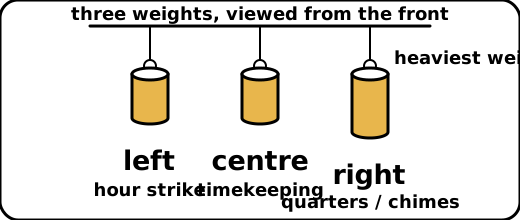
If the weights are unmarked, the usual arrangement, viewed from the front, is:
- Left: the hour-striking weight
- Centre: the timekeeping weight
- Right: the heaviest weight, for quarter striking or the chime melody
- Two weights only: The heavier one usually drives the striking train. Call us before hanging them.
Hang the pendulum
Hold the pendulum by its rod, never by its suspension spring, and do not press on the suspension. It must be able to swing freely.
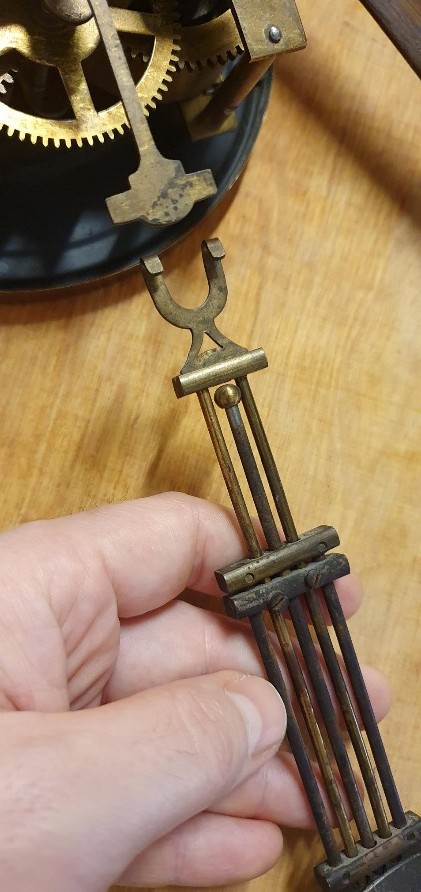
With the polished side of the bob facing forwards, lift the pendulum between the weights and cables. Hold the pendulum leader steady, engage the pendulum hook in its opening, then lower the pendulum slowly.
Check that the pendulum leader or rod engages with the crutch. Otherwise the clock will stop. This is one of the most common reasons a newly repaired clock will not run.
Finally, check that:
- The pendulum hangs centrally at rest.
- The bob touches nothing.
4. Winding
Use the crank only with the weight attached; never turn against the ratchet.
Wind every train fully on the same day. If the striking train runs down before the timekeeping train, the clock will subsequently strike incorrectly or not at all.
- Cable drive: Use the crank only with the weight attached and do not lift the weight while winding. Stop when the pulley is just below the seatboard.
- Chain drive: Pull steadily on the free chain end, never on the length carrying the weight. Support the weight lightly and stop before it reaches the top.
- Thirty-hour movement: Pull one of the two lengths carrying the lead tensioning ring (Chapter 8).
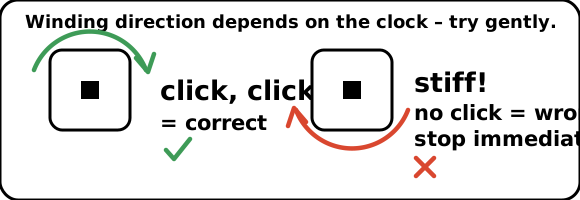
Do not use force, pliers or levers. Winding directions can differ between trains. Try gently. The correct direction is the one in which the click, the small pawl preventing unwinding, clicks.
When should you wind it?
- Wind an eight-day movement once a week on a fixed day, even if it is still running. That leaves a day in reserve.
- Wind an English thirty-hour clock at the same time every day.
- If you do not know the running duration, wind weekly. This does no harm to a movement with a longer duration. If it stops after a little over a day, wind daily.
5. Setting the time
Move the hands forwards only and allow every strike to finish.
- Hold the minute hand close to its centre. It bends easily at the tip.
- Turn it slowly clockwise until the required time is reached.
- At every quarter, half and full hour, allow the striking or chime melody to finish completely before continuing.
Move the hands forwards only. This is essential with count-wheel striking, Comtoise clocks and old movements: moving backwards can easily bend the striking release.
The hour hand is friction-fitted and can be turned independently. If the hour struck does not match the display, move it by the shorter route to the hour just struck, immediately after the striking has finished. Never do this just before the full or half hour. If it is stiff, call us. For count-wheel striking, see Chapter 9.
Daylight saving time
- In March, move the clock forwards by one hour, allowing every strike to finish.
- In October, gently stop the pendulum at the end of its swing and restart it after exactly one hour. This is kinder to the striking mechanism.
Silencing the strike and night-time shut-off
Many longcase clocks have one lever for strike/silent and another for selecting the melody. Some have a night-time shut-off that silences the striking from about 10 pm to 7 am.
If the clock strikes at night and is silent during the day, its night-time shut-off is twelve hours out. Advance the hands by twelve hours, allowing every strike to finish.
After the clock has stopped
- Wind all trains.
- If the clock is no more than six hours fast, leave the pendulum stopped until the actual time catches up. Otherwise move the hands forwards, allowing every strike to finish.
- Start the pendulum.
- If the next hour strike is wrong, move the hour hand to the hour struck. For count-wheel striking, see Chapter 9.
- On the first evening, check the night-time shut-off and reset any moon disc (Chapter 8).
6. Starting the clock and achieving an even beat
Tick and tock should be evenly spaced: listen carefully.
Move the pendulum to one side and release it without pushing. A pushed pendulum can wobble.
Is the beat uneven?
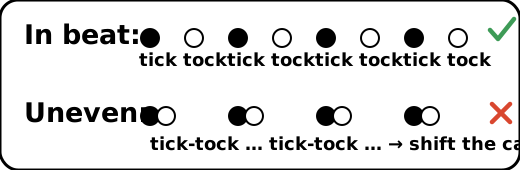
Tick and tock should be evenly spaced; the clock is then in beat. A clock that is out of beat will eventually stop. A spirit level helps make the case stable, but your ears determine the beat.
To put the clock in beat:
- Check that the pendulum swings freely and engages with the crutch.
- Tilt the case a few millimetres to either side, using thin card underneath or extending an adjustable foot slightly.
- Listen with the pendulum swinging through a small arc. If the beat becomes more even, continue in the same direction; otherwise try the other side.
- Once the ticking is even, stabilise the case and fully tighten its wall fixing.
Only on newer movements with automatic beat adjustment, such as some Hermle, Kieninger or Urgos movements, is one wide pendulum swing often sufficient. Do not allow the pendulum to hit anything.
7. Regulating
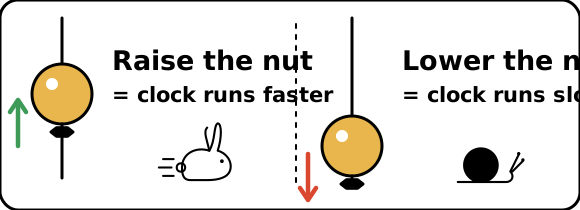
Raise the nut: faster. Lower it: slower.
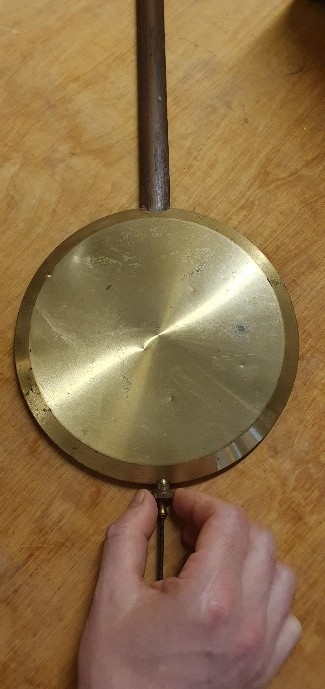
If the clock gains or loses over a week, adjust the regulating nut beneath the pendulum bob, the round disc near the bottom of the pendulum. Turning the front edge of the nut to the right raises the bob and makes the clock run faster. To the left makes it run slower.
The effect of one turn depends on the pendulum length. Modern movements have a length stamped on the back, for example “94 cm”. Otherwise measure from the suspension-spring fixing to the underside of the nut and use the closest figure.
With a usual thread, one full turn changes the rate by approximately:
- 94 cm pendulum: about 26 seconds per day
- 114 cm pendulum (seconds pendulum): about 22 seconds per day
On a Comtoise clock, the bob height is what matters. Just 1 mm changes the rate by about 40 seconds per day.
For example, your clock with a 94 cm pendulum gains two minutes in a week. That is 120 seconds divided by seven days, or just over 17 seconds a day. One turn changes the rate by about 26 seconds. Turn the front edge of the nut to the left by a little under two-thirds of a turn.
Step by step
- Allow the clock to settle for two to three days after setting it up.
- Then compare it with a radio-controlled clock or smartphone over a week. Divide the discrepancy by the number of days.
- Stop the pendulum and hold its rod above the bob so that the suspension spring cannot twist.
- Turn the nut by the calculated amount, preferably a little less rather than too much.
- If you have lowered the nut, gently slide the bob down until it rests on the nut again.
- Restart the pendulum. If the clock is still noticeably fast or slow after another week, adjust it again.
Two nuts
Where there are two regulating nuts, the upper one supports the bob. The lower one is only a locknut to prevent movement.
- Turn the lower nut down a little, at least far enough to accommodate any intended lowering of the bob.
- Regulate with the upper nut.
- Hold the upper nut still and tighten the lower nut against it. Otherwise the regulation can alter by itself.
8. Particular types of clock
Find your type and read that section.
Modern cable-driven longcase clock
- Hold the case steady and crank all the weights to the same height, just below the seatboard. If the polystyrene spacers are still fitted, wind only until the pulley touches them, without compressing them. Remove the crank afterwards.
- Start the pendulum (Chapter 6).
- Set the strike lever to strike and advance the time, allowing each chime sequence to finish. If the next quarter-hour plays the wrong melody, wait: many newer movements correct this themselves within about an hour.
- After about 24 hours of running, pull the polystyrene spacers straight upwards without twisting the cables.
A tubular chime with long metal tubes needs a particularly heavy weight to drive its melody train. Never interchange it with another weight.
Modern chain-driven longcase clock
Pull the free chain end until the weight is just below the seatboard.
Setting the moon phase
- With light finger pressure, turn the moon disc clockwise until the full moon is centred.
- Find the date of the last full moon. Advance the disc one notch for each day since then.
- If the disc is stiff, its advancing mechanism is engaged. Wait three to eight hours and never force it.
English eight-day longcase clock
Its movement rests loosely on the seatboard.
- Set the case up as it was before repair, with wedges under the front and secured to the wall. Pad the bottom of the case with foam in case a rope breaks.
- Remove the hood forwards or upwards and refit the movement exactly as it sat before.
- Hang the pendulum from behind, engaging the suspension spring in its fixing at the top of the rear movement plate and the pendulum rod with the crutch.
- Hang the weights and replace the hood. The minute hand must not touch the glass.
- If shutters cover the winding holes, the clock has maintaining power. First pull the cord or lever until the shutters open, then wind promptly.
- Wind both trains on the same day, stopping when the pulley is just below the seatboard. Many old clocks have no end stop.
- Start the pendulum with a swing of only a few centimetres. Set moon and date displays forwards only, without force.
Without maintaining power, the movement stops or briefly runs backwards during winding. This is normal. Restart the pendulum afterwards if necessary.
English thirty-hour longcase clock
A single weight on an endless chain or rope drives both the timekeeping and striking trains, including during winding. A small lead ring keeps the return length taut.
- When setting up, check that the chain or rope passes correctly over both pulleys.
- At the same time each day, pull one of the two lengths carrying the lead ring until the main weight is just below the seatboard.
- Pulling the correct length makes the click sound. If there is firm resistance and no clicking, release it immediately.
- Set the time forwards only, using the single hand if there is only one. If the number of strikes is wrong, see Chapter 9.
Comtoise
A Comtoise repeats the full-hour strike after about two minutes and strikes once at the half hour. This is normal.
- Set its top-heavy case upright, secure it to the wall and refit the movement as it sat before.
- The pendulum hangs in front of the movement, close behind the dial. Hook it in at the top and pass its rod through the crutch. The thin sheet-metal decorations bend very easily; do not hold them.
- Use only the original weights. Wind both weekly, steadily and without jerking, stopping just below the movement. Use the crank or pull the free length, as appropriate.
- Pack underneath the case a little at a time until tick and tock sound evenly spaced.
- Set the time forwards only, allowing both the strike and its repetition to finish. If the count is wrong, move the hour hand to the hour struck.
- Regulate only after a week (Chapter 7).
9. Synchronising the strike and hands (count wheel)
The count wheel follows a sequence: never move the hands backwards.
A count wheel is a notched disc, usually at the back of the movement. It counts the strikes in sequence independently of the hour hand. Advancing the hands before striking has finished, moving them backwards, or allowing the striking train to run down can leave the strike out of step with the hands until you resynchronise them.
The three rules
- Set the time slowly and forwards with the minute hand, or the single hand on a one-handed clock. Allow every strike to finish completely.
- Never turn backwards.
- Always wind the timekeeping and striking trains together. On a thirty-hour clock, a single weight drives both.
Synchronising the strike and hands
- Wait for the next hour strike and count it.
- Immediately afterwards, move the hour hand alone to the hour struck. Hold it near the centre and turn without pressure.
- If the minute hand moves with it, or the hour hand is stiff, stop immediately.
- The strike and hands now agree. If the clock is fast, stop the pendulum until the actual time catches up. If it is slow, or more than six hours fast, advance the minute hand (or the only hand on a one-handed clock), allowing every strike to finish.
For example, it is four o’clock but the clock strikes seven. Move the hour hand to seven and leave the pendulum stopped until seven o’clock.
Is the hour hand stiff?
If you wish and feel confident doing so, you can release the striking manually. A small lever rests on the edge of the count wheel at the back of the movement. Otherwise leave synchronisation to us.
- Set the hands to the correct time, following the three rules.
- Lift the lever briefly and release it immediately. The clock strikes the next hour in its sequence.
- Let it finish completely and count the strikes.
- Repeat until the number of strikes agrees with the hour hand.
- Wind the clock again afterwards: every strike consumes energy.
10. Care and maintenance
Never oil it yourself; arrange an overhaul about every ten years.
- Dust the case with a soft, dry cloth only. Apply glass cleaner to the cloth. Keep furniture spray and polish away from the movement.
- Never oil the movement yourself. Household oils, penetrating oils and sprays leave gummy deposits in it.
- Do not polish lacquered brass parts such as the pendulum bob, and avoid touching them with bare fingers.
- Check cables and chains occasionally when winding. If a cable is frayed or a chain link is open, call us.
The overhaul
Movement oil deteriorates even when the clock runs well. Have the movement overhauled about every ten years. We dismantle it completely, clean it and lubricate it afresh. Do not wait for the clock to stop: dried oil traps dust and wears pivots and bearings. Simply adding more oil is not an overhaul.
↑ Back to contentsTroubleshooting
The clock does not tick, ticks unevenly or stops soon after starting.
Possible cause: A transport restraint is still fitted, the pendulum is not engaged with the crutch, or the case is shifting.
What you can do: Remove the restraint, rehang the pendulum and put the clock in beat (Chapter 6). Secure the case to the wall.
The pendulum wobbles or rubs.
Possible cause: The suspension spring is kinked, or the clock leans forwards or backwards.
What you can do: Rehang the pendulum and align the case. We can replace a kinked suspension spring.
A weight swings with the pendulum.
Possible cause: It is level with the bob and the case is not firmly secured.
What you can do: Wind all weights to the same height and stabilise the case.
The hands race and the movement runs down rapidly.
Possible cause: The pendulum is missing or is not engaged with the crutch.
What you can do: Fit the pendulum correctly. If the movement continues to run down, support and remove the weights.
The crank does not click or turns freely.
Possible cause: The click or ratchet wheel is faulty.
What you can do: Do not release the crank. Support and remove the weight, then bring the clock to us.
A chain rattles or has come off its wheel.
Possible cause: It is twisted, has been pulled sharply, or the clock was laid down with unsecured chains.
What you can do: Untwist the chain and pull steadily. If it has come off its wheel, remove the weight. We can refit the chain.
A cable overlaps on its drum, or a weight falls.
Possible cause: The cable was slack or has broken.
What you can do: Stop winding and do not rehang a fallen weight. We can rewind or replace the cable.
The clock strikes a different hour from the one shown by the hour hand.
Possible cause: The hour hand has moved, or the count wheel has advanced out of step.
What you can do: Immediately after striking, move the hour hand to the hour struck. For count-wheel striking, see Chapter 9.
The chime melody plays at the wrong quarter hour.
Possible cause: The weights have been interchanged, or the hands were advanced too quickly.
What you can do: Hang the heaviest weight on the right and advance the hands one quarter at a time. If the chime does not correct itself within an hour, call us.
The clock is silent or strikes only at night.
Possible cause: The striking train has run down, the lever is set to silent or partly engaged, or the night-time shut-off is out of step.
What you can do: Wind the clock and engage the lever fully. Adjust the night-time shut-off as described in Chapter 5.
The sound is dull or distorted.
Possible cause: A transport restraint is still fitted, or a hammer is resting against a rod or gong.
What you can do: Remove all restraints. Leave hammer and chime-rod adjustment to us.
The clock strikes continuously or gives one strike too many.
Possible cause: A striking lever is sticking.
What you can do: Do not bend anything; call us.
The clock gains or loses time.
Possible cause: It has not yet been regulated, the season has changed, or the bob is not following the nut.
What you can do: Measure the variation over a week and regulate as described in Chapter 7. If the nut cannot turn any further, we will check the pendulum.